
Battleships – Easy
Download puzzle & solution
Share puzzle
Our puzzles are completely free. Please support this website by recommending it to your friends and family. Thank you!
New puzzle
Battleships
Battleships is a logic puzzle also known by names such as "Solitaire Battleships," "Battleship Solitaire," "Bimaru," or "Yubotu." A complete fleet is hidden in a 10x10 grid. The goal is to find all ships solely through logical deductions.
The ships are placed horizontally or vertically. Different ships must not touch, not even diagonally. Numbers at the right and bottom edges indicate how many cells of ship parts are in the respective row or column. Some water or ship cells may already be given.
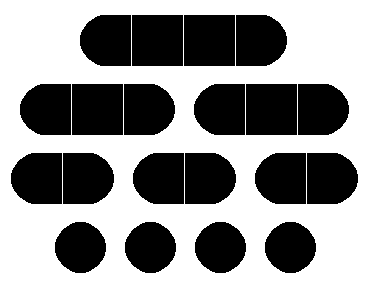
Our puzzles use the classic fleet:
- a battleship with 4 cells
- two cruisers with 3 cells each
- three destroyers with 2 cells each
- four submarines with 1 cell each
Basic Rules
- The playing field consists of 10 rows and 10 columns.
- The complete given fleet must be placed exactly once in the grid.
- Each ship runs as a straight horizontal or vertical line of connected cells.
- Ships cannot be bent.
- Different ships must not touch horizontally, vertically, or diagonally.
- The number to the right of a row indicates exactly how many ship cells are in that row.
- The number below a column indicates exactly how many ship cells are in that column.
- A given endpoint also indicates the direction in which the ship continues.
- All cells not part of a ship are water.
- The puzzle is solved when the fleet, all boundary numbers, and the touching restrictions are all fulfilled.
Strategies for Solving
1. Mark all rows and columns with the hint 0 completely as water
In the following example, the eighth row has the hint 0. Additionally, the fourth and eighth columns have the hint 0. No ship part can lie in these lines.
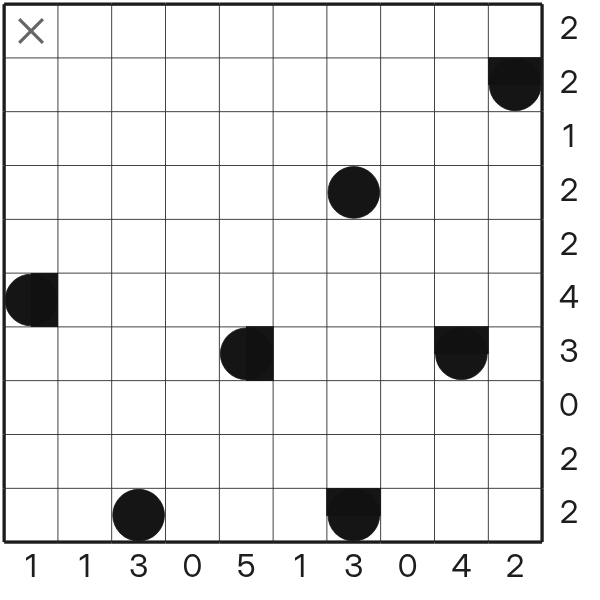
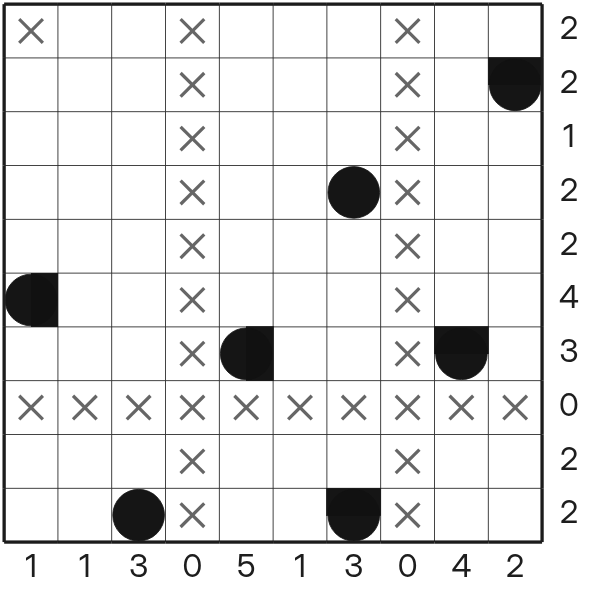
This step is always unambiguous. A zero means that every cell in the respective row or column is water.
2. Complete an endpoint at the grid edge
The last cell of the second row has a specified ship end. The ship must continue upward. Since only the top cell is above, the ship can only be two cells long here.
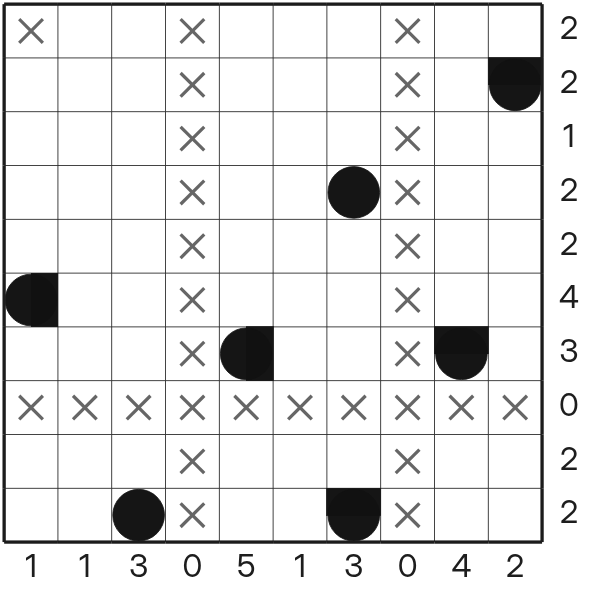
The cell directly above becomes the top end. All cells beside and below the complete ship are water, as it must not touch another ship.
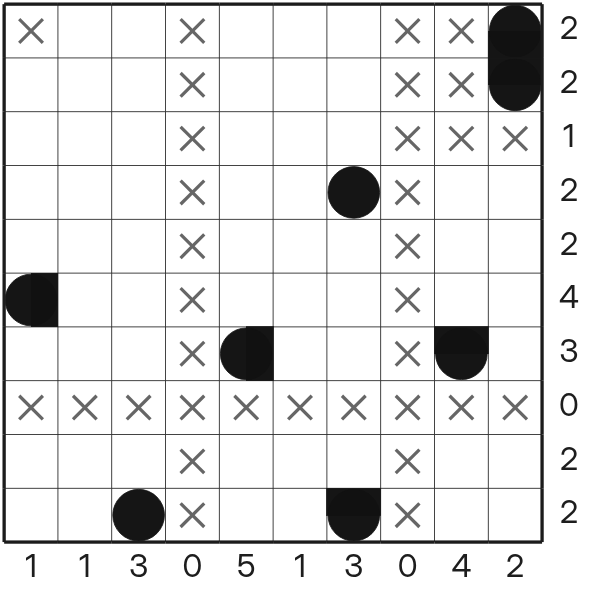
The ship in the last column is thus fully identified as a destroyer of length 2.
3. Surround a submarine completely with water
The given submarine in the fourth row and seventh column is already a complete ship. Therefore, all adjacent cells horizontally, vertically, and diagonally must be water.
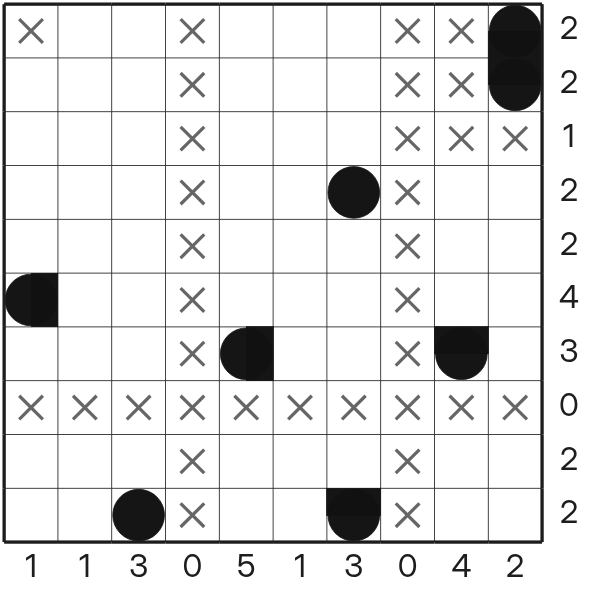
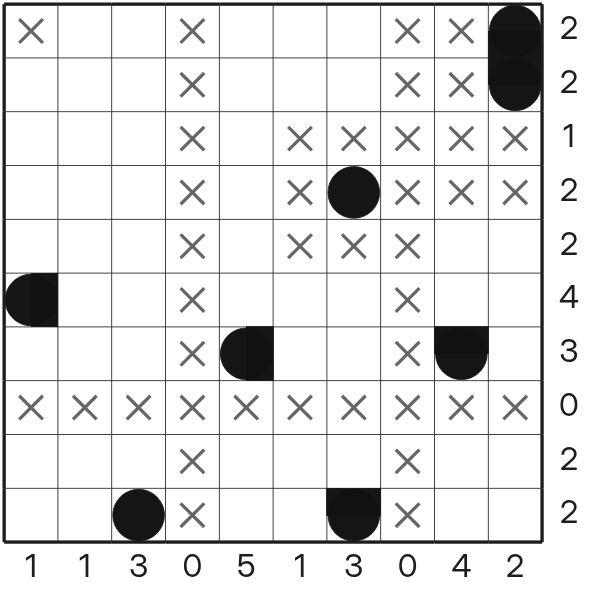
The marking prevents a second ship from touching the submarine on a side or corner.
4. When a row number is reached, the rest is water
In the following example, four ship cells are already known in the sixth row: a horizontal cruiser in the first three cells and part of a vertical ship in the ninth cell.
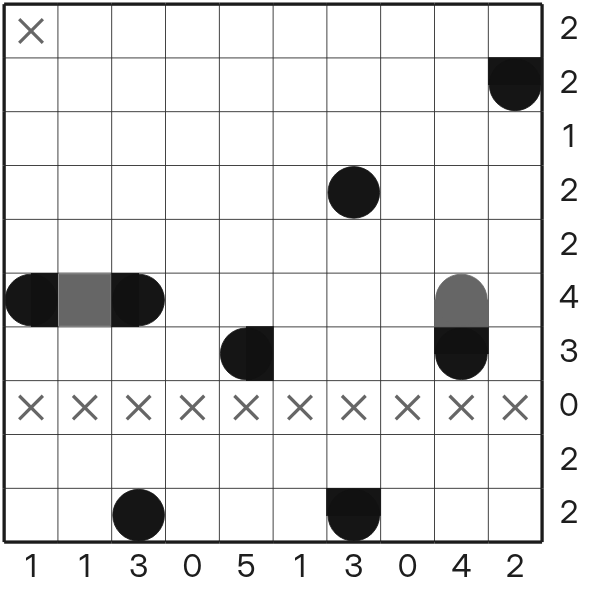
The row hint is 4. The required number is already reached. All remaining cells in the row are water.
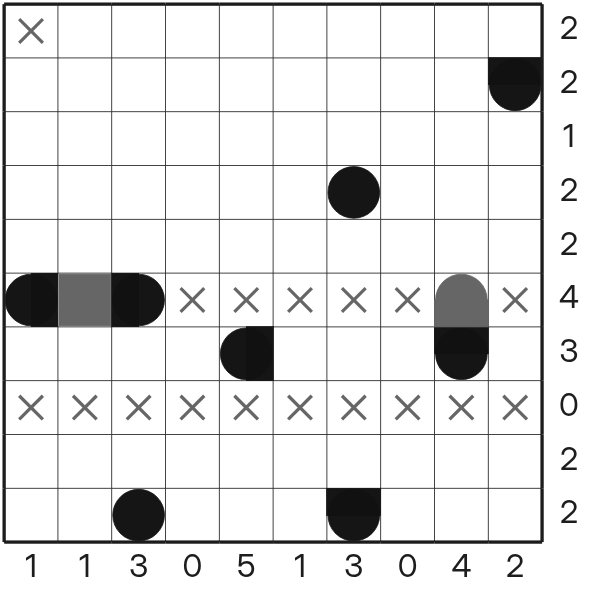
The same principle applies to columns: as soon as the boundary number is reached, all remaining cells are marked as water.
5. If only as many cells are possible as needed, mark all as ship cells
The fifth column in the example must contain a total of five ship cells. The cell in the seventh row is already known as the left end. All other cells in the column, except for the positions in rows 2 to 5, are water.
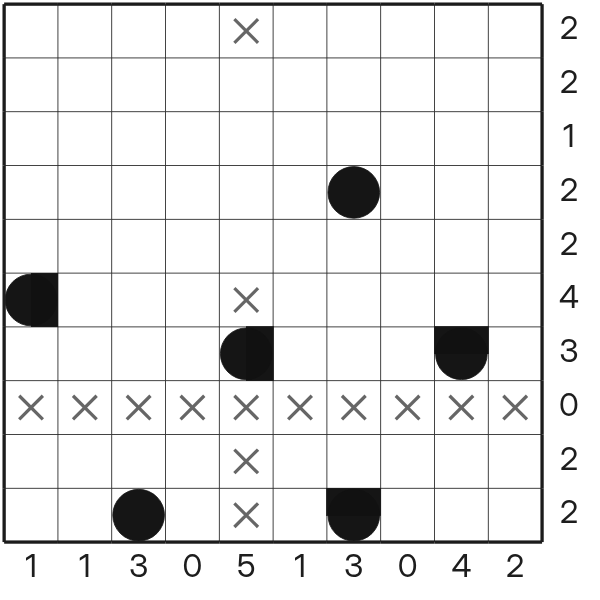
The column still needs four ship cells, and there are exactly four possible positions. Therefore, all four cells must be occupied.
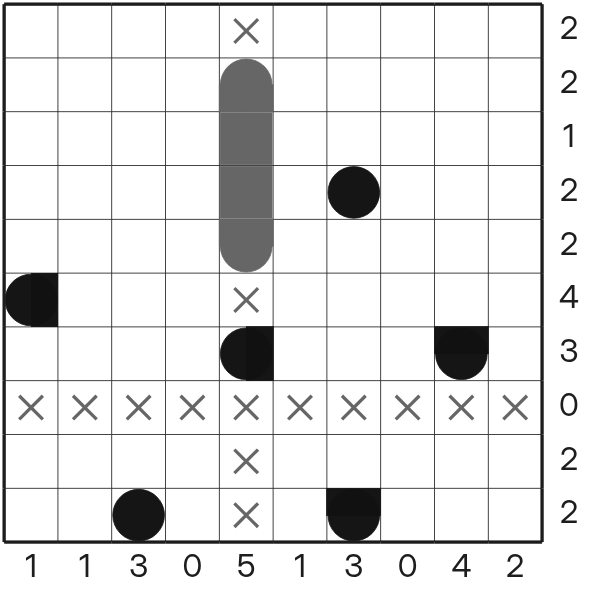
The four connected cells from rows 2 to 5 form the battleship of length 4.
6. Continuously update the fleet list
Each fully identified ship is removed from the fleet list. For example, once the only battleship of length 4 is found, no other four-cell ship can be created.
The remaining unknown ship cells must then combine into the remaining ship lengths. This information helps decide whether a started ship must be extended or is already complete.
7. Always exclude diagonal touching
A confirmed ship cell makes all diagonally adjacent cells water, even if the ship itself is not yet complete. Horizontal or vertical neighbors may belong to the same ship if the shape of the known segment allows it.
Typical solving process
- First, mark all rows and columns with hint 0 completely as water.
- Evaluate given submarines and end pieces.
- Mark diagonal neighbors of each confirmed ship cell as water.
- Compare in each row and column the boundary number with known ship cells and still possible positions.
- If a boundary number is reached, mark the rest of the line as water.
- If the number of possible cells exactly matches the remaining count, mark all as ships.
- Complete begun ships considering their end pieces and the fleet list.
- Eliminate fully identified ships from the fleet and check remaining lengths.
Common mistakes
- Allow ships to touch diagonally.
- Extend an end piece in the wrong direction.
- Treat a submarine as part of a longer ship.
- Only consider row hints without checking column numbers simultaneously.
- Fail to fully separate a confirmed ship with water from the rest of the fleet.
- Ignore the fleet list, producing too many ships of one length.
- Mark a cell as a ship when multiple arrangements are still possible.
Tips for beginners
- Always start with zeros, submarines, and clearly directed end pieces.
- Consistently mark water. Water information is often more important than new ship cells.
- Count in each row and column both confirmed ship cells and remaining possible cells.
- Immediately surround a fully identified ship with water.
- Keep a small list of remaining ships to be placed.
- Before extending a ship, check if the shape matches the given end piece and the remaining fleet.
Battleships is solved not by guessing but by the interaction of boundary numbers, ship shapes, water cells, and fleet counts. Each confirmed ship part creates new water cells, and each water cell further restricts the possible positions for the remaining fleet.