
Consecutive Sudoku – Hard
Download puzzle & solution
Share puzzle
Our puzzles are completely free. Please support this website by recommending it to your friends and family. Thank you!
New puzzle
Solving Consecutive Sudoku: Rules and Strategies
Consecutive Sudoku is a Sudoku variant. Markings between horizontally or vertically adjacent cells indicate consecutive numbers.
A marking signifies a difference of exactly 1. In this fully marked form, a missing marking indicates that the neighboring numbers are not consecutive.
The goal is a fully filled, contradiction-free puzzle. Each move must follow the visible clues and already confirmed entries.
Rules
- Each active cell contains exactly one number from 1 to 9.
- Each row contains the numbers 1 to 9 once without repetition.
- Each column contains the numbers 1 to 9 once without repetition.
- Each normal 3×3 block contains the numbers 1 to 9 exactly once.
- A marking means a difference of exactly 1. Missing markings indicate non-consecutive neighboring pairs.
- Given numbers are not altered.
- Every final entry must satisfy all rules simultaneously.
Grid Orientation
Rows are counted from top to bottom, columns from left to right. For a number pair, the first number indicates the row, and the second the column; e.g., (4,7) refers to the cell at row 4, column 7.
The examples show specific intermediate states. Blue markings indicate applied assumptions, red markings exclude possibilities, and green markings confirm results.
Basic Solving Idea
Note possible neighbor values for each marking and also consider missing markings as exclusions.
After each confirmed entry, it's worthwhile to perform a full, brief scan of the affected units and clues. This creates a chain of small, traceable steps.
1. Complete a Nearly Full Row
In row 1, all cells are filled except for (1,2). Visible are 1, 2, 3, 4, 5, 6, 7, 9; only 8 is missing from the allowed numbers.
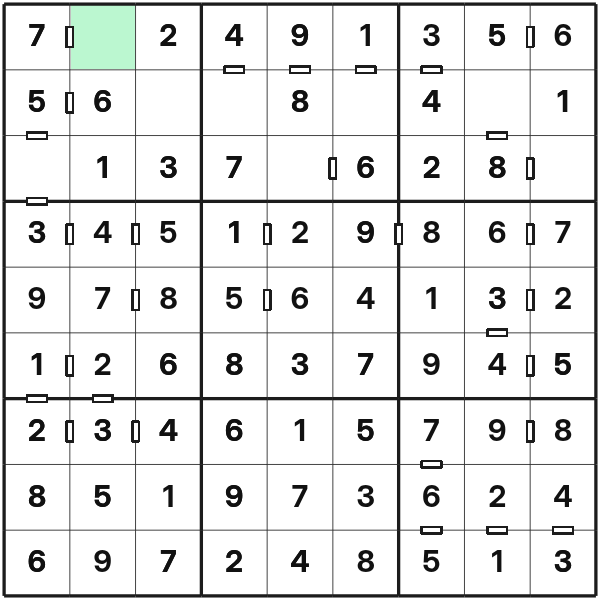
Hence, 8 goes into (1,2). This move requires no guess: the other values of the considered unit are fully visible in the image.
2. Complete a Nearly Full Column
In column 1, all cells are filled except for (3,1). Visible are 1, 2, 3, 5, 6, 7, 8, 9; only 4 is missing from the valid numbers.
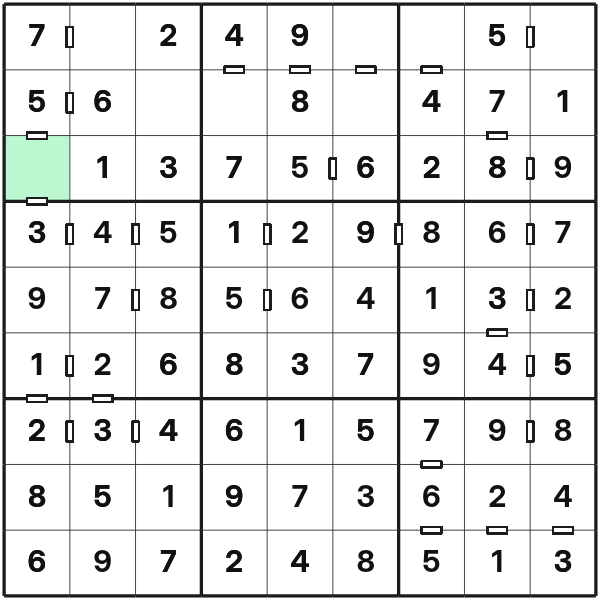
Therefore, 4 goes into (3,1). This move requires no guess: the other values of the considered unit are fully visible in the image.
3. Fully Read the Dominant Area
In the 3×3 block 1, all cells are filled except (1,2). Visible are 1, 2, 3, 4, 5, 6, 7, 9; only 8 is missing from the allowed numbers.
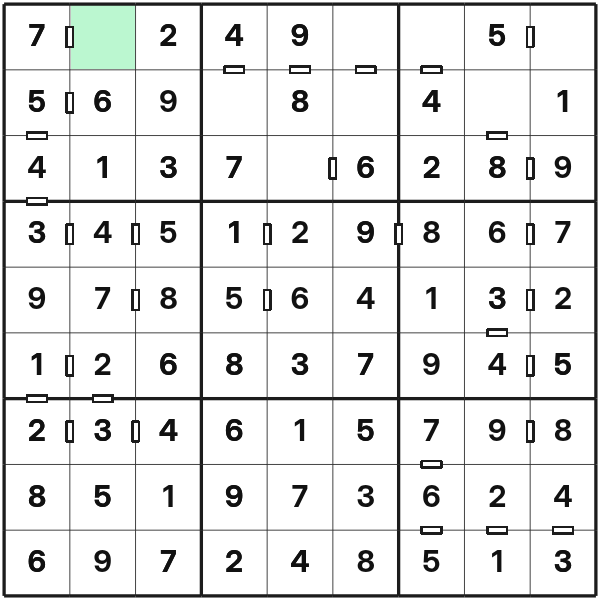
Hence, 8 goes into (1,2). This move requires no guess: the other values of the considered unit are fully visible in the image.
4. Analyze a Marked Neighborhood
There is a marking between (1,4) and (2,4). Next to 4, only 3 and 5 are possible at first.
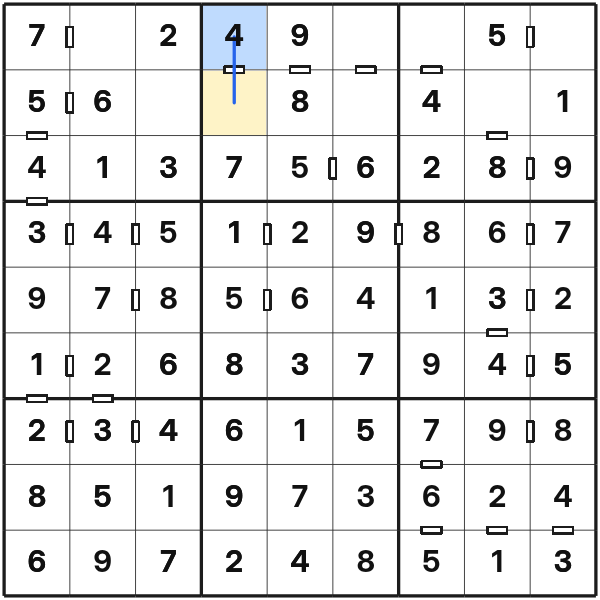
Row, column, and block decide between these consecutive values. In the verified solution state, the value for (2,4) remains 3.
5. Use a Missing Marking as Exclusion
Between (1,3) with 2 and (1,2), there is no marking. Therefore, these two values cannot have a difference of 1.
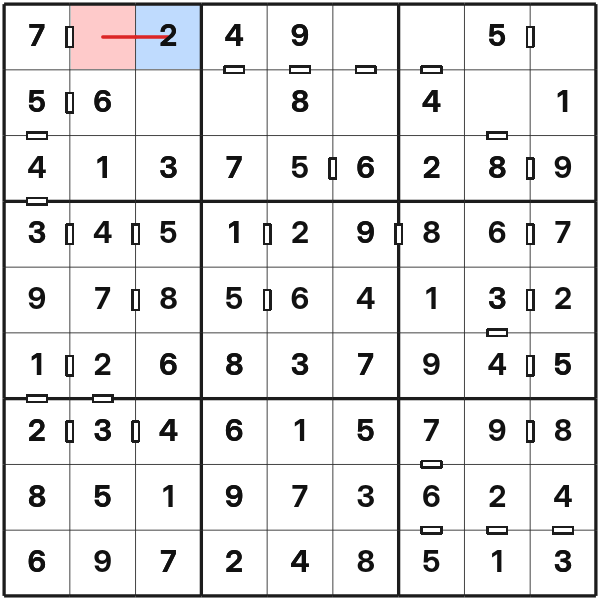
The candidate 3 is eliminated. The negative rule applies only to horizontally and vertically adjacent cells; diagonal neighbors are not compared.
6. Intersect Two Markings on One Cell
(3,1) is consecutive to 5 at (2,1) and 3 at (4,1).
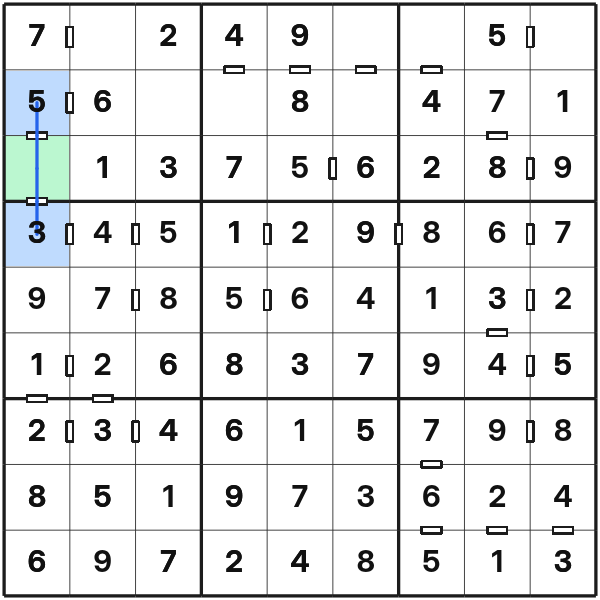
Only 4 satisfies both neighbor conditions and Sudoku units. Therefore, it is confidently entered.
7. Combine Multiple Units in One Cell
In (1,2), several units are still incomplete. After eliminating possibilities across all related rows, columns, and regions, only 8 remains.
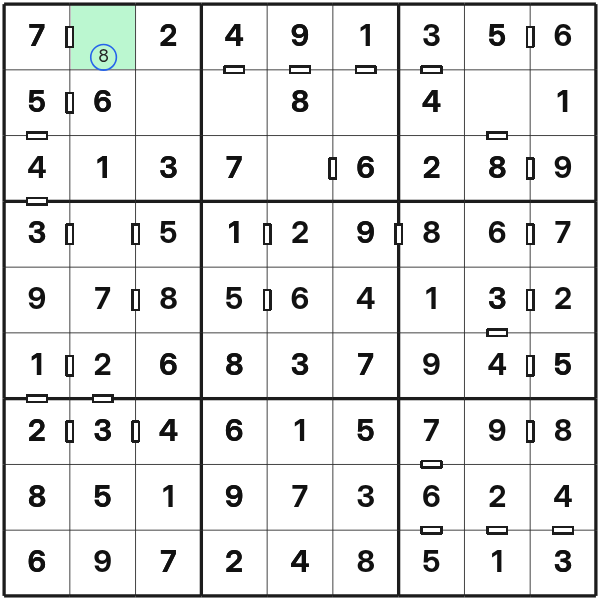
The candidate set for (1,2) is now {8}. Such single possibilities often emerge only when all types of units are checked simultaneously.
Typical Solving Process
- Immediately fill in fully determined rows, columns, and key regions.
- Note only candidates allowed by all standard units for open cells.
- Then apply the additional rule of the puzzle type to these candidates.
- Enter only values that are clearly justified.
- After each entry, recheck all affected units and clues.
- Repeat the scan until the grid is complete.
Common Errors
- Using only existing markings: In this complete variant, their absence is also informative.
- Considering 1 and 9 as consecutive: The sequence does not wrap around cyclically.
- Guess too early: Multiple candidates remaining do not justify guessing yet.
- Not rechecking after an entry: One value can affect multiple units and clues simultaneously.
Tips for Beginners
- Start with units or clues with especially many visible details.
- Write down small candidate sets instead of mixing possibilities mentally.
- Always check a candidate against all rules affecting its cell.
- Handle confirmed exclusions as real progress, even if no value is set yet.
- If no move is visible, switch methodically between rows, columns, regions, and clues.
Consecutive Sudoku becomes clear once standard units and additional clues are consistently reevaluated after each confirmed move. Small, fully justified deductions are more reliable than early guessing.