
Download puzzle & solution
Share puzzle
Our puzzles are completely free. Please support this website by recommending it to your friends and family. Thank you!
New puzzle
Solve Even-Odd Sudoku: Rules and Strategies
Even-Odd Sudoku is a Sudoku variation. Gray circles and squares indicate whether an odd or even number must be in a cell.
A circle indicates an odd number. A square indicates an even number. A cell without a symbol can be either even or odd.
The goal is a fully and correctly filled puzzle. Each entry must be based on the visible clues and the numbers already placed.
Rules
- Each cell contains exactly one number from 1 to 9.
- Each row contains the numbers 1 to 9 without repetition.
- Each column contains the numbers 1 to 9 without repetition.
- Each normal 3×3 block contains the numbers 1 to 9 exactly once.
- A circle indicates an odd number. A square indicates an even number. A cell without a symbol can be either even or odd.
- Given numbers are not changed.
- Each entry must satisfy all the rules.
Orientation in the grid
Rows are numbered from top to bottom, columns from left to right. (4,7) means row 4, column 7.
The images show specific intermediate states. Blue-marked cells are used for steps, red indicates eliminated options, and green shows verified results.
Basic idea of solving
First, check the normal Sudoku rules. Then use circles or squares to narrow down possible numbers to odd or even values.
After each confirmed entry, check the affected row, column, block, and all additional hints again. Often, this leads directly to the next step.
1. Complete an almost finished row
In row 1, only cell (1,2) is empty. The numbers 1, 3, 4, 5, 6, 7, 8, 9 are already present. Therefore, only 2 is missing.
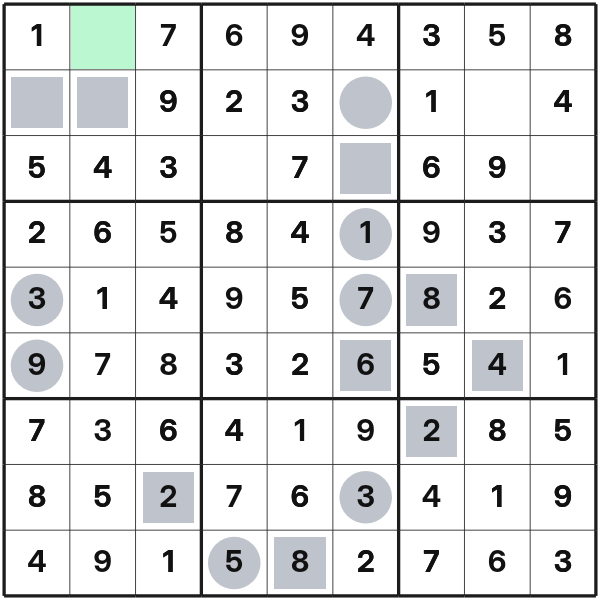
So, (1,2) must be 2. All other numbers are already in row 1.
2. Complete an almost finished column
In column 1, only cell (2,1) is empty. The numbers 1, 2, 3, 4, 5, 7, 8, 9 are present. Only 6 is missing.
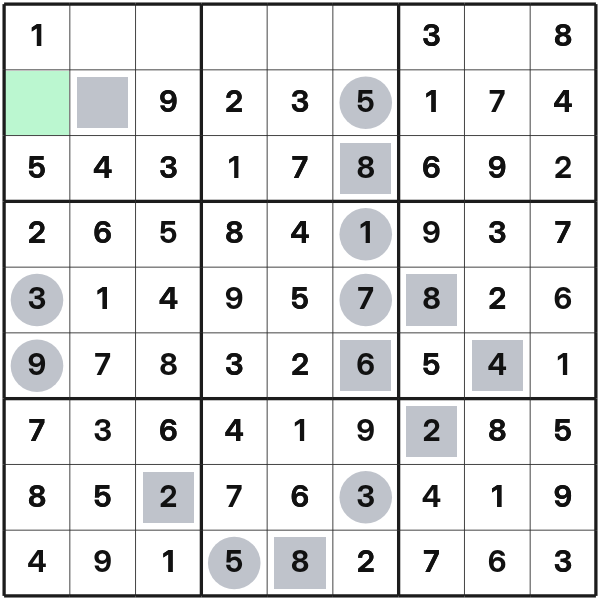
So, (2,1) must be 6. All other numbers are already in column 1.
3. Complete a region
In the 3×3 block 1, only cell (1,2) is empty. Numbers 1, 3, 4, 5, 6, 7, 8, 9 are already present. Only 2 is missing.
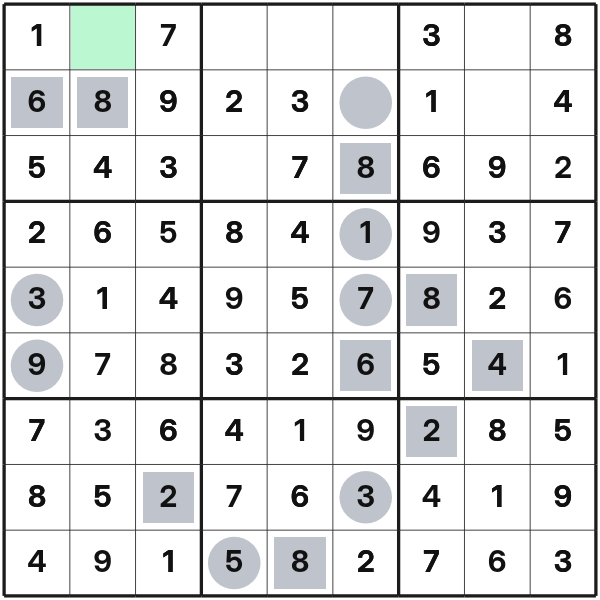
So, (1,2) must be 2. All other numbers are already in block 1.
4. Use a circle as a hint
Cell (2,6) has a gray circle. Therefore, only an odd number can be in this cell, options are 1, 3, 5, 7, 9.
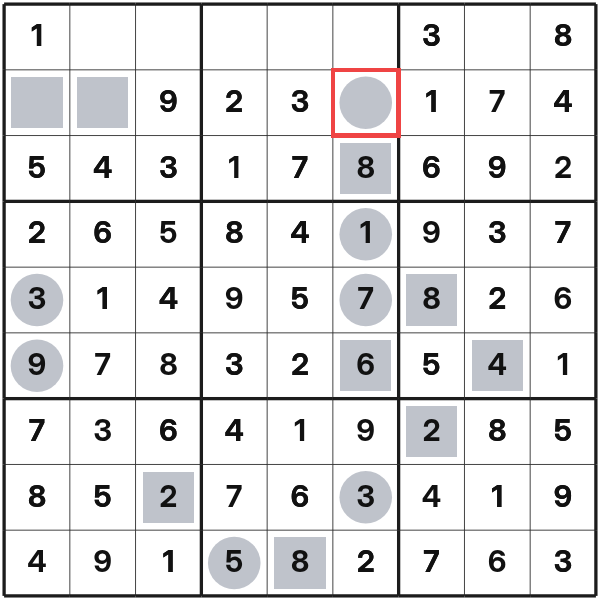
Even numbers are eliminated. After checking row, column, and block, only 5 remains here.
5. Use a square as a hint
Cell (2,1) has a gray square. Only an even number, options are 2, 4, 6, 8.
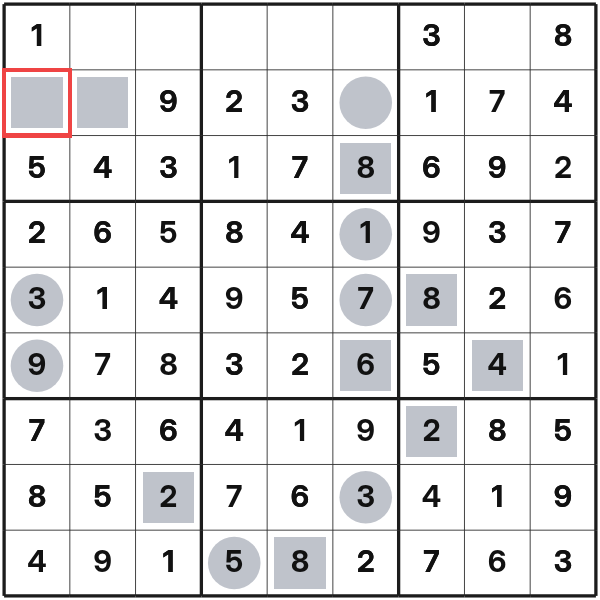
Odd numbers are eliminated. Only 6 remains after checking row, column, and block.
6. Solve two open cells with symbols
In row 2, only 5 and 6 are missing. The square at (2,1) needs an even number, so it must be 6. The circle at (2,6) needs an odd number, so it must be 5.
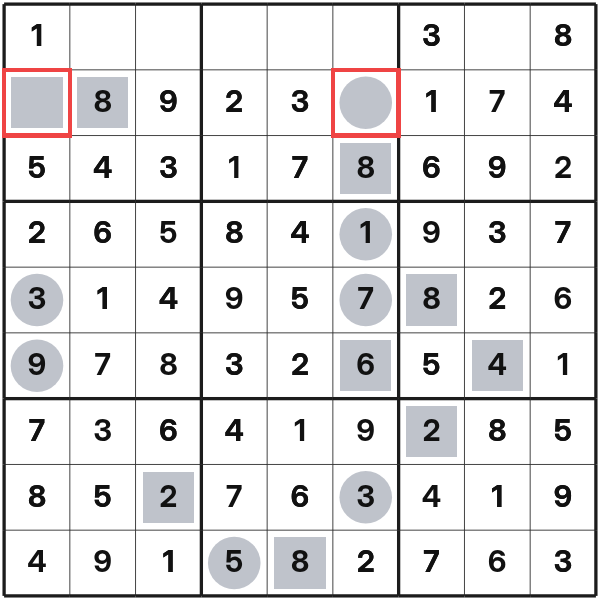
Both cells are now confidently resolved. Always check such pairs together with their symbols.
7. Check row, column, and region together
For cell (1,2), check row, column, and region simultaneously. All numbers except 2 are eliminated.
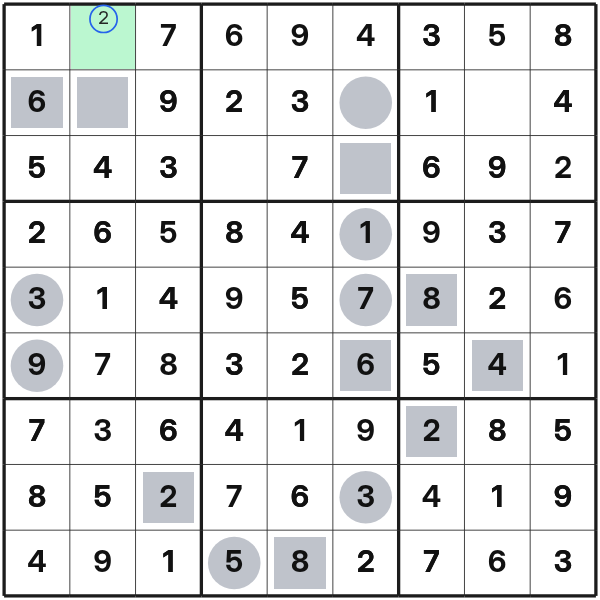
Therefore, only 2 remains at (1,2). Always check all related areas for an open cell.
Typical solving process
- Start by looking for rows, columns, or blocks with few open cells.
- Note possible numbers for an open cell.
- Use circles to eliminate even numbers, squares to eliminate odd numbers.
- Enter a number as soon as only one possibility remains.
- Then, recheck the row, column, and block affected.
Common mistakes
- Confusing circle and square: Circle means odd, square means even.
- Deciding an un symbolized cell as even or odd: Both are possible if no symbol is given.
- Rushing too early: If multiple numbers are possible, the cell isn't solved yet.
- Not rechecking after an entry: A new number can immediately solve other cells.
Tips for beginners
- Start with rows, columns, blocks, or hints with few open cells.
- Write down possible numbers if you can't keep them all in mind.
- Check each possible number against all the rules.
- Crossed-out possibilities are progress too.
- If stuck, switch systematically between rows, columns, blocks, and hints.
Solve Even-Odd Sudoku in small, safe steps. Recheck the affected row, column, block, and additional hints after each entry. This way, you often reach the goal without guessing.