
Futoshiki – Medium
Download puzzle & solution
Share puzzle
Our puzzles are completely free. Please support this website by recommending it to your friends and family. Thank you!
New puzzle
Futoshiki
Futoshiki is a number puzzle on a square grid. The name roughly means "inequality." The puzzle type is also known by names such as "Unequal" or "More or Less."
The grid consists of 6 rows and 6 columns. In each row and column, the numbers 1 to 6 must be entered exactly once. Inequality signs are placed between some cells, indicating which of the two neighboring numbers is smaller.
Unlike Sudoku, there are no additional 2x3 or 3x3 regions. Only rows, columns, and the drawn inequalities are important.
Main rules
- The grid has 6 rows and 6 columns.
- A number from 1 to 6 is entered into each cell.
- Each number from 1 to 6 must appear exactly once in each row.
- Each number from 1 to 6 must appear exactly once in each column.
- A less-than sign indicates that the number on the open side is greater and the number at the tip is smaller.
- A greater-than sign is read accordingly in the opposite direction.
- Vertical signs always point to the smaller number.
- There are no additional block rules like in Sudoku.
- The given numbers and inequality signs must not be changed.
- The puzzle is solved when each row and column contains the numbers 1 to 6 exactly once and all inequalities are satisfied.
Solving strategies
1. An inequality chain orders two missing numbers
In the fifth row of this example, only the numbers 2 and 6 are missing. The pattern of signs in this row contains the chain:
1 < ? < ?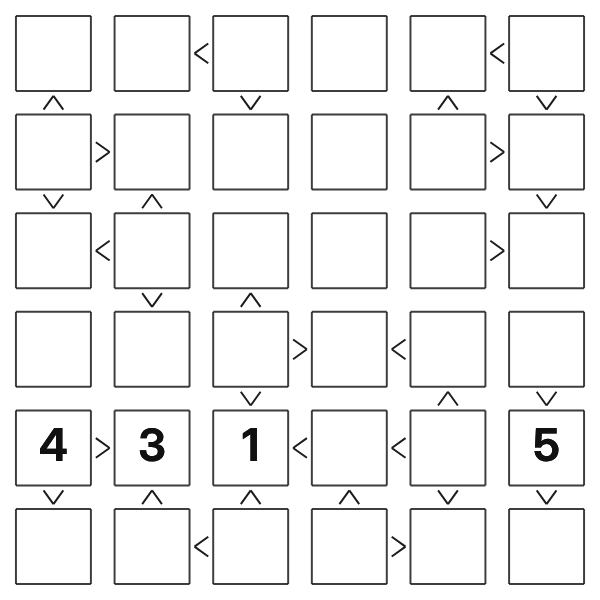
The two empty cells must contain 2 and 6. Since the first of the two must be smaller than the second, only the following order is possible:
4312652 goes into the fourth cell and 6 into the fifth cell. The reversed order would violate the less-than sign.
2. A valley forces the smallest remaining number
In the fourth row of the following example, between the third, fourth, and fifth cells, the signs are:
4 > ? < 2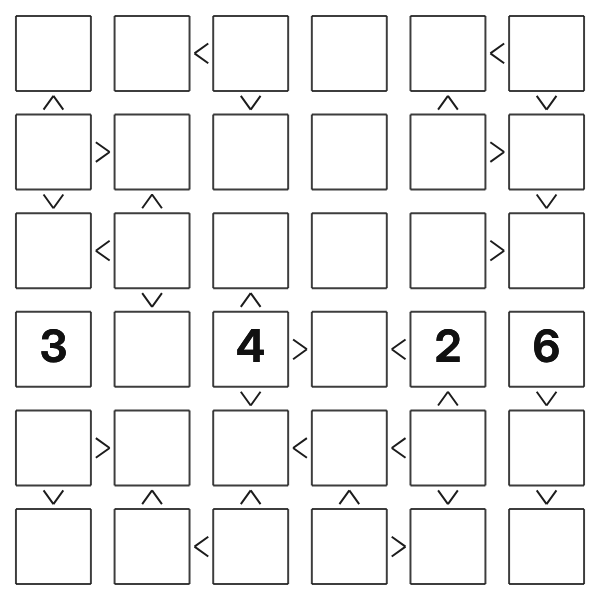
Only the numbers 1 and 5 are missing in the fourth row. The fourth cell must be smaller than 4 and simultaneously smaller than 2. Of the two missing numbers, only 1 satisfies this condition.
354126This makes the fourth cell 1 and the second cell 5. The inequality clearly determines the value.
3. A single sign decides the order of a pair
In the last row of this example, the numbers 4 and 5 are missing. There is a less-than sign between the two empty cells.
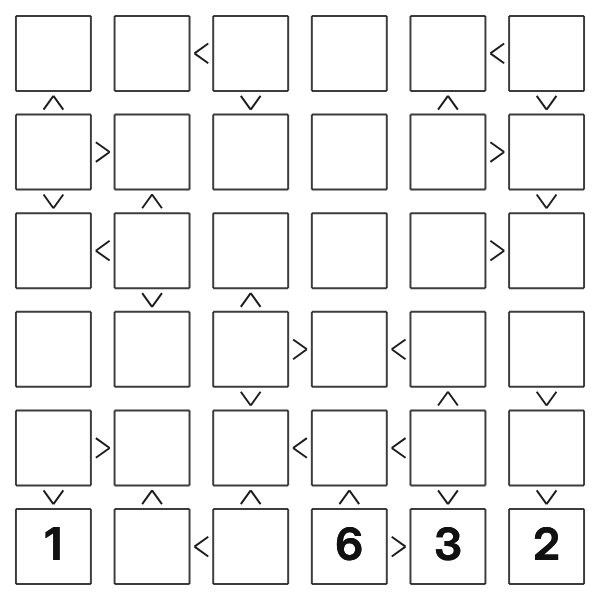
The relevant sequence is:
? < ?The left cell must contain the smaller of the two missing numbers. Therefore, the sequence is:
1456324 is on the left and 5 on the right. Without the inequality sign, both sequences would initially be possible.
4. Vertical signs connect a chain
Several vertical signs can also establish a sequence together. In the last column of this example, the first three rows have two downward-pointing signs, meaning:
upper cell > middle cell > lower cellIn the current state, only the numbers 1 and 3 are missing in this column:
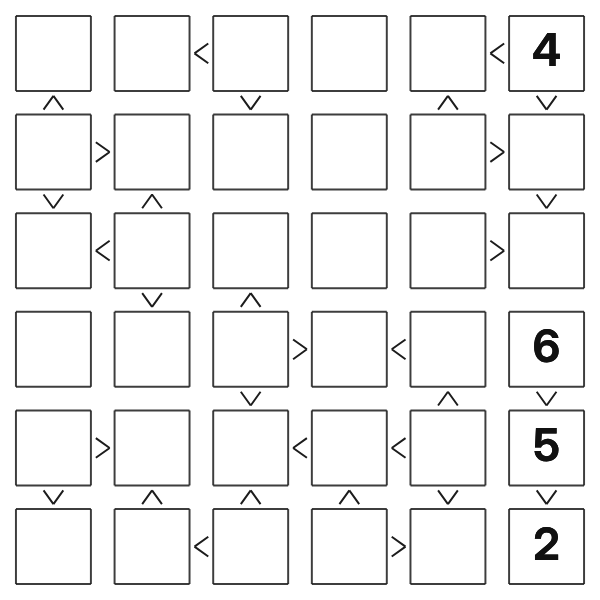
The middle cell must be smaller than 4 but larger than the one below. For the missing numbers, only:
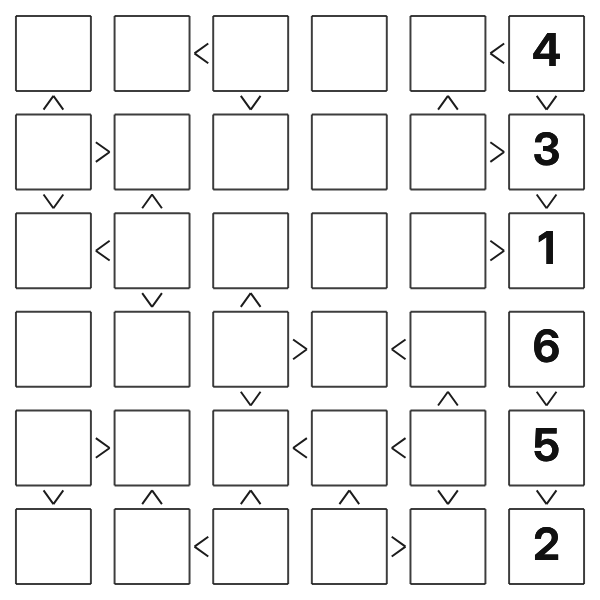
The order 1 over 3 would be impossible because the numbers must decrease downward.
5. Inequalities provide upper and lower bounds
A cell that must be smaller than a cell with the number 2 can only be 1. Conversely, a cell that must be larger than 5 can only be 6 in a 6x6 puzzle.
Such extreme cases are particularly valuable. Even if the neighboring number is not yet fixed, a longer chain can significantly limit candidates. In a three-link ascending chain, the first cell can never be 5 or 6 because two larger numbers must follow.
6. Always check rows, columns, and signs together
A value might match an inequality but still be already present in the corresponding row or column. Conversely, row and column candidates can be reduced to a single possibility by a sign.
Before entering a value, three questions must be answered:
- Is the number still missing in the row?
- Is the number still missing in the column?
- Does it satisfy all neighboring inequalities?
Typical solving process
- Start by looking for rows and columns with many given numbers.
- Note the missing numbers in each nearly complete section.
- Use inequality signs to order the missing numbers.
- Check chains of multiple signs and derive upper or lower bounds.
- Look for cells that must be less than 2 or greater than 5.
- Immediately transfer each new entry to the corresponding row, column, and adjacent inequalities.
- Only enter numbers whose position is clearly determined.
Common mistakes
- Reading the sign in the wrong direction. The tip always points to the smaller number.
- Interpreting vertical signs differently from horizontal ones.
- Entering a number that fits the inequality but already exists in the row or column.
- Immediately deriving concrete numbers from an inequality when only the order is fixed.
- Considering multiple connected inequalities individually instead of as a chain.
Tips for beginners
- Read each sign as a simple statement, e.g., "left is smaller than right".
- Start with signs next to already known very small or very large numbers.
- Note both values for two missing numbers and then check their order.
- Look for chains like "smaller than – smaller than" or valleys like "larger than – smaller than".
- Recheck the entire row and column after each entry.
- If a sign only restricts candidates but doesn't fix a number, note the remaining possibilities and do not guess.
Futoshiki combines the structure of a Latin square with size comparisons. The number rules determine which values are missing in a row or column, and the inequalities define the order these values must follow.