
Download puzzle & solution
Share puzzle
Our puzzles are completely free. Please support this website by recommending it to your friends and family. Thank you!
New puzzle
Hitori
Hitori is a Japanese logic puzzle where some number cells are blackened. The puzzle starts with a completely filled number grid. Some numbers appear multiple times in each row and column. The goal is to blacken as many of these numbers as possible so that each remaining unblackened number appears only once in its row and column.
Blackening is limited by two additional rules: black cells cannot touch horizontally or vertically, and all white cells must be connected through shared sides in the end. This means you cannot simply remove any duplicate numbers arbitrarily.
Basic Rules
- Some cells of the fully filled grid must be blackened.
- In each row, each unblackened number can appear at most once.
- In each column, each unblackened number can appear at most once.
- Black cells must not touch horizontally or vertically.
- Diagonal neighboring black cells are allowed.
- All white cells must form a single connected area through horizontal or vertical connections.
- A cell remains white if blackening it would violate the contact or connectivity rules.
- The puzzle is solved when all duplicates are removed and both additional rules are satisfied.
Strategies for solving
1. A number between two identical numbers remains white
In the following example, we consider the third column, which contains the numbers 1, 4, and 1 from top to bottom.
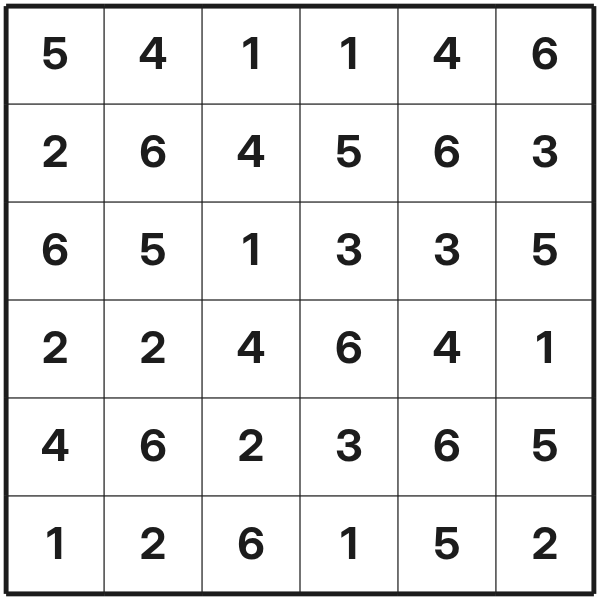
At least one of the two 1s must be blackened since they are in the same column. If the 4 between them were also blackened, it would be directly above or below a black cell: either the top 1 and the 4, or the 4 and the bottom 1. This is forbidden.
Therefore, the 4 must remain white in the second row.
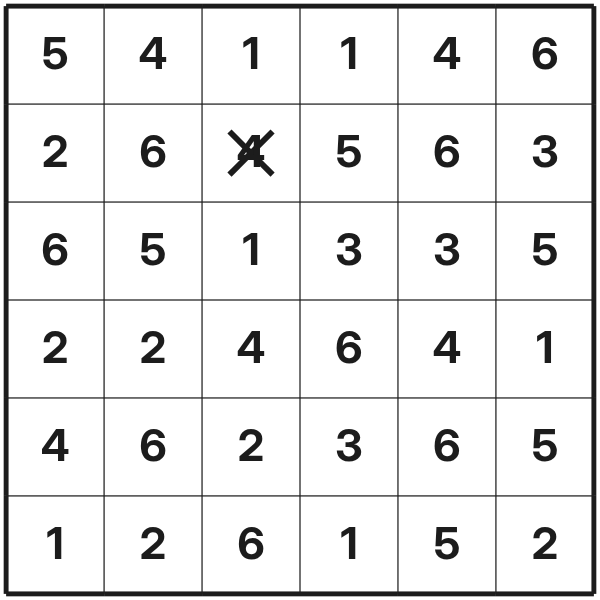
This pattern is often called a sandwich: in A–B–A, the middle cell B must stay white.
2. A certainly white number blackens its duplicates
The 4 recognized as white in the third column is below a second 4 in the same column.
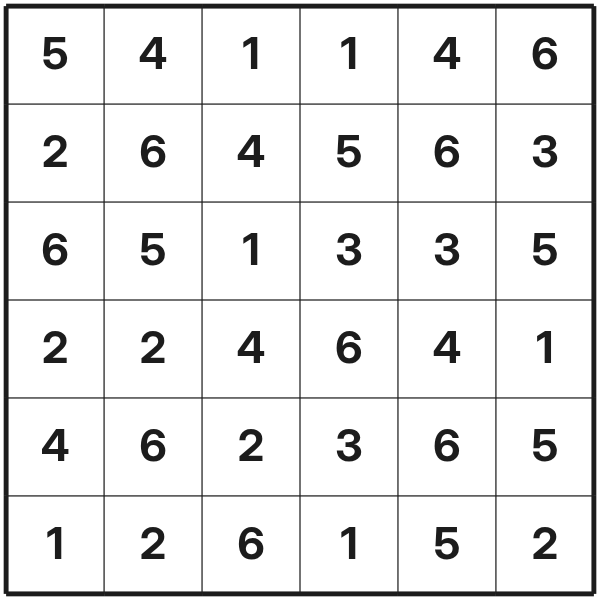
Since the upper 4 is definitely white, the other 4 in the same column cannot also stay white. The cell in the fourth row and third column must be blackened.
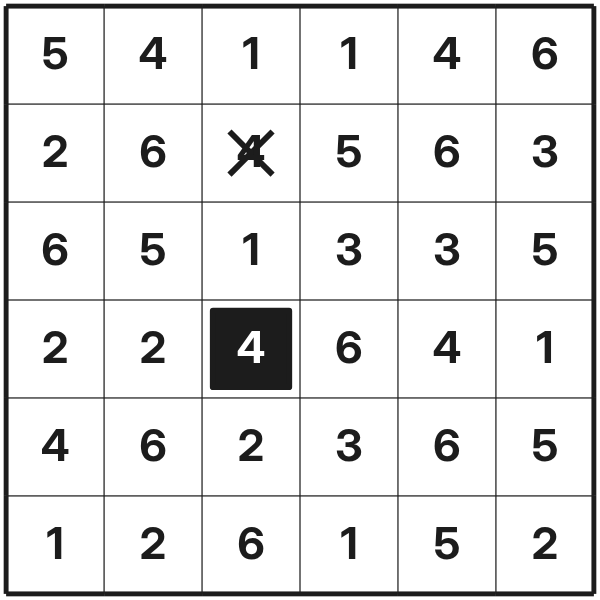
The conclusion is clear: two white 4s in the same column would violate the main rule.
3. Neighbors of a black cell remain white
The black cell in the fourth row has four possible side neighbors. Since black cells cannot share a side, these neighbors must remain white.
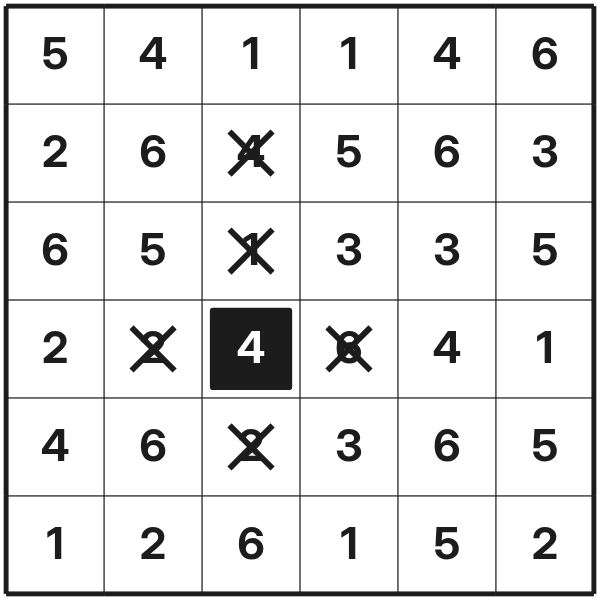
This often leads to further number deductions. A number marked as white can again imply that a matching cell in the same row or column must be blackened.
4. Connected white cells must not be cut off
The connection rule is just as important as the number rule. In the following example, in the last row, the second and fourth cells are already black.
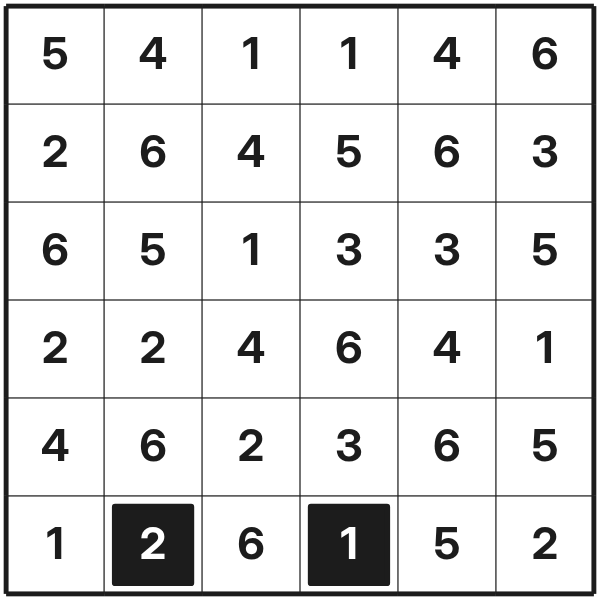
The third cell of the last row can only remain connected to the rest of the white area via the cell directly above. There are already black cells to the left and right, and the grid ends below.
If the cell above were also blackened, the 6 in the last row would be completely isolated. Therefore, the third cell of the fifth row must stay white.
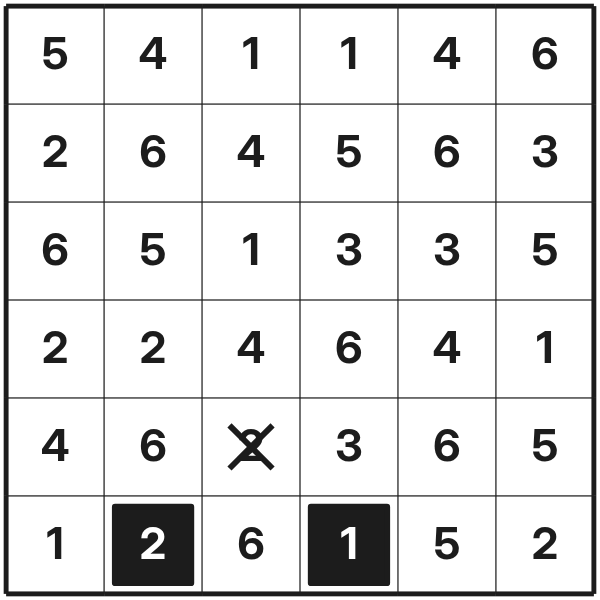
This conclusion is based not on a number duplication but solely on the requirement to keep all white cells connected.
5. Adjacent equal numbers form a bonded group
In the fourth row of the following example, two 2s are right next to each other at the beginning.
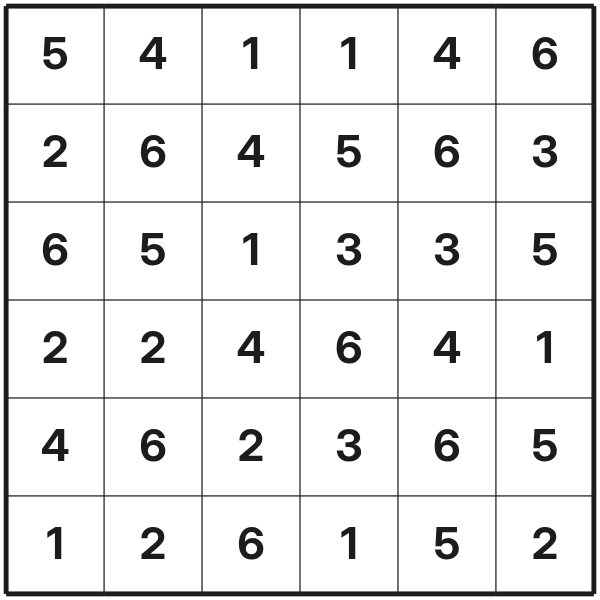
At least one of the two 2s must turn black. Both cannot become black, as they would touch. So, it is certain: exactly one of the two 2s remains white and exactly one becomes black.
If there was a third 2 in the same row, it would also have to turn black. One of the two neighboring 2s must stay white, and no further white duplicate should be next to it.
6. Always check blackenings against all three conditions
A cell should not be blackened simply because its number appears twice. Before blackening, three questions must be answered:
- Is each white number in the row still unique?
- Is each white number in the column still unique?
- Are black cells separated and all white cells connected?
Only when all conditions are met and the alternative is impossible, is the blackening certain.
Typical solving process
- Look for patterns of the form A–B–A in rows and columns. Mark the middle cell as definitely white.
- Use each definitely white number to blacken identical numbers in the same row or column.
- After each blackening, mark all horizontal and vertical neighbors as white.
- Check neighboring equal numbers and bonded groups.
- Regularly verify whether a potential blackening would cut off white cells.
- Repeat number, contact, and connectivity checks after each confirmed step.
Common mistakes
- Blackening all duplicates arbitrarily.
- Placing two black cells side by side horizontally or vertically.
- Falsely forbidding diagonally neighboring black cells.
- Only checking rows and overlooking same numbers in columns.
- Checking all white cell connections only at the end.
- Blackening a cell when both options are still logically open.
Tips for beginners
- Mark safe white cells as consistently as black cells.
- Start with sandwich patterns and neighboring identical numbers.
- Immediately check the four neighbors of each black cell.
- Consider narrow connections in the white area early as potential bridges.
- Ask yourself with each step which specific rule makes the decision clear.
Hitori is a exclusion puzzle with three equivalent levels: duplicate numbers, separated black cells, and a connected white area. Good progress often results from a safe white or black cell immediately triggering new consequences in all three levels.