
Download puzzle & solution
Share puzzle
Our puzzles are completely free. Please support this website by recommending it to your friends and family. Thank you!
New puzzle
Jigsaw Sudoku
Jigsaw Sudoku is a variation of traditional 9x9 Sudoku. The rows and columns work as usual, but the nine 3x3 blocks are replaced by irregularly shaped regions. These regions look like puzzle pieces, hence the name Jigsaw.
Each irregular region consists of nine cells and must contain the numbers 1 to 9 exactly once. The focus is on the thick boundary lines of the puzzle, not the usual 3x3 blocks.
Basic Rules
- The playing field consists of 9 rows and 9 columns.
- Each row contains the numbers 1 to 9 exactly once.
- Each column contains the numbers 1 to 9 exactly once.
- The thick lines divide the grid into nine irregular regions.
- Each of these regions contains the numbers 1 to 9 exactly once.
- The normal 3x3 blocks do not automatically apply; instead, the outlined Jigsaw regions do.
- The given numbers may not be changed.
Strategies for Solving
1. Treat irregular regions like blocks
Even if the shapes are unfamiliar, the logic is familiar: a region can contain each number only once. In the following example, we look at an irregular region spanning multiple rows.
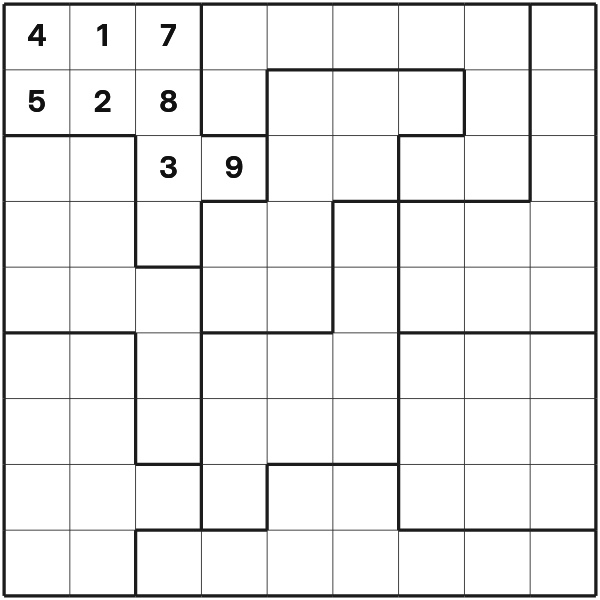
The marked Jigsaw region already contains the numbers 1, 2, 3, 4, 5, 7, 8, and 9. The only missing number for this region is 6. The empty cell in row 4, column 3 must therefore be a 6.
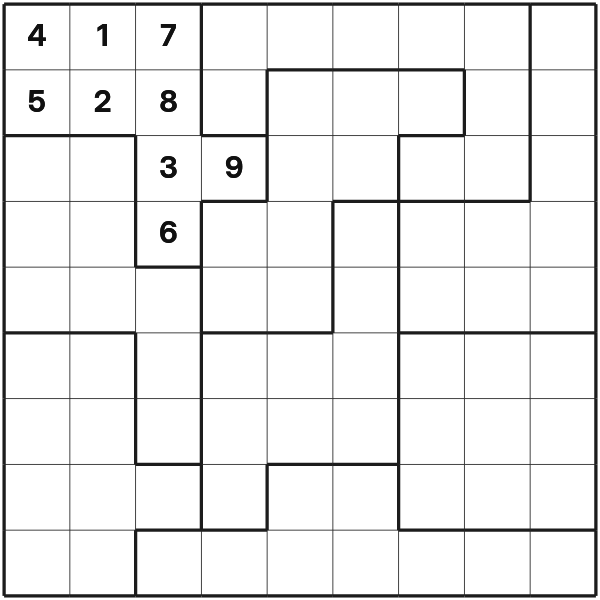
It is important to note that this region does not correspond to a normal 3x3 block. The conclusion only applies because the thick Jigsaw boundary precisely connects these nine cells into a region.
2. Do not think in 3x3 blocks
The main difference from classic Sudoku is the shape of the regions. A cell can lie within a region that extends over multiple traditional 3x3 boundaries. The thick lines of the puzzle are always decisive.
3. Combine region and row
If a number is missing in a Jigsaw region, check all cells of that region. Cells whose row or column already contains this number are excluded. This often leaves only one possible position.
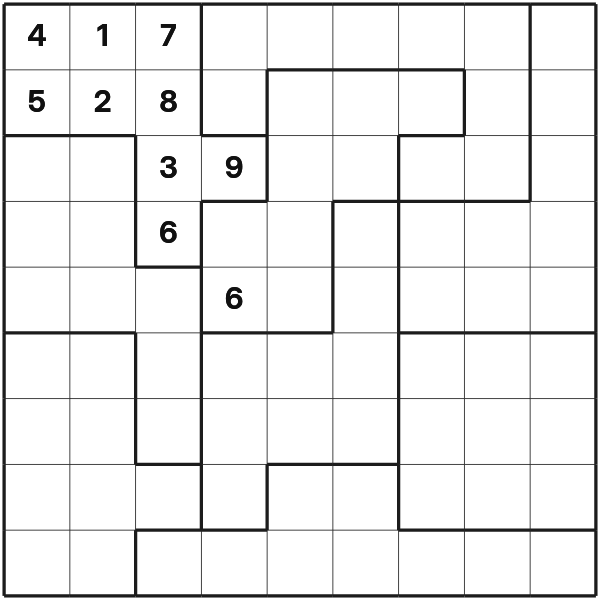
The 6 in the Jigsaw region is already placed. Therefore, no other 6 can appear in the same row, column, or region. A single entry thus works like in classic Sudoku but in three areas at once.
Typical Solving Process
- Start by observing the thick boundaries of the Jigsaw regions.
- Look for regions with many given numbers.
- Note the missing numbers of a region.
- Check possible cells against row and column.
- Use each entry again for the affected row, column, and region.
Common Mistakes
- Automatically applying standard 3x3 blocks, although the puzzle has Jigsaw regions.
- Overlooking a thick region boundary.
- Not fully tracking a region because of its unusual shape.
- Guessing too early instead of combining row, column, and region.
Tips for Beginners
- First scan each Jigsaw region before entering numbers.
- Mentally mark cells belonging to the same region.
- Start with regions containing many numbers.
- Check each cell: row, column, and Jigsaw region.
Jigsaw Sudoku does not change the fundamental idea of Sudoku but alters the shape of the regions. Those who read the regions carefully can use the same logical methods as with classic Sudoku.