
Kakuro – Easy
Download puzzle & solution
Share puzzle
Our puzzles are completely free. Please support this website by recommending it to your friends and family. Thank you!
New puzzle
Kakuro
Kakuro is a number puzzle that combines elements of crossword puzzles and sum logic. It is also known by the English name "Cross Sums." White cells are filled with numbers from 1 to 9. Black clue cells indicate the sum that a connected sequence of numbers, either across or down, must reach.
Within such a sequence, no number may be repeated. This rule is crucial: for example, a sum of 17 with two cells can only be 8 and 9. Longer sequences produce possible number combinations, where the specific order is determined by the crossing sum clues.
Basic Rules
- A number from 1 to 9 is entered into each white cell.
- The number in a black clue cell indicates the sum of the directly adjacent white cells, either to the right or downward.
- A number sequence ends at the next black cell or at the edge of the grid.
- No number may be repeated within the same horizontal or vertical sequence.
- A number may appear in different, unrelated sequences multiple times.
- Each white cell must satisfy both its horizontal and vertical sum constraints.
- The puzzle is solved when all cells are filled, all sums are correct, and all repetition rules are obeyed.
Solving Strategies
1. Determine small remaining sums from a total
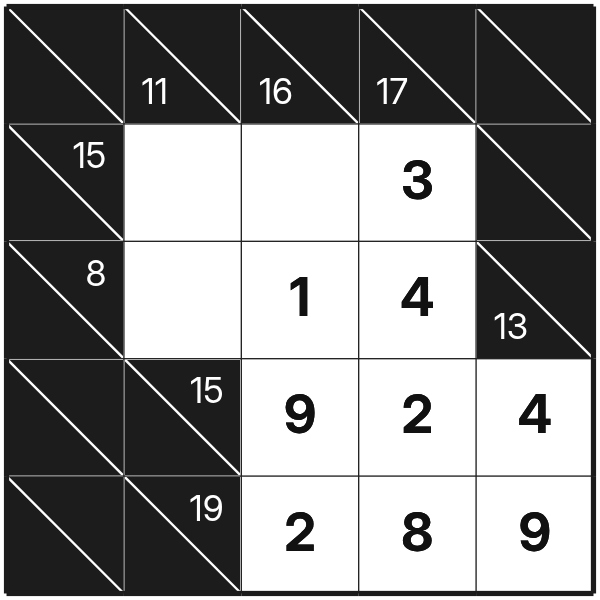
In the lowest horizontal sequence in the following example, the total is 19. The first cell already contains a 2.
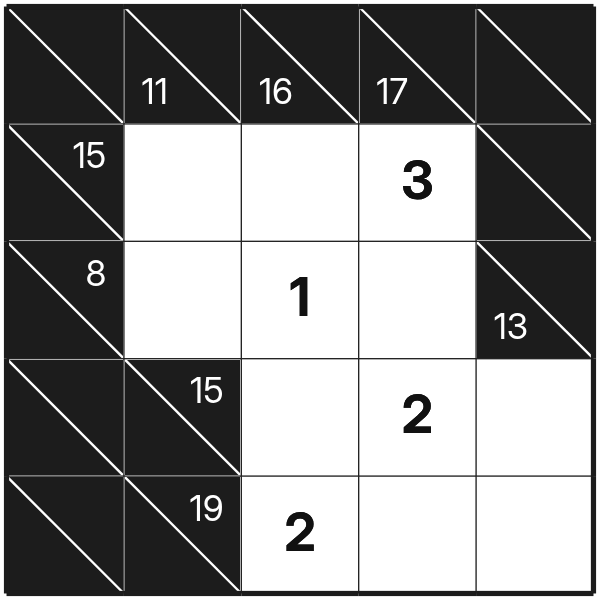
The remaining sum for the two other cells is 17:
19 - 2 = 17Only 8 and 9 from the numbers 1 to 9 can sum to 17. The two cells thus definitely contain 8 and 9, although their order is initially unknown.
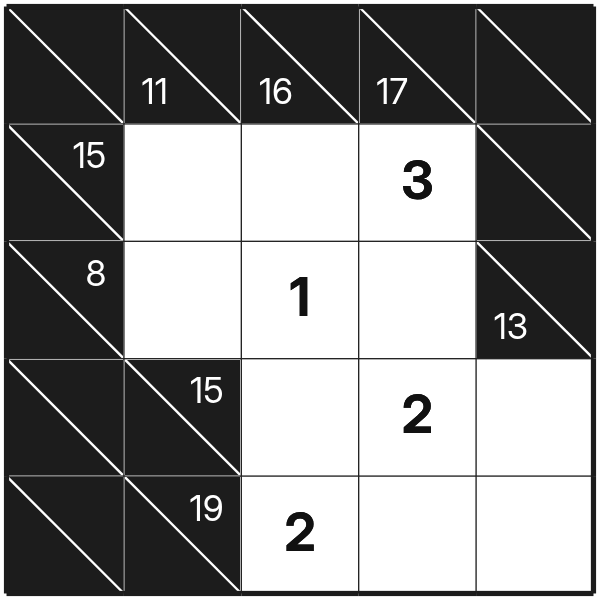
This step does not set the order but clearly reduces the candidate numbers for both cells.
2. A crossing sum determines the order
The middle of the two open cells also belongs to the vertical sum of 17. This vertical run contains the numbers 3 at the top, an empty cell, 2, and the current cell from the bottom row.
If we initially assume that the bottom cell of this vertical sequence is 9, then the other empty cell must be 3:
3 + 3 + 2 + 9 = 17This is impossible because 3 would appear twice in the same vertical sequence. Therefore, the bottom cell cannot be 9 and must be 8.
Thus, the order in the lowest horizontal sequence is clear:
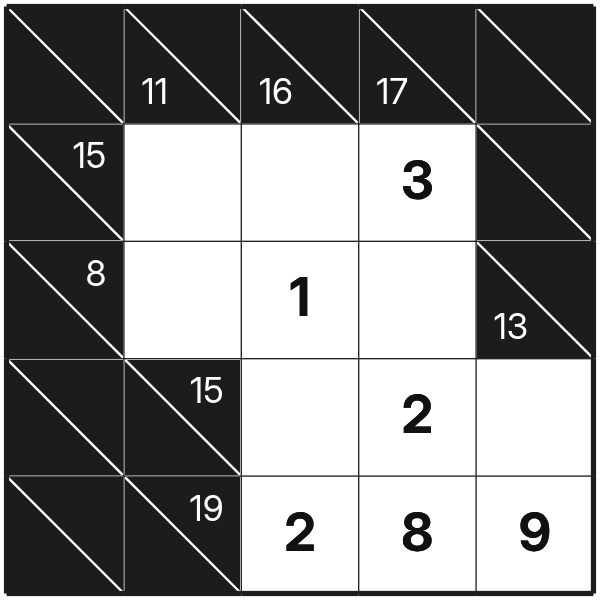
In the vertical sequence summing to 17, the missing value is:
17 - 3 - 2 - 8 = 4This empty cell in the sequence must be a 4.
3. Use a newly fixed value immediately in another sum
The recently determined 9 at the bottom right belongs to the vertical sum of 13. This sum involves only two cells.
top cell + 9 = 13The top cell must therefore be 4.
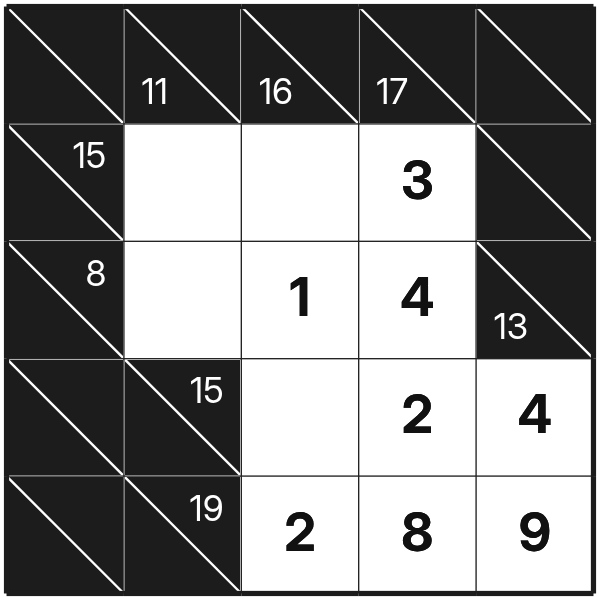
The horizontal sum of 15 in the penultimate row now contains an empty cell as well as 2 and 4:
15 - 2 - 4 = 9The remaining cell in this sequence must be a 9.
4. Complete a long vertical sum
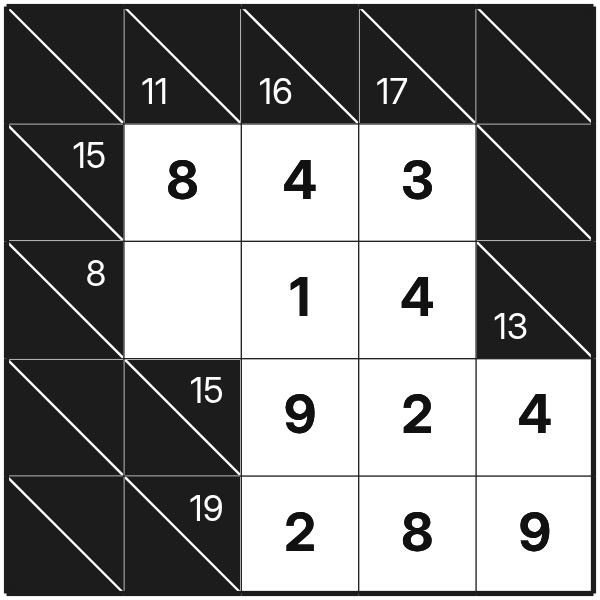
The vertical sum of 16 now includes, from top to bottom, an empty cell, 1, 9, and 2.
16 - 1 - 9 - 2 = 4The top empty cell must be a 4.
This leaves only one open cell in the above horizontal sequence besides the given 3:
15 - 4 - 3 = 8So, the top horizontal sequence is 8, 4, and 3.
5. Crossings can solve the entire puzzle as a chain
The vertical sum of 11 over the first number contains 8 at the top. The second cell must therefore be 3.
11 - 8 = 3The horizontal sum of 8 in this row now contains 3, 1, and 4, fulfilling it completely.
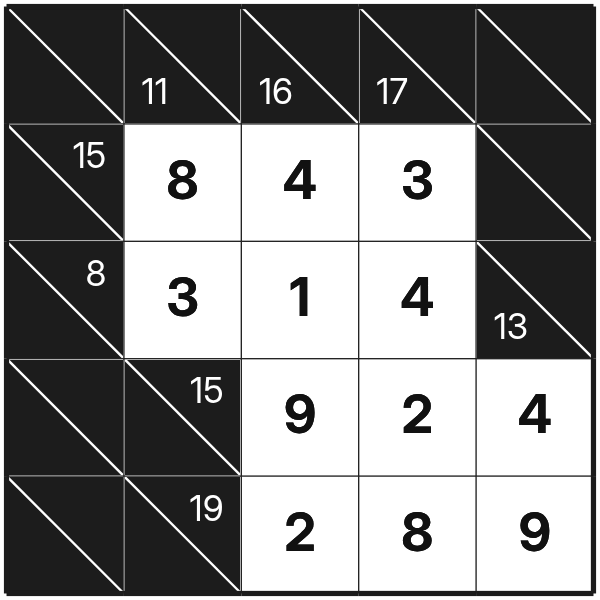
This example demonstrates the typical way of thinking in Kakuro: a combination is initially limited, a crossing sum determines the order, and each new value triggers further sums.
Typical solution process
- Identify short sequences and very small or very large sums.
- Write down possible combinations without repetitions.
- Separate combination and order: often, only the set of numbers involved is known first.
- Compare horizontal and vertical candidates at their crossings.
- Immediately subtract known numbers from the relevant sum.
- Verify after each entry that no number repeats within the sequence.
- Continue working through the chain of subsequent steps.
Common mistakes
- Using the number 0. In Kakuro, only 1 to 9 are allowed.
- Entering a number twice within the same sequence.
- Confusing a possible number combination with a fixed order.
- Checking only the horizontal or only the vertical sum for a cell.
- Continuing a sequence over a black clue cell.
- Relying on guesses too early when multiple combinations are possible.
Tips for Beginners
- Write possible combinations unordered first.
- Start with pairs and sums close to the minimum or maximum.
- Use the repetition ban as actively as the sum itself.
- Check crossings for common candidates.
- A safe entry should satisfy both the horizontal and vertical sums simultaneously.
Possible Kakuro sums
- 3 = 1 + 2
- 4 = 1 + 3
- 5 = 1 + 4 or 2 + 3
- 6 = 1 + 5 or 2 + 4
- 7 = 1 + 6, 2 + 5, or 3 + 4
- 8 = 1 + 7, 2 + 6, or 3 + 5
- 9 = 1 + 8, 2 + 7, 3 + 6, or 4 + 5
- 10 = 1 + 9, 2 + 8, 3 + 7, or 4 + 6
- 11 = 2 + 9, 3 + 8, 4 + 7, or 5 + 6
- 12 = 3 + 9, 4 + 8, or 5 + 7
- 13 = 4 + 9, 5 + 8, or 6 + 7
- 14 = 5 + 9 or 6 + 8
- 15 = 6 + 9 or 7 + 8
- 16 = 7 + 9
- 17 = 8 + 9
Kakuro is not just a basic calculation puzzle. The addition suggests possible number sets, the repetition rule narrows them down, and the crossings determine exact placement. This creates a fully logical solution chain without guessing.