
Download puzzle & solution
Share puzzle
Our puzzles are completely free. Please support this website by recommending it to your friends and family. Thank you!
New puzzle
Kazaguruma
Kazaguruma is a multi Sudoku. This means: The puzzle does not consist of a single classic Sudoku, but rather of multiple interconnected 9x9 Sudokus. Each sub-Sudoku follows the normal Sudoku rules: in each row, column, and 3x3 block, the numbers 1 to 9 must appear exactly once.
Kazaguruma is a windmill-shaped multi Sudoku. Several classic 9x9 Sudokus are offset and interlock like the blades of a windmill.
In Kazaguruma, you must be especially careful to check which blade and which overlapping area a cell belongs to. As with all Sudokus, no calculations are involved. The numbers are symbols correctly placed through logical elimination.
Basic Rules
- The puzzle consists of several classic 9x9 Sudokus connected into a single figure.
- Exactly one number from 1 to 9 is entered into each active cell.
- Within each individual 9x9 Sudoku, each row must contain the numbers 1 to 9 exactly once.
- Within each individual 9x9 Sudoku, each column must contain the numbers 1 to 9 exactly once.
- Within each individual 9x9 Sudoku, each 3x3 block must contain the numbers 1 to 9 exactly once.
- Shared cells belong to multiple sub-Sudokus simultaneously. The entered value is the same for all participating sub-Sudokus. <li-Givens cannot be changed.
- Empty regions outside the visible grid are not part of the puzzle and are not filled in.
- A multi Sudoku is solved when each contained 9x9 Sudoku is correctly completed and all shared cells match.
- Important: A long visible row is not automatically a Sudoku row. Always consider the boundaries of the respective 9x9 sub-Sudoku.
Strategies for Solving
The basic techniques are the same as in classic Sudoku. The difference is that secure entries in one sub-Sudoku can influence other sub-Sudokus. Shared cells and overlapping areas are especially important.
1. Check a single sub-Sudoku like a regular Sudoku
Start with a sub-Sudoku that already has many numbers filled in. Usually, simple secure entries can be found there without considering the entire multi Sudoku at once.
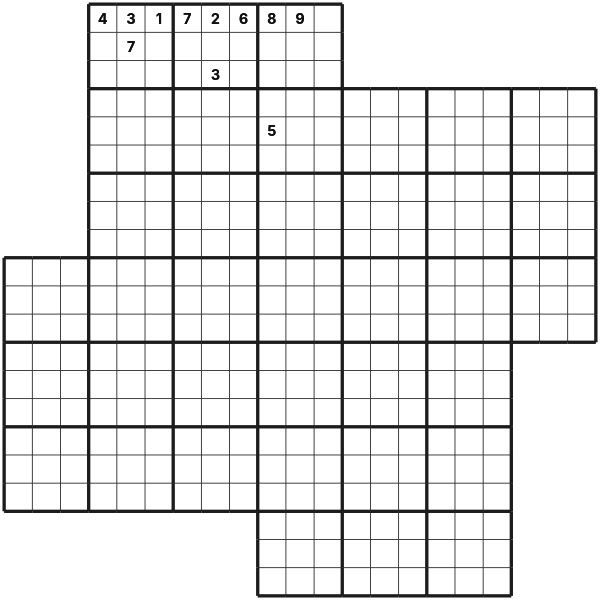
In the examined 9x9 sub-Sudoku, one row reads 43172689.. The numbers 1, 2, 3, 4, 6, 7, 8, and 9 are already present. The only missing number is 5. Therefore, the last empty cell in this row of the sub-Sudoku must be a 5.
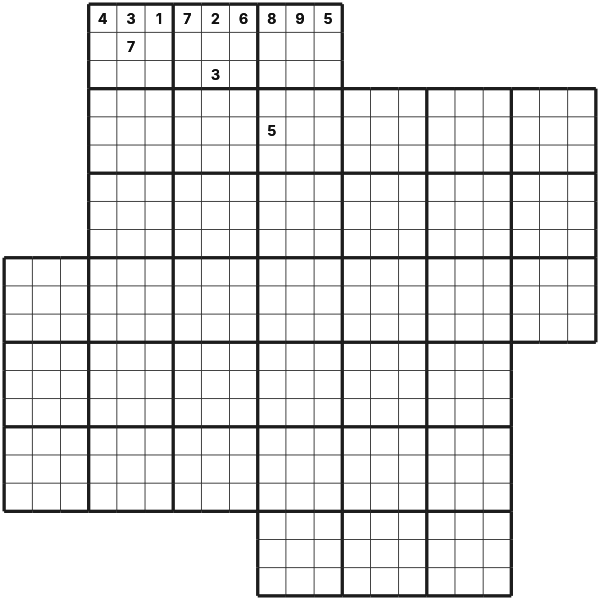
This conclusion applies not to the entire visible width of the figure, but precisely to the nine cells of this one sub-Sudoku row.
2. Hidden single candidate in a 3x3 block
Not every secure number arises from an almost complete row. Often, a number can only be placed in one spot within a 3x3 block. In the complete Kazaguruma grid below, we look at the top-left 3x3 block of a sub-Sudoku to find the number 5.
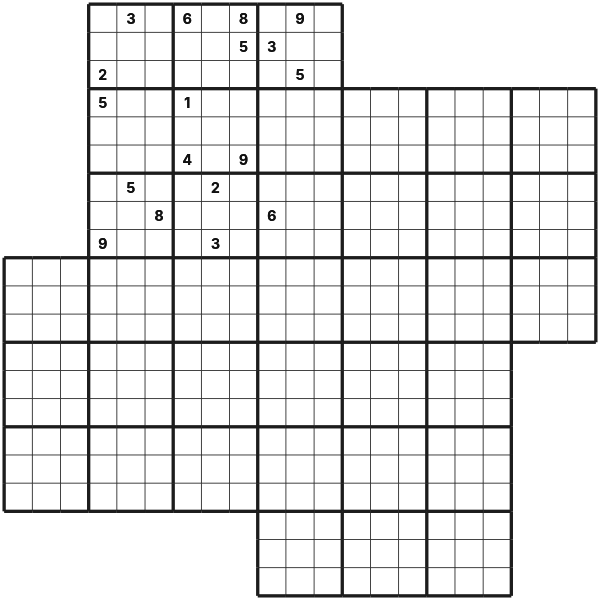
In the considered sub-Sudoku, the 5 is checked within the top-left 3x3 block. In the second and third rows of this sub-Sudoku, a 5 is already present, so the 5 cannot be in these rows within the block. Additionally, the first and second columns of this sub-Sudoku already contain a 5. This excludes the first two cells of the first row in the block. The only remaining option is the third cell of the first row, which must contain the 5.
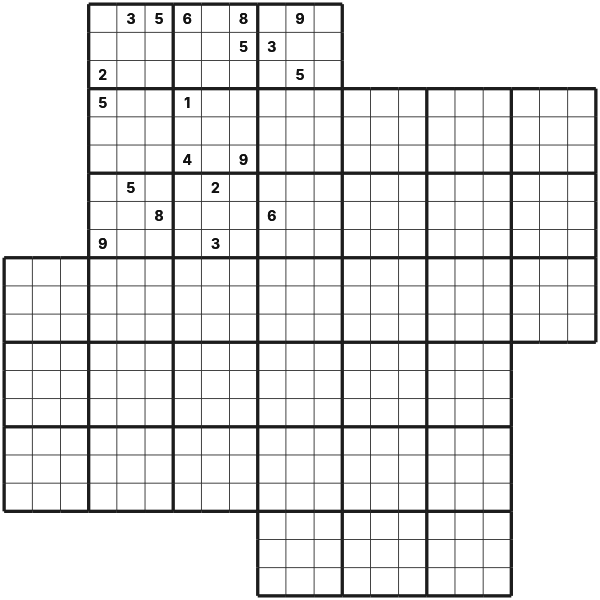
This is a hidden single candidate. The cell might not seem obviously forced at first, but for the number 5, there is only this one allowed position in the examined block.
3. Use a shared cell as a bridge
Shared cells are the most important special feature of Kazaguruma. A shared cell belongs to multiple sub-Sudokus. If a number is confidently determined there, it must be immediately considered in all involved sub-Sudokus.
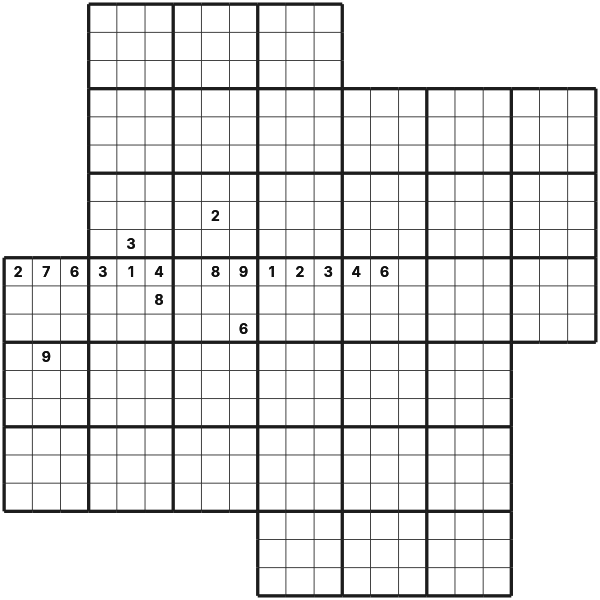
In the first row of the example, the sequence 276314.89 is present. In this sub-Sudoku, only the 5 is missing. The open cell is also part of an adjacent sub-Sudoku. Once the 5 is entered, it also alters the corresponding row there.
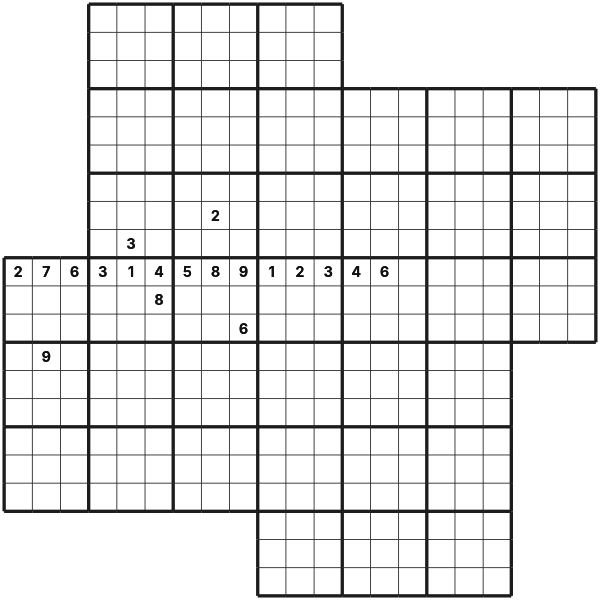
The first entry is thus not just a local progress. It also serves as a hint for the adjacent sub-Sudoku because the same cell is part of a row, a column, and a 3x3 block there as well.
4. Derive a follow-up step from an overlap
In the adjacent sub-Sudoku, the relevant 9-row is 58912346.. Only the 7 is missing, so this cell can be confidently filled as well.
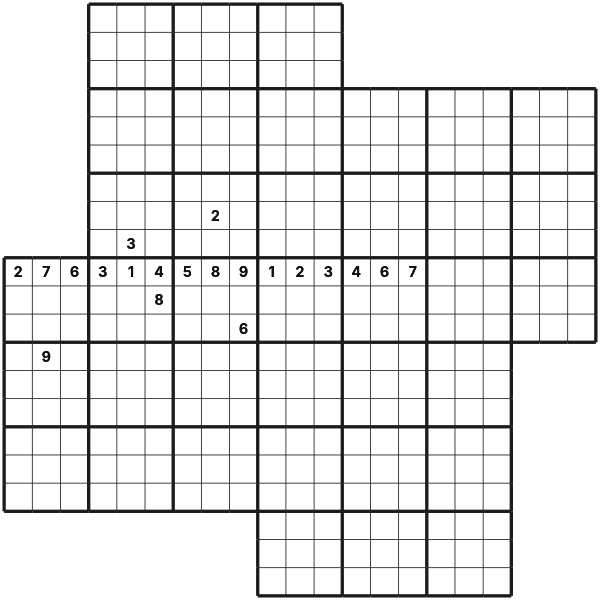
This example demonstrates the typical multi Sudoku effect: First, a cell in one sub-Sudoku is confidently solved. Because this cell is shared, it immediately leads to another confident step in the neighboring sub-Sudoku.
5. Carefully check candidates in overlaps
A normal Sudoku cell is constrained by a row, column, and 3x3 block. A shared cell can also belong to other rows, columns, and blocks of different sub-Sudokus. Therefore, a candidate in a shared cell can only stay if it is allowed in all involved sub-Sudokus.
Practically: do not evaluate a shared cell only from the perspective of the sub-Sudoku you are currently working on. Deliberately switch to the other sub-Sudoku and check the row, column, and block there as well. This way, shared cells often become clearly defined as border cells earlier.
6. Track the boundaries of sub-Sudokus carefully
Kazaguruma looks like a large connected puzzle. Still, the logic is derived from the individual 9x9 Sudokus. A visible row may contain parts of several different sub-Sudoku rows. Therefore, always clearly identify which 9x9 Sudoku you are currently examining.
Typical solving process
- Get an overview of the arrangement: a windmill-like layout of five 9x9 Sudokus.
- Select a sub-Sudoku with many givens and look for confident classic Sudoku steps.
- Check nearly complete rows, columns, and 3x3 blocks.
- Look for hidden single candidates: numbers that can only fit in one position within a certain area.
- Mentally mark shared cells and overlapping areas.
- Immediately transfer any confirmed entry in a shared cell to all involved sub-Sudokus.
- Check afterward if new single candidates or eliminations appear in neighboring sub-Sudokus.
- Regularly switch between sub-Sudokus instead of solving an area in isolation.
- Verify for each entry that it is allowed in all affected rows, columns, and 3x3 blocks.
- Only finish the puzzle when each individual 9x9 Sudoku is fully and consistently solved.
Common mistakes
- Treating the whole figure as a single large Sudoku. Rules only apply within each individual 9x9 Sudoku.
- Updating only in one sub-Sudoku for shared cells. A shared cell affects all sub-Sudokus it belongs to.
- Falsely tracking boundaries. In offset grids, not every visible row belongs to the same Sudoku row.
- Interpreting empty regions as cells. Areas without a grid are not filled.
- Rushing too early. A wrong entry can damage multiple sub-Sudokus simultaneously.
- Not strictly checking candidates in overlaps. A candidate must be allowed in all involved rows, columns, and blocks.
- Not continuing after a secure entry. Shared cells often immediately produce new eliminations.
Tips for beginners
- Start with one sub-Sudoku and solve only secure steps there.
- Early on, identify shared areas. They often create the most crucial links.
- Strictly observe the 9x9 boundaries of each Sudoku.
- Always check all involved sub-Sudokus for shared cells, not just the one you're working on.
- Use candidate notes as soon as multiple sub-Sudokus are in play.
- Change perspective: if one sub-Sudoku stalls, check its neighboring shared cells.
- Ask yourself on each entry: is this number secure in that sub-Sudoku, and does it influence another sub-Sudoku?
- View overlaps not just as difficulties but as additional clues.
Kazaguruma extends the classic Sudoku without changing the fundamental logic. Each number still follows the known Sudoku rules. The challenge is to connect multiple sub-Sudokus cleanly. Those who use shared cells consistently can logically solve complex multi Sudoku puzzles step by step.