
Kuromasu – Medium
Download puzzle & solution
Share puzzle
Our puzzles are completely free. Please support this website by recommending it to your friends and family. Thank you!
New puzzle
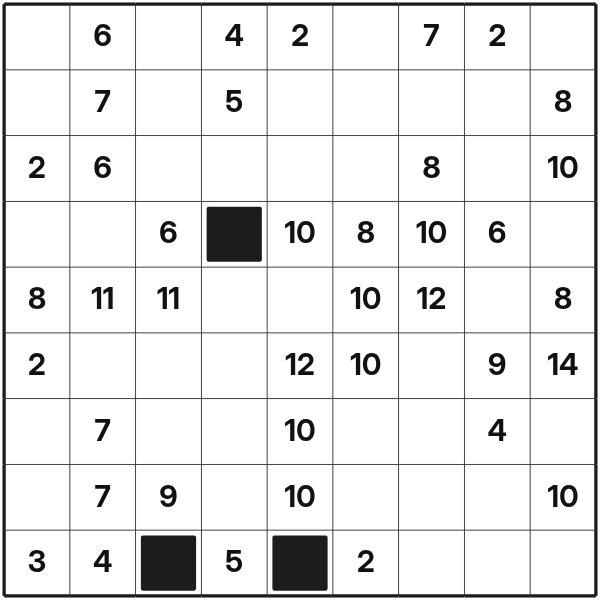
Kuromasu
Kuromasu is a Japanese logic puzzle also known as Kurodoko. Some cells contain numbers, while the remaining cells are empty. The goal is to blacken specific empty cells and leave all others white.
Each number indicates how many white cells it can see horizontally and vertically. The cell with the number is included in the count. The line of sight extends in all four directions until it reaches the edge of the grid or the first black cell. Black cells block the view.
Additionally, black cells must not share a side, and all white cells must remain connected through shared sides.
Basic Rules
- Each cell is ultimately either black or white.
- Cells with numbers remain always white.
- A number counts all visible white cells in its row and column, including the number cell itself.
- View ends at the edge or at the first black cell.
- Black cells must not touch each other horizontally or vertically.
- Diagonally adjacent black cells are allowed.
- All white cells must form a single connected area.
- The puzzle is solved when each number has exactly its specified line of sight, and both additional rules are fulfilled.
Solving Strategies
1. Evaluate a small number with blocked directions
In the following example, we consider the 2 in the bottom row. Assume the cell directly above and the cell directly to the left are already black.
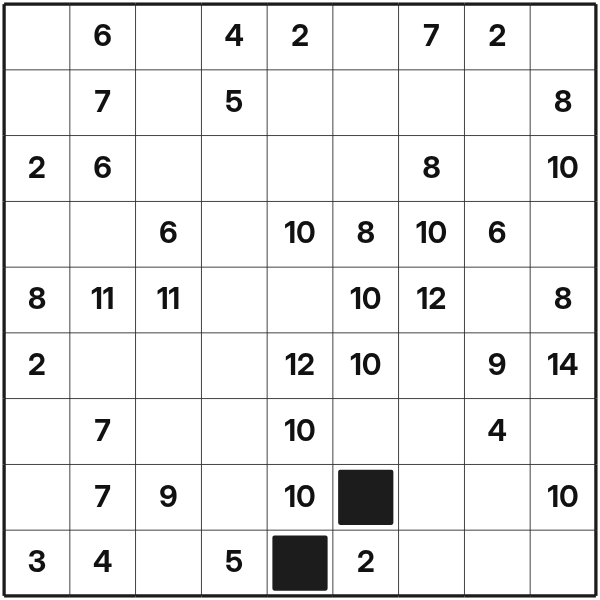
The 2 already counts itself as one white cell. Its view to the top and left is immediately blocked. Therefore, exactly one more white cell must be visible to the right.
The immediate right cell must be white. The next cell to the right must be black to prevent the view from extending over three cells.
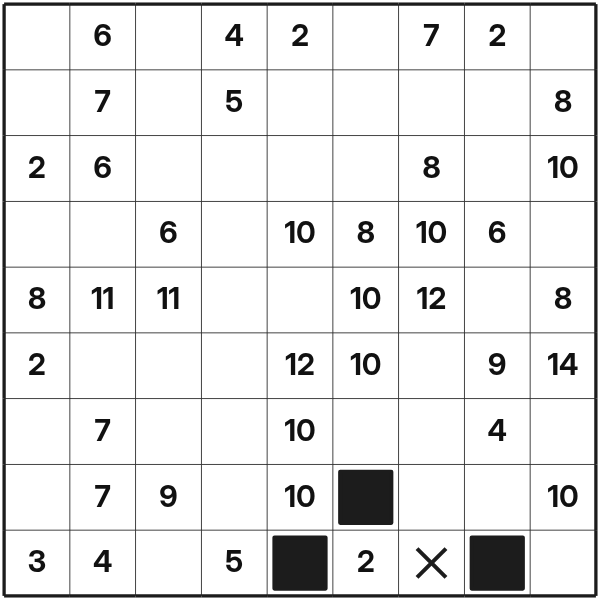
Now the line of sight is exactly: number cell 2 plus one white cell to the right.
2. Neighboring black cells must remain white
The black cell just identified in the bottom row must not have black neighbors on its sides. Therefore, the cells to the left, to the right, and directly above must remain white unless they are number cells.
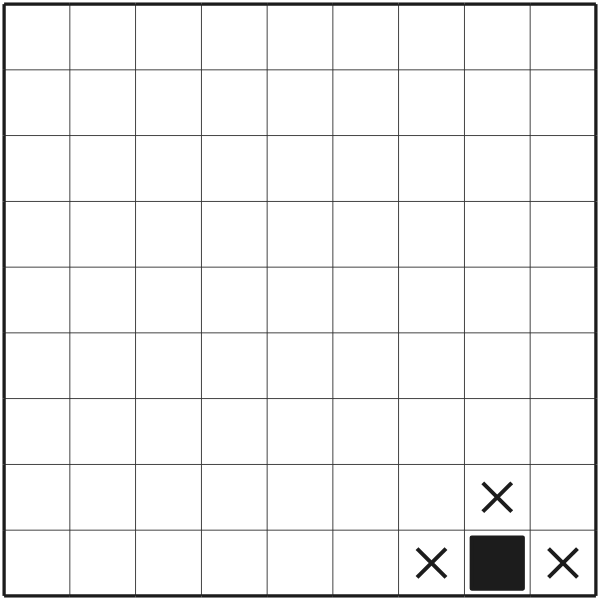
This rule often creates safe white cells, which are then counted when calculating the view range of neighboring numbers.
3. A number stops its view exactly at the right spot
Let's consider the 2 in the first row. Assume the cells to the right and directly below are already secured as black. The cell to the left is the 4, which is definitely white as a number cell.
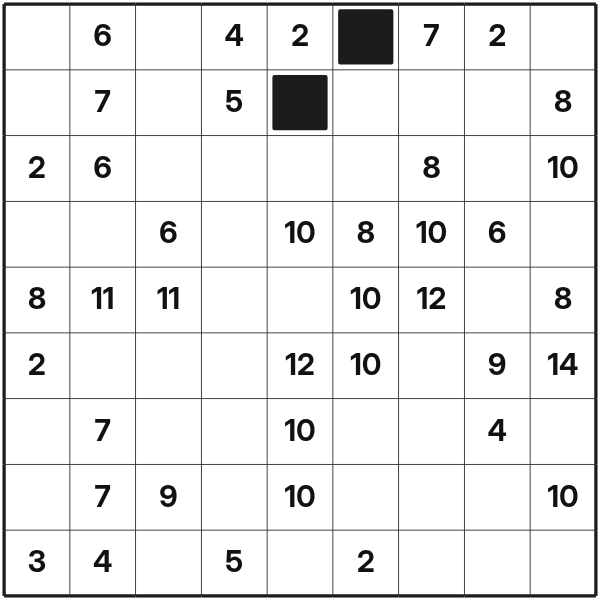
The 2 sees itself and the 4 to the left. That makes exactly two visible white cells. The next cell further to the left must be black; otherwise, the view would extend to at least three cells.
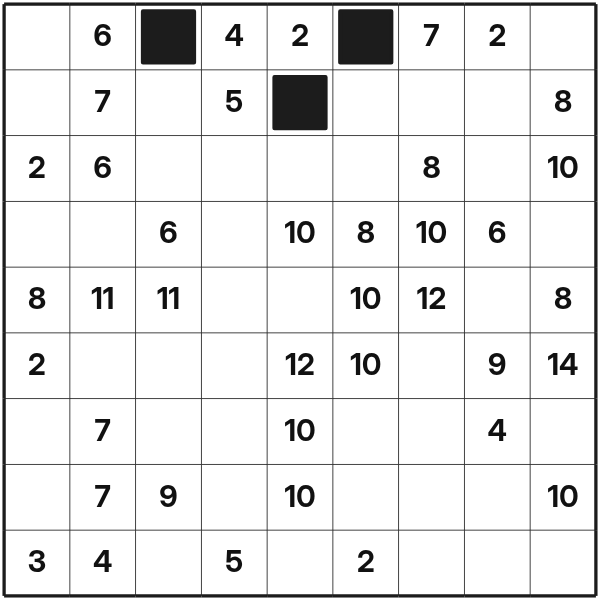
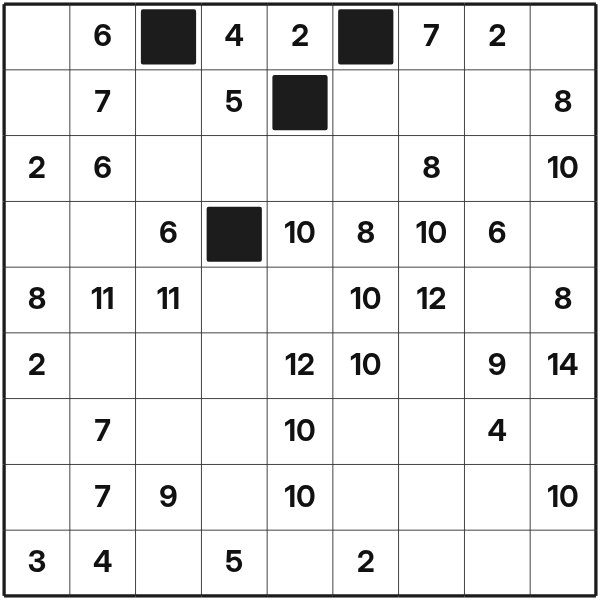
This number influences not only its immediate neighbors but also determines where a longer white line of sight must end.
Now, it's clear how far the 4 can see. The view to the right is constrained to 2 cells, which clarifies the view downward:
4. A white connection must not be cut off
In the bottom row, examine the 5 in the following example. Assume the cells to the left and right of this number are already secured as black.
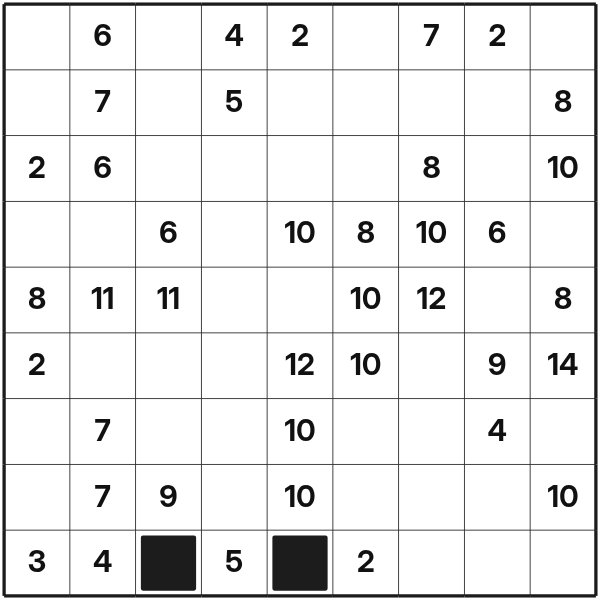
The 5 can only be connected to the remaining white area via the cell directly above. If this cell were black, the 5 would be completely enclosed by black cells and the bottom edge.
The cell directly above the 5 must therefore remain white.
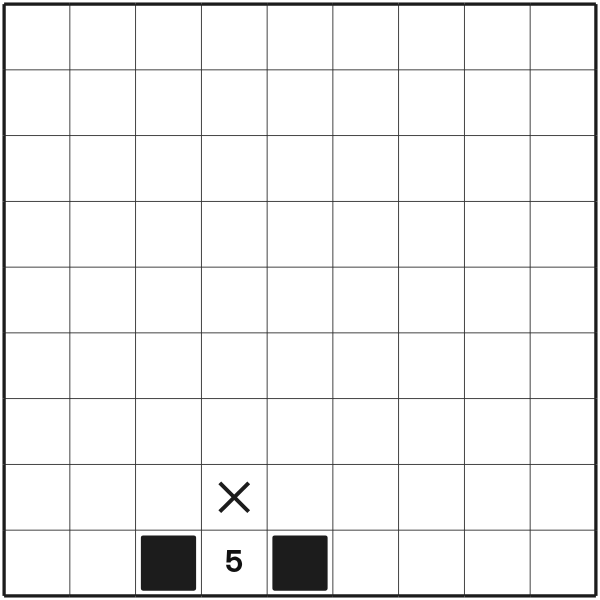
This conclusion follows from the connection rule, regardless of how the view for 5 is later divided.
Since the cell with 5 can only look upward, the black cell is confirmed by the view range of 5.
5. Number cells provide fixed white anchors
Each number cell is automatically white. It can serve as a secure part of a line of sight or as a connection in the white area.
If no black cell can lie between two number cells, they see each other. Their line of sight must be compatible with this shared white stretch. Conversely, a small number can force a black cell to be between it and a more distant number cell.
6. Large numbers require long white sight lines
High figures like 12 or 14 can only be satisfied if many cells in multiple directions stay white. Black candidate cells near such numbers are therefore heavily restricted.
A high number does not automatically restrict each direction individually. Instead, sum the visible white stretches upward, downward, leftward, and rightward, counting the number cell once. Additional cells are only marked when the remaining possibilities are clear.
Typical Solution Process
- Mentally mark all number cells as definitely white.
- Look for small numbers on edges or next to known black cells.
- Determine how many more white cells must still be visible.
- Place black stops once the view range is fully achieved.
- Mark neighbors of black cells as white.
- Regularly check whether a blackening would separate the white area.
- Use high numbers to secure long white lines.
Common Mistakes
- Not including the number cell itself in the count.
- Counting beyond a black cell.
- Placing two black cells sharing a side.
- Blackening a number cell.
- Only checking the connection of all white cells at the end.
- Focusing on a high number in only one direction when all four directions should be summed.
Tips for Beginners
- Use the formula: own cell plus visible cells in four directions for each number.
- Mark safe white cells as consistently as black cells.
- Immediately check the four neighbors of each black cell.
- Look for white cells serving as the only bridge to a border or number cell.
- Place a black stop only when the allowed line of sight is definitely reached.
Kuromasu combines precise counting with area logic. Each number determines a line of sight, black cells limit this range, and the entire white area must remain connected. Clear solutions always arise from the interaction of these three rules.