
Light Up – Medium
Download puzzle & solution
Share puzzle
Our puzzles are completely free. Please support this website by recommending it to your friends and family. Thank you!
New puzzle
Light Up
Light Up is a logic puzzle also known under the Japanese name Akari. The playing field consists of white cells and black clue cells. Lamps are placed in some white cells. Each lamp illuminates its entire row and column up to the next black cell or the edge of the board.
The goal is to light all white cells. At the same time, no lamp may see or illuminate another lamp directly. Numbers in black cells indicate how many lamps must be placed immediately horizontal or vertical to that clue.
Basic Rules
- Lamps may only be placed in white cells.
- A lamp lights up all white cells horizontally and vertically until a black cell or edge is reached.
- Black cells block light.
- Every white cell must end up lit.
- No lamp may see or directly illuminate another lamp horizontally or vertically.
- A number in a black cell indicates how many lamps are directly above, below, left, and right of it.
- Diagonally adjacent lamps are not counted by a clue number.
- A black cell without a number contains no additional lamp clues.
- The puzzle is solved when all white cells are lit, all numbers are satisfied, and no two lamps see each other.
Strategies for Solving
1. A 0 excludes all immediate neighboring cells
A black 0 requires exactly zero neighboring lamps. Therefore, no lamps can be in all directly adjacent white cells.
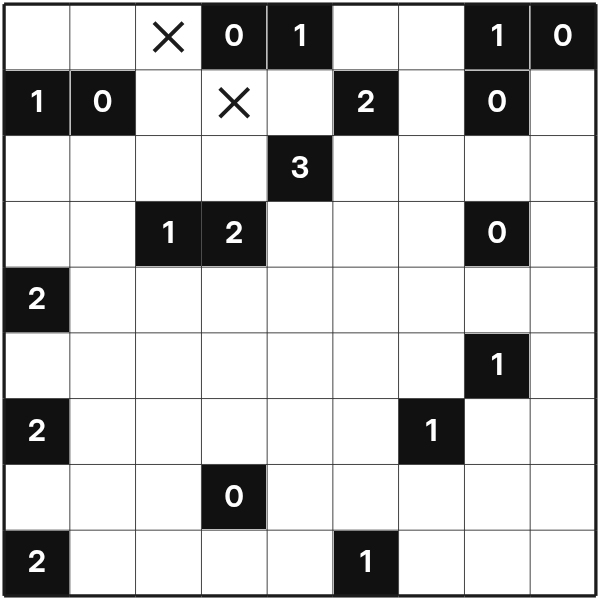
At the top of the puzzle, there is a 0 in the fourth cell of the first row. The cell to its left and the cell directly below are excluded. To the right, there is already a black clue cell.
The 0 in the second cell of the second row also excludes the cell directly above, the cell to the right, and the cell directly below.
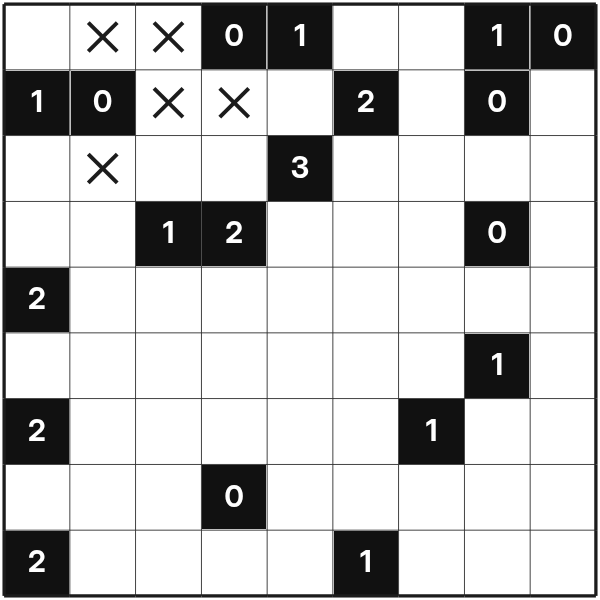
Such exclusions are often the first step, as they later show where a given cell can still be illuminated from.
2. A cell with only one possible light source mandates a lamp
Consider the top-left corner cell. Its view downward is immediately blocked by the black clue cell at the start of the second row.
Theoretically, lamps in the first, second, or third cell of this corner could illuminate the cell above and to the right. However, the second is excluded by the 0 below, and the third by the 0 to the right.
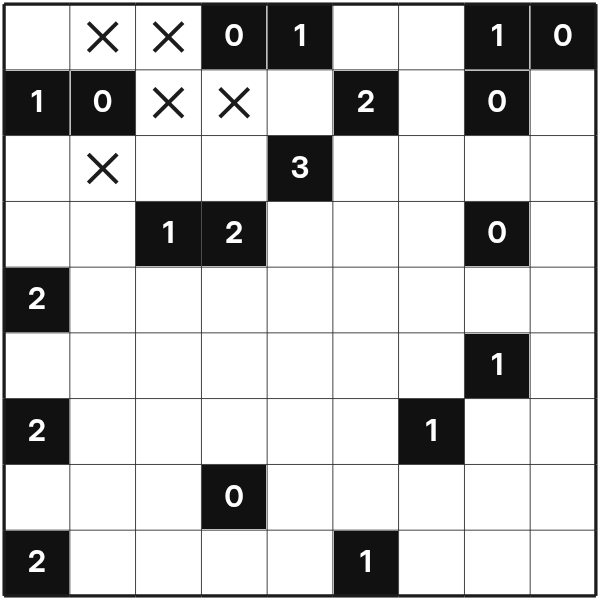
Thus, only the corner cell itself remains as a possible lamp position. A lamp must be placed there.
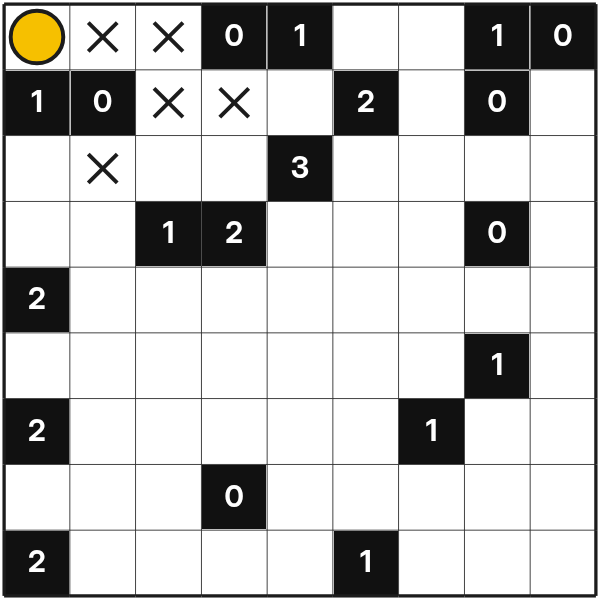
This conclusion arises from the lighting rule: every white cell must receive light, and for the corner cell, only one possible lamp position remains.
3. A lamp excludes its entire line of sight for other lamps
The lamp in the top-left lights the two white cells to its right up to the black cell. No more lamps can be in these lit cells, as they would directly see the existing lamp.
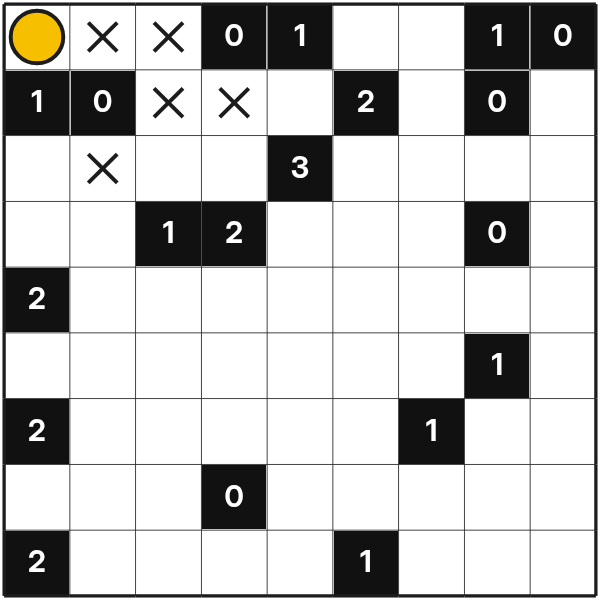
The X marks have two functions: they were previously excluded by the 0 clues and are now also confirmed by the line of sight of the lamp.
4. A number clue can set all other neighbors to lamps
In the center of the top area, there is a black 3. Its four neighboring cells are above, below, to the left, and to the right.
If the left neighbor is already excluded because it is seen by a lamp in the same row, then exactly three neighboring cells are left. Since the clue 3 requires exactly three lamps, all three must contain lamps.
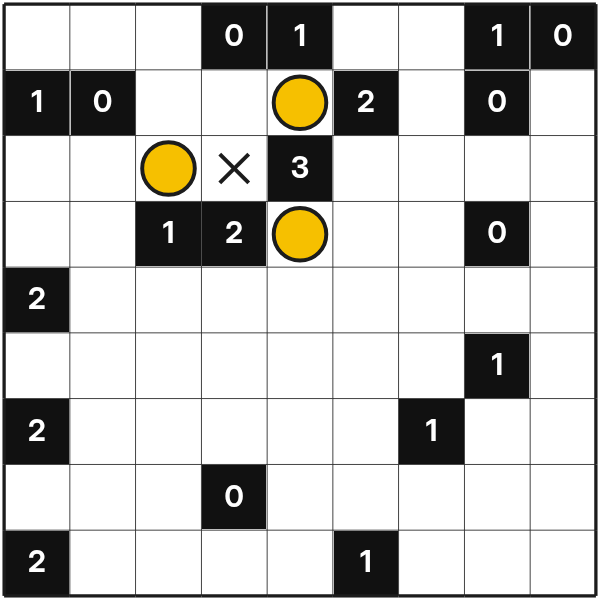
The three lamps are above, to the right, and below the 3. They do not see each other because the black clue cell with the 3 separates their horizontal and vertical lines of sight.
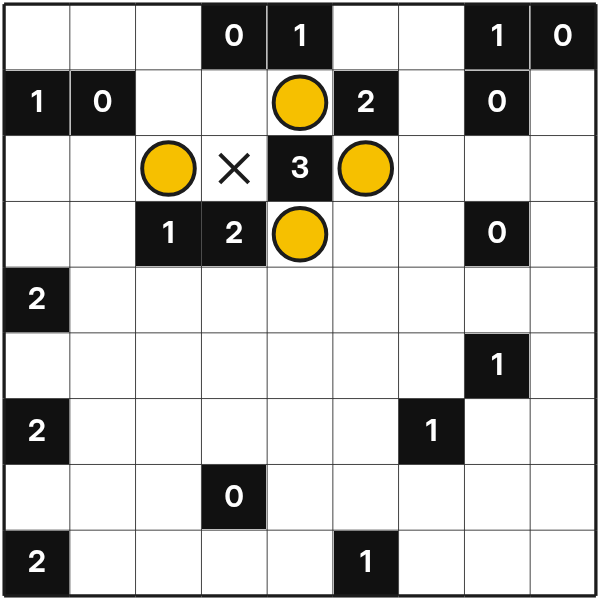
The logic is clear: three lamps are needed, and there are exactly three possible cells remaining.
5. When a clue is fulfilled, all remaining neighbors are lamp-free
In the bottom-right part of this example, a black 1 is present. Suppose a secure lamp is already directly below it.
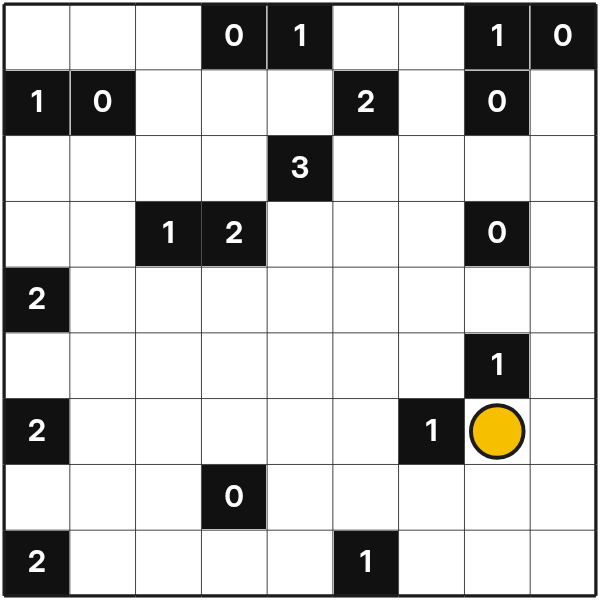
The clue requires exactly one lamp and is already satisfied. Therefore, the other immediately adjacent white cells to the left, right, and above must not contain lamps.
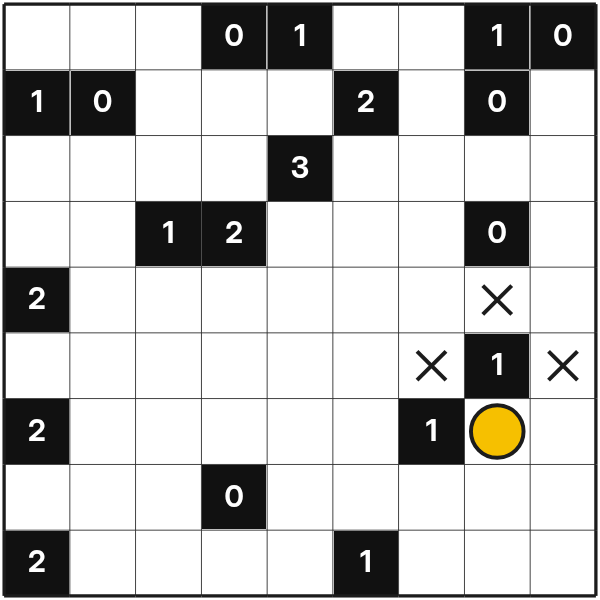
These cells will be illuminated later by other lamps but should not contain lamps themselves.
Similarly, the adjacent black cell, which also contains a 1, meets the condition as well.
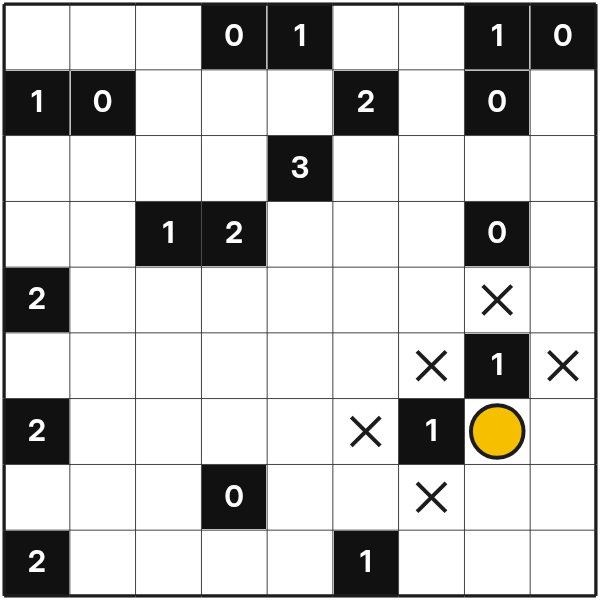
6. Check lighting and number clues together
A permissible lamp position must satisfy two conditions simultaneously:
- The lamp does not see another lamp.
- It does not overfill an adjacent number clue.
7. Black cells divide rows and columns into light sections
Each contiguous sequence of white cells between two black cells forms its own light section. At least one lamp must reach this section horizontally or vertically.
It is helpful to consider such sections individually. If a cell in a section can only be illuminated from a single source, that source is a safe lamp position.
Typical Solution Process
- First, mark all cells next to black 0s as lamp-free.
- Check number clues where lamps or excluded cells are already known.
- If the remaining missing lamp count matches the number of possible neighbor cells, place lamps there.
- If a clue is already satisfied, exclude all other neighbor cells.
- After placing each lamp, mark its entire line of sight as lit and blocked for further lamps.
- Look for white cells that can only be illuminated from one position.
- Finally, verify that all white cells are lit.
Common Mistakes
- Counting diagonally adjacent lamps as part of a number clue.
- Extending light through a black cell.
- Placing two lamps on the same sightline.
- Only solving number clues and ignoring unlit white cells.
- Placing a lamp that would overfill an already satisfied clue.
Tips for Beginners
- Always start with 0 clues and heavily restricted numbers.
- Consistently mark lamp-free cells with a small cross.
- Immediately extend the light beams of new lamps to the next black cell.
- Check corners and short white sections for a single possible light source.
- For each unlit cell, ask which cells could still provide light.
Light Up combines local number clues with a global lighting task. Secure lamps are either directly adjacent to number cells or where a white cell has only one possible light source. Each lamp placement simultaneously changes lighting, line of sight, and neighboring number clues.