
Little Killer Sudoku – Easy
Download puzzle & solution
Share puzzle
Our puzzles are completely free. Please support this website by recommending it to your friends and family. Thank you!
New puzzle
Solve Little Killer Sudoku: Rules and Strategies
Little Killer Sudoku is a variant of Sudoku. Numbers and arrows outside the 9×9 grid indicate sums along diagonal lines.
All cells on the diagonal indicated by the arrow sum up to the edge number. Unlike in killer cages, numbers can repeat on such a diagonal.
The goal is a fully and correctly filled puzzle. Each entry must be derived from visible clues and already placed numbers.
Rules
- Each cell contains exactly one number from 1 to 9.
- Each row contains the numbers 1 to 9 without repetition.
- Each column contains the numbers 1 to 9 without repetition.
- Each normal 3×3 block contains the numbers 1 to 9 exactly once.
- All cells on the diagonal indicated by the arrow sum to the edge number. Numbers can be repeated on such a diagonal, unlike in killer cages.
- Given numbers are not changed.
- Every entry must satisfy all rules.
Orientation in the grid
Only count inside the inner 9×9 solution field: rows from top to bottom, columns from left to right. A pair of numbers: the first indicates the row, the second the column; (4,7) lies in row 4, column 7. Edge clues are outside the solution field.
The pictures show specific intermediate states. Blue-marked cells are used for the step, red means excluded, and green shows a certain result.
Basic idea for solving
Subtract known values from the diagonal sums and combine the remaining sums with normal Sudoku candidates.
After each certain entry, check the affected row, column, block, and all additional clues again. Often, this already leads to the next step.
1. Complete a nearly full row
In row 1, only cell (1,2) is empty. The numbers 1, 3, 4, 5, 6, 7, 8, 9 are already present. Therefore, only 2 is missing.
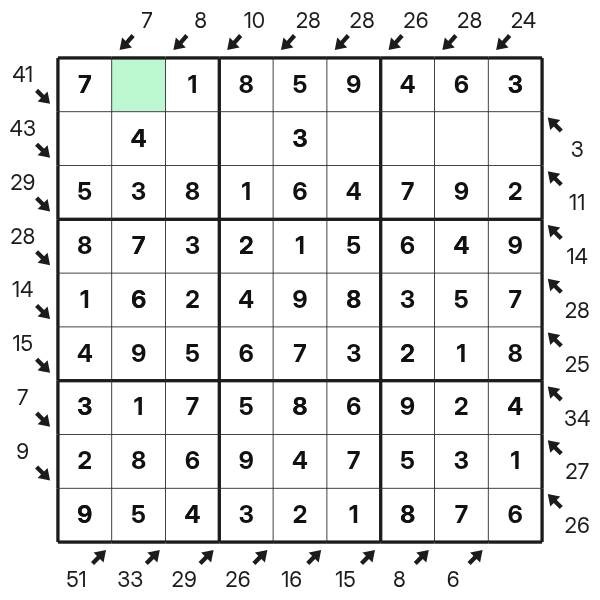
So, 2 belongs in (1,2). All other numbers are already in row 1.
2. Complete a nearly full column
In column 1, only cell (2,1) is empty. The numbers 1, 2, 3, 4, 5, 7, 8, 9 are already present. So, 6 is missing.
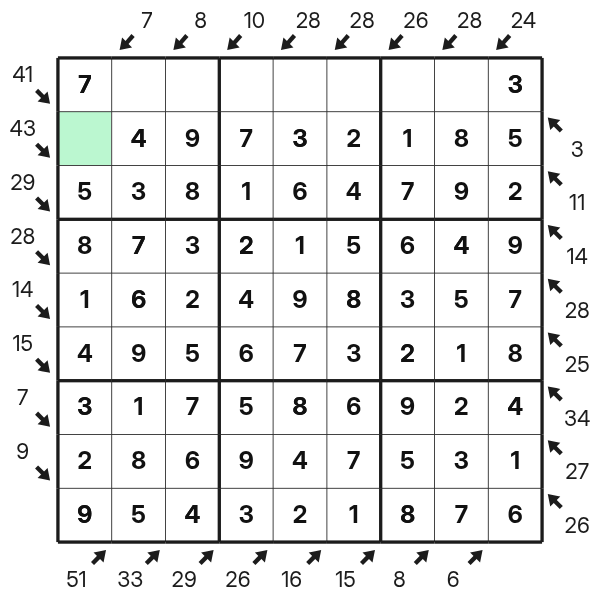
So, 6 belongs in (2,1). All other numbers are already in column 1.
3. Complete a nearly full region
In the 3×3 region 1, only cell (1,2) is empty. The numbers 1, 3, 4, 5, 6, 7, 8, 9 are present. So, 2 is missing.
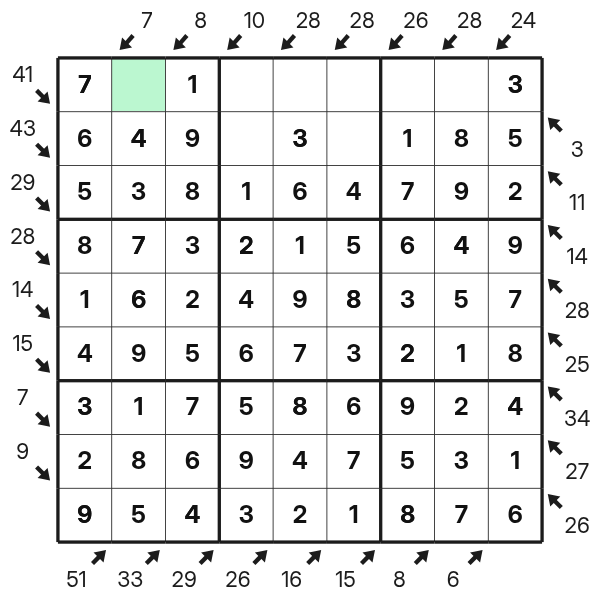
So, 2 belongs in (1,2). All other numbers are already in region 1.
4. Finish a diagonal sum
The arrow indicates a sum of 6 for its diagonal. The visible values except (9,9) sum to 0.
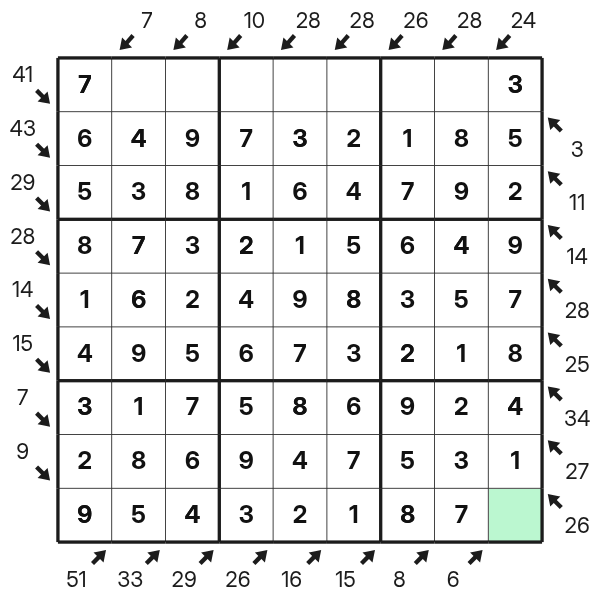
Missing is 6 − 0 = 6. This number is entered in (9,9).
5. Treat two open diagonal cells as remaining sum
After subtracting known values, the two marked cells must sum to 7. The sum alone does not determine their order.
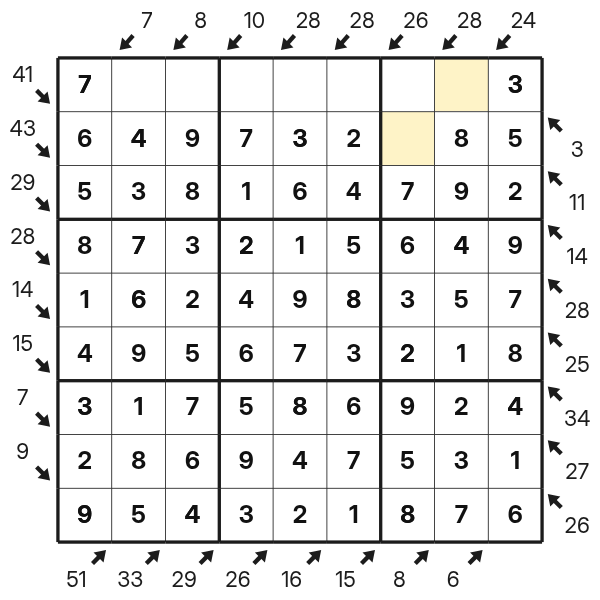
Rows, columns, and 3×3 blocks assign the values 6 and 1 to the positions. Repetitions on the sum diagonal are allowed if normal Sudoku rules permit.
6. Don't confuse sum diagonal with a Sudoku unit
The marked diagonal shows 8 in multiple positions. This is allowed because the arrow only indicates the sum 28.
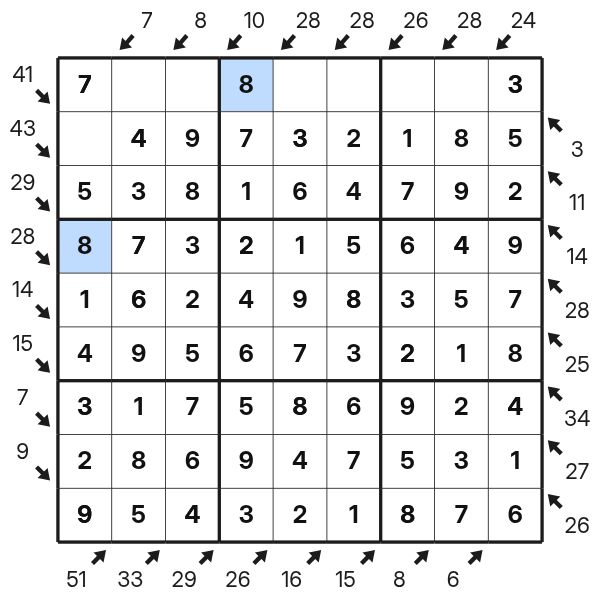
An exclusion only arises if two of these cells are also in the same row, column, or 3×3 block. The sum diagonal itself has no repetition rule.
7. Check row, column, and region together
For (1,2), check row, column, and region simultaneously. All numbers except 2 are excluded.
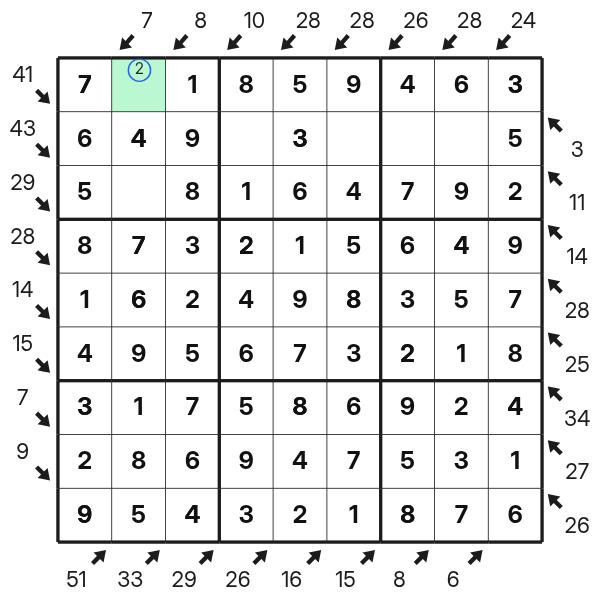
Thus, only 2 remains in (1,2). Always check all related areas when dealing with open cells.
Typical solving process
- Mark each sum arrow's complete sequence of cells.
- Subtract known values from the arrow sum.
- Create combinations for two or more open diagonal cells.
- Assign these values using rows, columns, and blocks.
- Allow repetitions on the diagonal as long as Sudoku rules are not violated.
Common mistakes
- Reading the arrow number as cell value: It's the total sum of the indicated diagonal.
- Disallowing repetitions outright: The sum diagonal itself is not a Sudoku unit.
- Guess too early: If multiple numbers are possible, the cell isn't settled yet.
- Not rechecking after an entry: A new number can immediately specify other cells.
Tips for beginners
- Start with rows, columns, regions, or clues with few open cells.
- Write down possible numbers if you can't keep them in mind confidently.
- Check each possible number against all rules of the cell.
- Crossed-out possibilities also represent progress.
- If stuck, switch deliberately between rows, columns, regions, and additional clues.
Solve Little Killer Sudoku in small, secure steps. Recheck affected row, column, block, and additional clues after each entry. This way, you often reach the goal without guessing.