
Download puzzle & solution
Share puzzle
Our puzzles are completely free. Please support this website by recommending it to your friends and family. Thank you!
New puzzle
Little Killer Sudoku
Little Killer Sudoku is a Sudoku variant with diagonal sum hints outside the grid. The basic grid is a normal 9x9 Sudoku. Additionally, numbers and arrows are provided on the edges. Each arrow points to a specific diagonal within the grid. The number next to the arrow indicates the sum that all cells on that diagonal must total.
Unlike Killer Sudoku, there are no outlined cages within the grid. Instead, the sums are effective along diagonals. The standard Sudoku rules for rows, columns, and 3x3 blocks still apply.
Basic Rules
- The game board consists of 9 rows and 9 columns.
- Each row must contain the numbers 1 to 9 exactly once.
- Each column must contain the numbers 1 to 9 exactly once.
- Each 3x3 block must contain the numbers 1 to 9 exactly once.
- An arrow outside the grid points to a diagonal within the grid.
- The number beside the arrow is the sum of all cells on that specific diagonal.
- The first cell of the diagonal is the cell towards which the arrow tip at the edge points.
- The diagonal continues in the direction of the arrow until it reaches the opposite edge.
- A short diagonal can consist of only one or two cells; longer diagonals contain more cells accordingly.
- Numbers may repeat within a sum diagonal, provided they do not violate standard Sudoku rules.
- The given numbers cannot be changed.
- The puzzle is solved when all Sudoku rules and all diagonal sums are satisfied.
Solving Strategies
1. Start with the four corner clues
The simplest clues are at the four corners. A diagonal starting there only includes the corner cell itself, so the sum can be directly entered as a number.
The following example puzzle includes these four corner clues:
- The top-left clue shows 7 directed down-left. The diagonal only consists of 7.
- The top-right clue shows 3 directed up-left. The diagonal only consists of 3.
- The bottom-left clue shows 9 directed down-right. The diagonal only consists of 9.
- The bottom-right clue shows 6 directed up-right. The diagonal only consists of 6.
In the example puzzle, three of these corner values are already given. The bottom-right corner cell is still empty and can be immediately filled with 6.
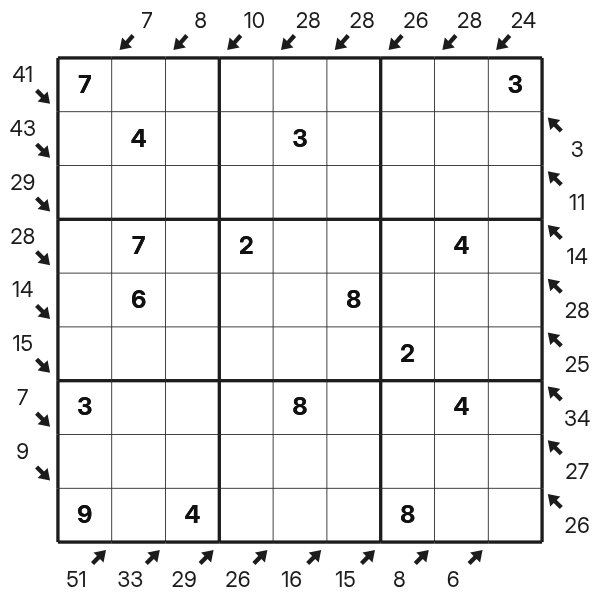
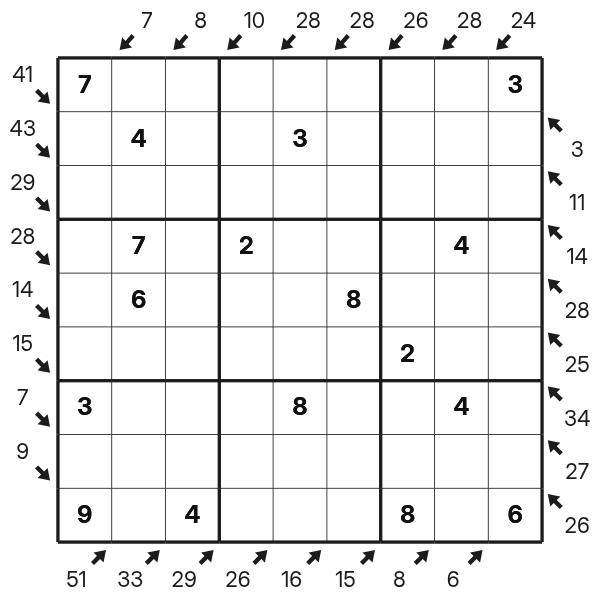
This step requires no further Sudoku logic. The diagonal sum consists of exactly one cell, which determines its value immediately.
2. Solve a two-cell diagonal with a known value
The clue 8 above the second column points down-left. Its diagonal consists of exactly two cells.
In the example puzzle, the first row is mostly complete, missing only the 2.
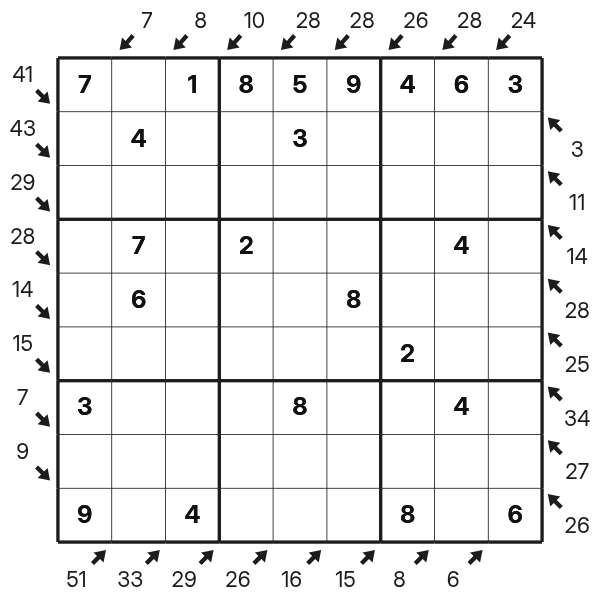
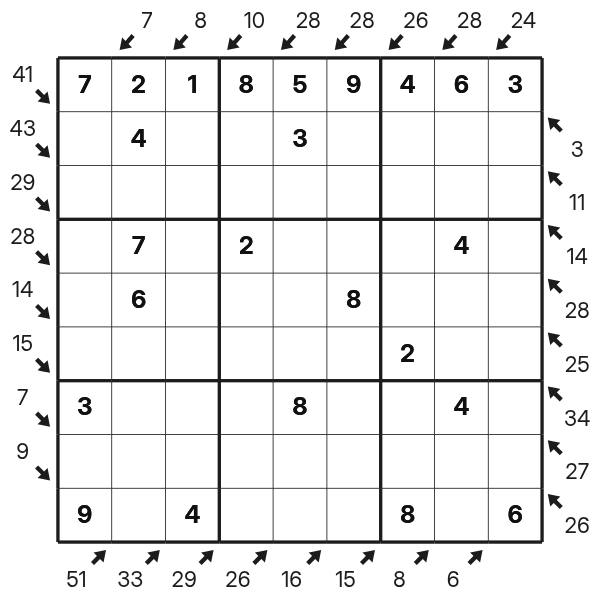
Now, using the 8 clues: the second cell on the diagonal must be a 6 since 2 + 6 = 8.
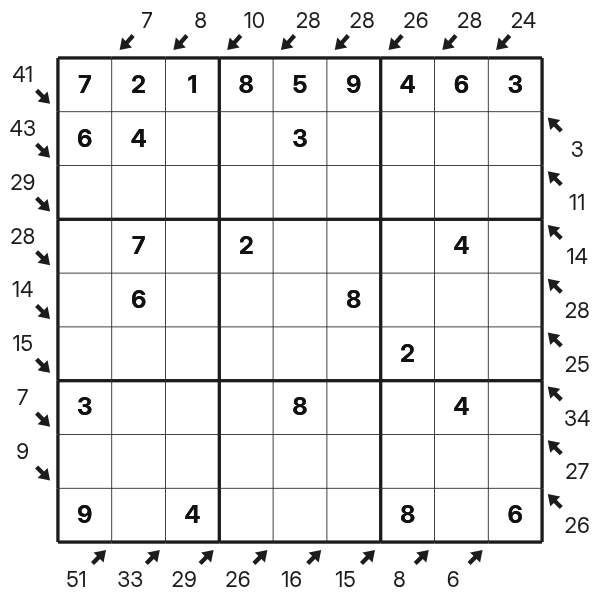
The order of the numbers here is not guessed. First, the Sudoku row determines the 2, then the diagonal sum unambiguously determines the 6.
3. Evaluate a three-cell diagonal
The clue 10 above the third column also points down-left. The associated diagonal consists of three cells.
In the example, 1 and 4 are already known. For the third cell in the diagonal, the equation is:
1 + 4 + ? = 10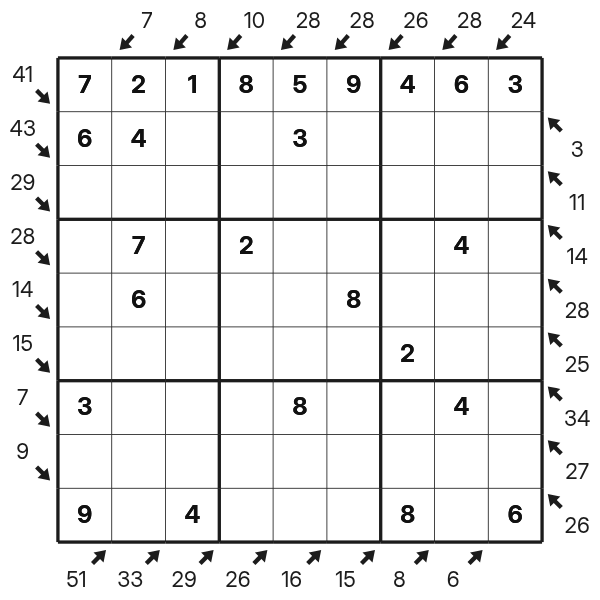
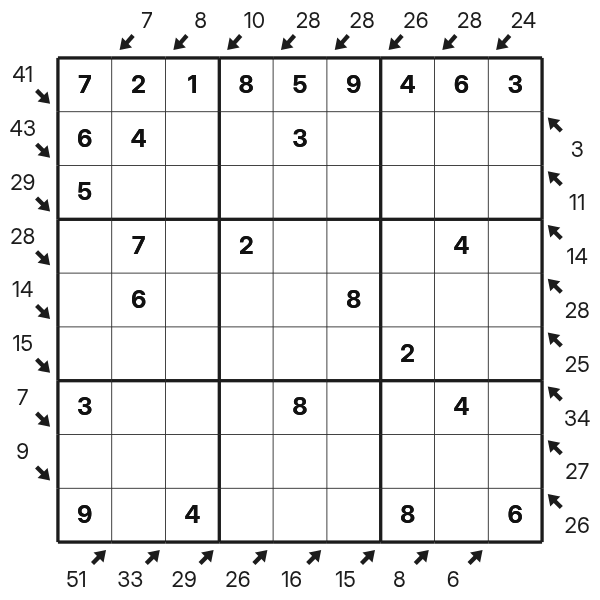
This step is also unambiguous. The two known values are subtracted from the sum of 10, leaving only 5 for the last cell.
4. Properly handle repetitions on a sum diagonal
A Little Killer diagonal is not an additional Sudoku region. The numbers on it do not all have to be different. Repetitions are allowed as long as the involved cells are not in the same row, column, or 3x3 block.
The clue 28 above the fourth column points down-left. The diagonal consists of four cells.
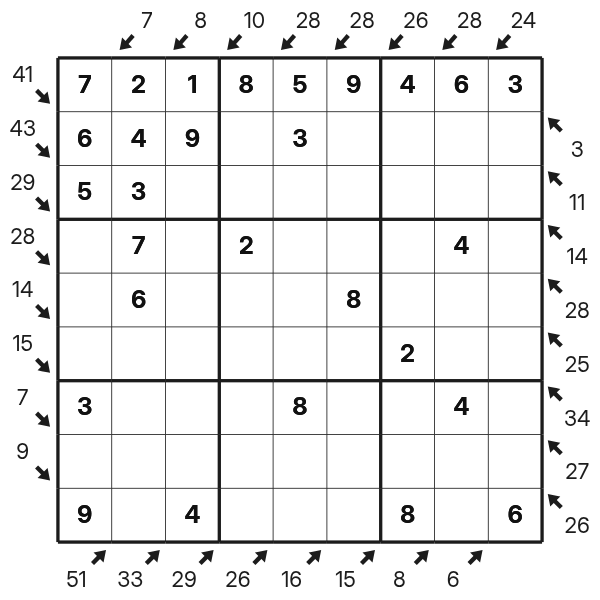
The following values are already known on this diagonal:
8, 9, 3, ?

8 + 9 + 3 + ? = 28
20 + ?= 28
The unknown cell is also an 8.
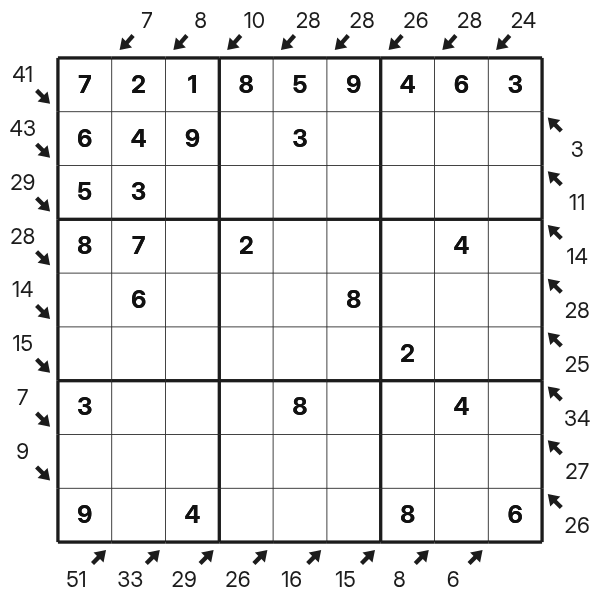
The two 8s are in different rows, columns, and 3x3 blocks, so repetition on the sum diagonal is permitted.
Typical solving process
- Enter the values of the four single-cell corner diagonals or confirm pre-given corner values.
- Check the two-cell diagonals next to the corners directly.
- Subtract known values from the respective sums.
- Combine the remaining sum with the normal rules for rows, columns, and 3x3 blocks.
- Next, work on the longer diagonals.
- Update each affected diagonal sum after a new entry.
- Only enter values that are clearly determined by the sum and Sudoku rules.
Common mistakes
- Misreading arrow directions and summing incorrect cells.
- Assuming all numbers on a sum diagonal must be different.
- Entering a mathematically fitting number that violates row, column, or block rules.
- Overlooking corner clues that could immediately provide a single value.
Tips for beginners
- Always start with the corners. There, the sum directly equals the corner value.
- Mentally mark each cell belonging to an arrow before calculating.
- Work from short to longer diagonals.
- Write down the remaining sum for longer diagonals.
- After each sum calculation, additionally check rows, columns, and 3x3 blocks.
- An appropriate sum alone is not sufficient if multiple number combinations or arrangements are possible.
Little Killer Sudoku combines standard Sudoku logic with diagonal sums. The safest entry points are the single-cell corner clues. Then, short diagonals are evaluated, and longer sums are gradually shortened step by step. It's crucial to follow each arrow precisely in its actual direction and to only enter numbers that can be uniquely deduced.