
Download puzzle & solution
Share puzzle
Our puzzles are completely free. Please support this website by recommending it to your friends and family. Thank you!
New puzzle
Masyu
Masyu is a Japanese loop puzzle. The playing field consists of a rectangular grid with black and white beads. The goal is to draw a single closed line that runs through the centers of the cells and visits all the beads.
The line only moves horizontally or vertically. It must not cross itself or branch and cannot visit the same cell twice. The two types of beads determine how the line must behave at their position.
Basic Rules
- A single closed loop must be formed.
- The line runs through the centers of the cells.
- The line moves only horizontally or vertically.
- The line must not cross, branch, or visit the same cell twice.
- The line must pass through every black and white bead.
- At a white bead, the line must go straight through.
- At a white bead, the line must turn immediately before or after the bead. It can also turn on both sides.
- At a black bead, the line must turn 90 degrees within the bead's cell.
- On both sides of a black bead, the line must continue straight in the adjacent cells.
- The loop must not close prematurely while beads remain outside.
Strategies for Solving
1. White beads on the edge determine the line direction
A white bead must be traversed straight. If it is at the top edge, the line cannot pass vertically through it because there is no cell above. It must therefore go horizontally.
The following example puzzle has two white beads in the first row. For both, the horizontal orientation is immediately clear.
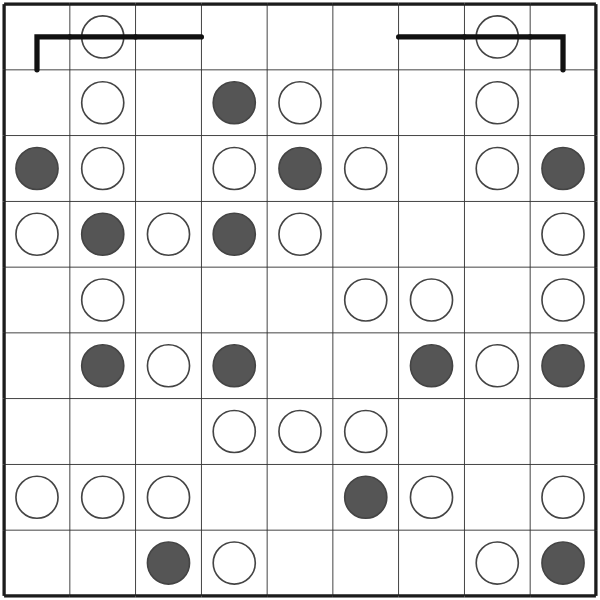
The three lines on the left show that the line passes through the cell left of the first bead, through the bead, and through the cell to the right. The same applies to the second bead at the right edge.
Due to the grid's corners, it is also already fixed which side of each bead the necessary curve must be on.
2. A black bead in a corner is fully determined
At the bottom right, there is a black bead in this example. At a black bead, the line must turn. In the corner, only two directions are available: up and left.
Additionally, the line must continue straight in the directly adjacent cells. This creates the following secure line segment:
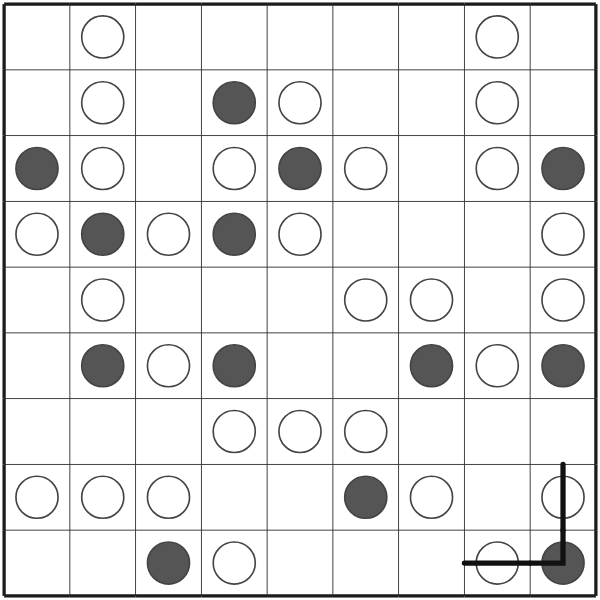
The line runs straight through the cell above the corner and also continues straight in the neighboring cell to the left.
3. A known arrival direction at a black bead forces the path forward
On the left, in the third row, there is a black bead in this example. Suppose a later solution state has already clearly shown that the line enters this bead from below.
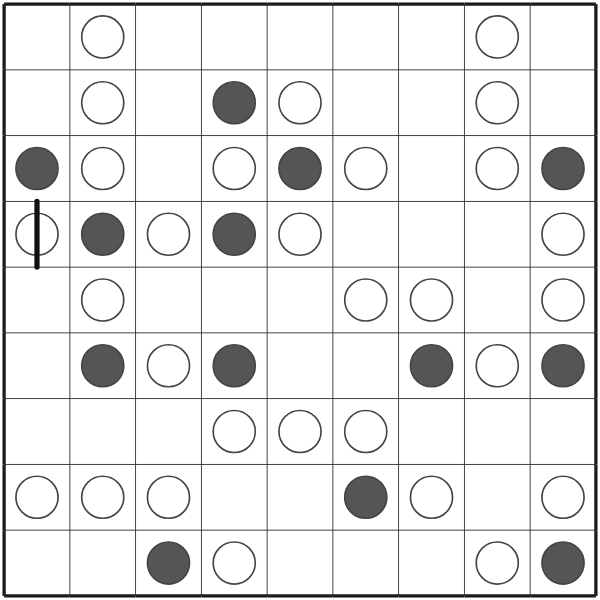
Since the bead is black, the line must turn there. It cannot continue to the left because of the grid border. It must turn right. Also, it must continue straight in the right neighboring cell.
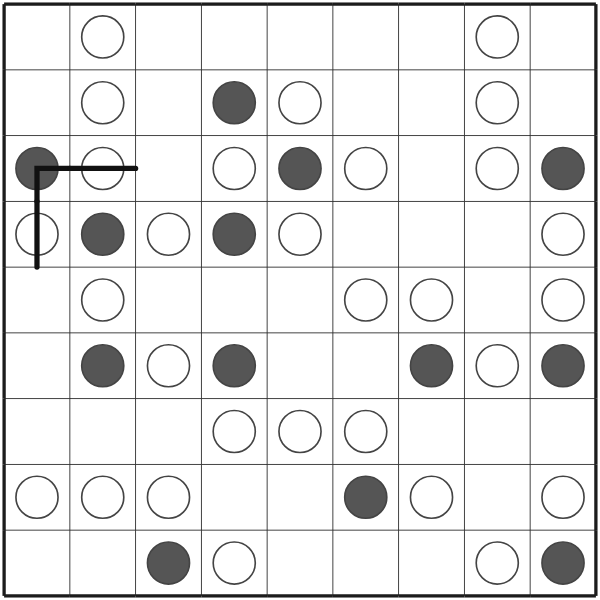
The conclusion is fully determined: entry from below, turn to the right, and a straight continuation through the next cell.
4. A white bead must not turn within the bead's cell
For white beads, the situation is exactly the opposite. The line must go straight through the bead's cell. A turn directly on a white bead is always excluded.
If another part of the loop already shows that the line enters a white bead from the left, it must exit again to the right. The necessary turn then must be located in the cell to the left or right of the bead.
This rule is particularly powerful when several white beads are adjacent. The line must go straight through each of them, while turns outside the beads must be placed outside.
5. Black beads force straight neighboring cells
A black bead not only determines the turn within its own cell. The two cells through which the line enters and exits cannot turn.
If the line turns immediately next to a black bead again, the black bead rule is violated. Consequently, possible directions can often be eliminated before determining which of the two turn orientations are used.
6. A small loop must not close prematurely
Connecting secure line segments might seem to create a closed loop. If beads remain outside thereafter, this connection is forbidden.
In such a case, the line must continue in another direction at an open point. The rule "exactly one loop through all beads" thus acts as an important global exclusion.
7. Avoid dead ends and branching
Each cell visited by the loop has exactly two line connections. A cell with only one connection would be a dead end; one with three connections would be a branch. Both are excluded.
If a line cell already has two secure connections, the other two sides cannot be used. If it has a secure connection and only one possible continuation, that continuation is mandatory.
Typical solution process
- Check beads on the edges and corners first.
- Set the possible straight line at white edge beads.
- Draw the fully forced curve at black corner beads and the straight neighboring cells.
- Transfer these lines to neighboring beads and check their rules.
- Use known entry directions at black beads to fix the curve.
- Ensure each line cell has exactly two connections.
- Prevent small closed loops while beads remain outside.
- Finally, connect all segments into a single loop.
Common mistakes
- Turning at a white bead directly within the bead's cell.
- Going straight at a black bead.
- Turning again immediately in the cell adjacent to a black bead.
- Forgetting the necessary curve beside a white bead.
- Closing a small loop while beads are still outside.
Tips for beginners
- Start with black beads in corners and white beads on edges.
- Mark not only the curve beside black beads but also the straight extensions.
- Explicitly check where the neighboring curve can be at each white bead.
- Use excluded line directions as consistently as the drawn lines.
- Check after each step whether the line can still form a single loop.
Masyu relies on the contrast between the two bead types: white means straight through the bead and the adjacent curve, black means a curve on the bead and straight adjacent. By cleanly combining these local rules with the global single-loop rule, you can construct the path step-by-step without guessing.