
Mathrax – Medium
Download puzzle & solution
Share puzzle
Our puzzles are completely free. Please support this website by recommending it to your friends and family. Thank you!
New puzzle
Mathrax
Mathrax is a number logic puzzle on a square grid. In a 6x6 puzzle, the numbers 1 to 6 are filled in such a way that each number appears exactly once in each row and column. There are no regions like in Sudoku.
At some intersections of four cells, there are circles with additional conditions. A circle with a number and arithmetic sign applies to both diagonal pairs surrounding the circle. For example, a hint 6+ means that both diagonal pairs must each sum to 6.
A circle with E requires all four adjacent fields to contain even numbers. A circle with O would require four odd numbers.
Basic Rules
- A number from 1 to 6 is filled in each cell.
- Each row contains the numbers 1 to 6 exactly once.
- Each column contains the numbers 1 to 6 exactly once.
- A circle is at the intersection of four cells.
- The diagonally opposite cells form two pairs of numbers.
- For an arithmetic hint, each of the two diagonal pairs must satisfy the indicated calculation.
- In case of addition, each pair must sum to the indicated total.
- In case of subtraction, the positive difference of each pair must match the hint.
- In case of multiplication, each pair must produce the indicated product.
- In division, the larger value divided by the smaller must give the indicated quotient.
- An E circle requires four even numbers.
- An O circle requires four odd numbers.
- The puzzle is solved when all rows, columns, and circle hints are satisfied.
Solving Strategies
1. An arithmetic circle applies to both diagonal pairs
In the example above, the 6+ circle in the top-left affects two diagonal pairs. In the following intermediate state, the second cell of the first row still lacks a number.
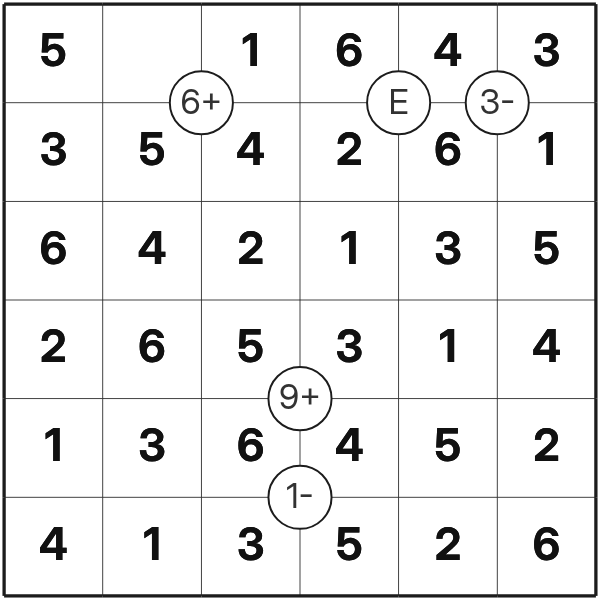
The first diagonal pair consists of the empty cell in the first row and the 4 diagonally right below. The 6+ hint requires:
? + 4 = 6Thus, the empty cell must be 2.
The second diagonal pair consists of the 1 in the first row and the 5 diagonally left below:
1 + 5 = 6Both diagonal pairs satisfy the same circle hint.
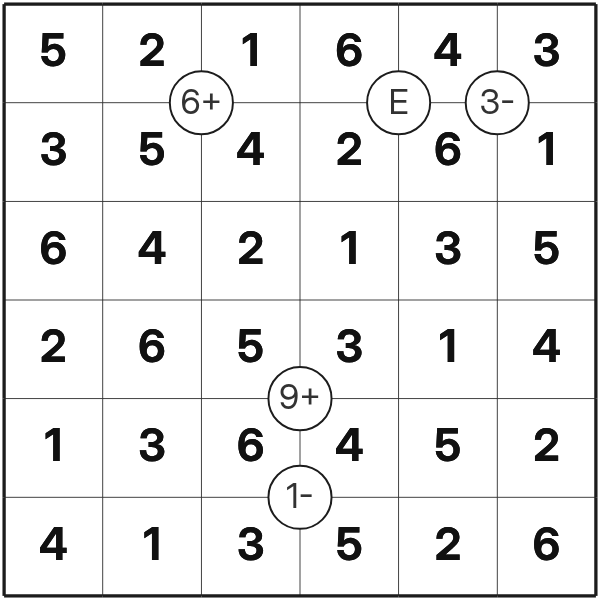
2. An E circle distinguishes between even and odd candidates
The E circle above in the middle touches four cells. All four must be even.
In the following intermediate state, the first row and the fourth column are missing the numbers 5 and 6, respectively. For the empty cell above, both candidates are initially possible.
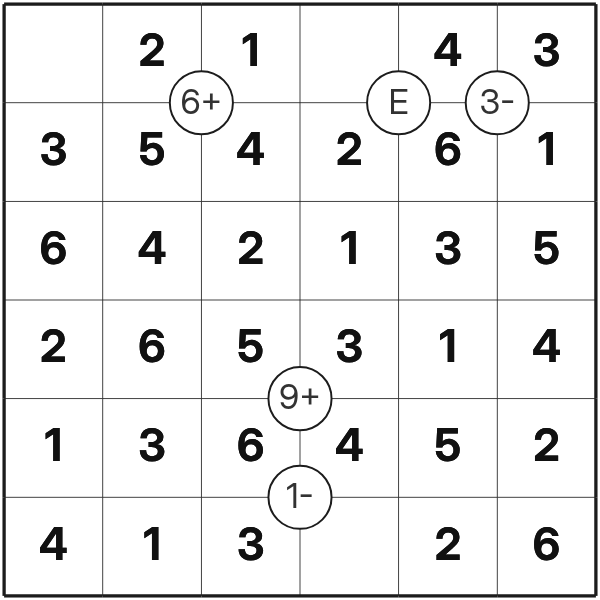
The considered cell is directly above the E circle. The 5 is odd and violates the parity condition. The 6 is even and remains the only option.
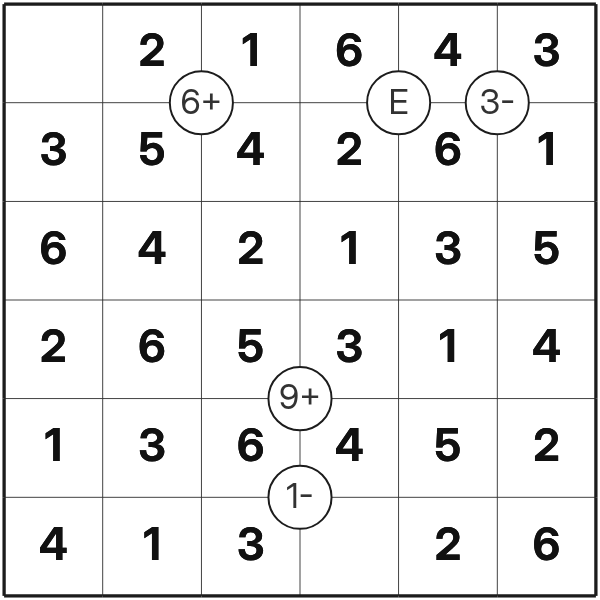
The E circle does not determine the exact value of all four fields alone. It acts as a candidate filter combined with row and column rules.
3. A difference can be unambiguously determined due to grid size
In the 3− circle in the top right, we consider the diagonal pair of 4 in the first row and the empty cell to the right below.
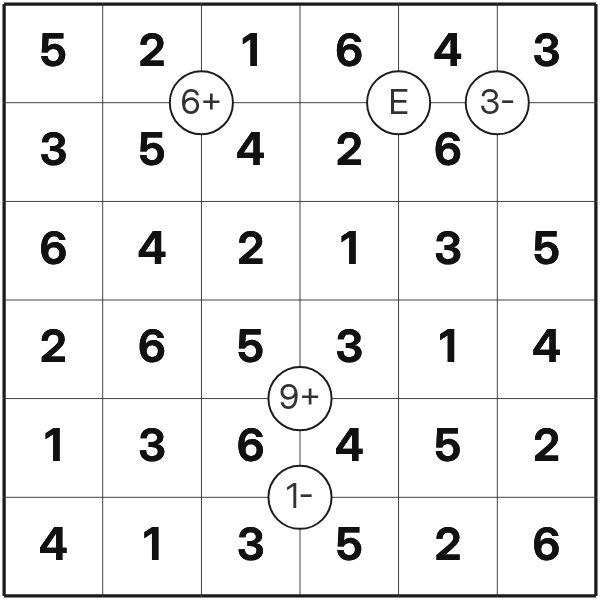
The positive difference must be 3. Calculations for 4 with 1 or 7:
4 - 1 = 3
7 - 4 = 3
However, only numbers 1 to 6 are allowed in the 6x6 grid; 7 is excluded. Therefore, the empty cell must be 1.
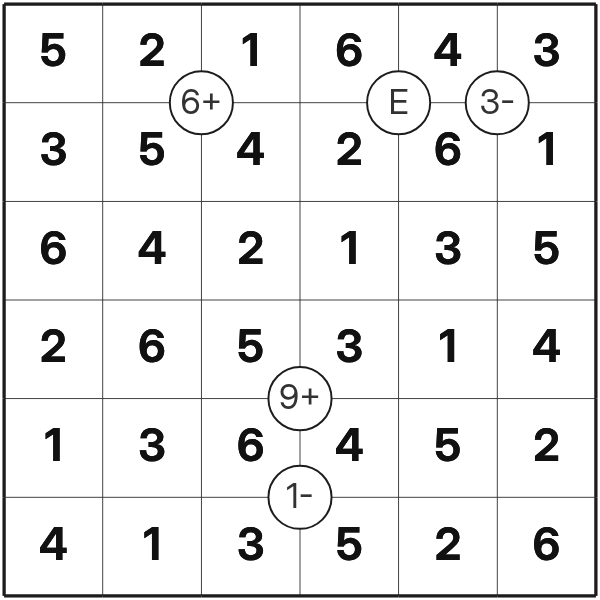
The second diagonal pair also confirms the hint: 6 and 3 have a difference of 3.
4. A 9+ circle can prepare for the next 1− circle
In the lower middle area, a 9+ circle and directly below a 1− circle are located. This allows one safe value to immediately generate a subsequent step.
For the 9+ circle, one of the diagonal pairs is still incomplete:
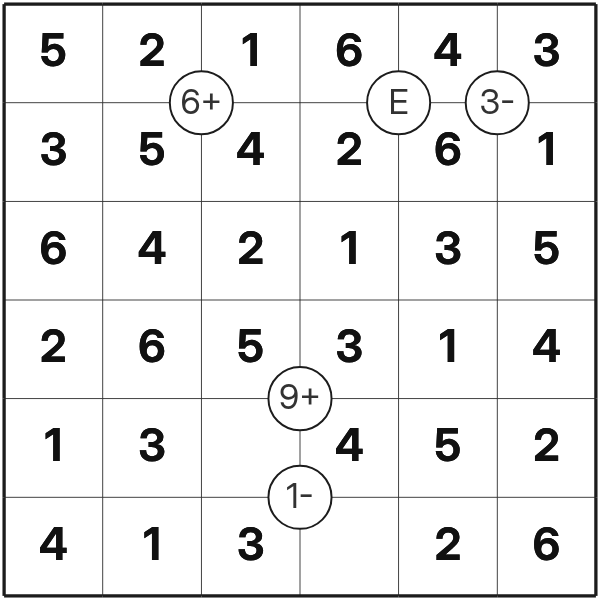
The 3 in the fourth row and the empty cell diagonally below must sum to 9:
3 + ? = 9Hence, the empty cell is 6.
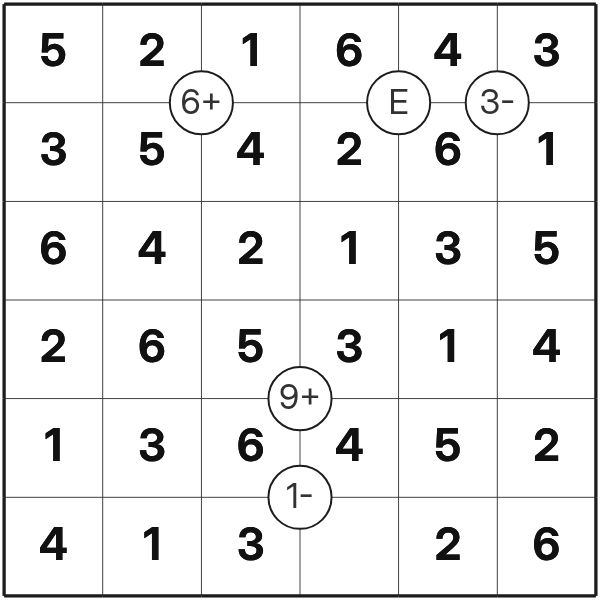
This new cell also belongs to the 1− circle below. It forms a diagonal pair with the still empty cell in the sixth row. The positive difference must be 1.
Matching with 6, possible values are 5 or 7. Since only 1 to 6 are allowed in the puzzle, only 5 remains.
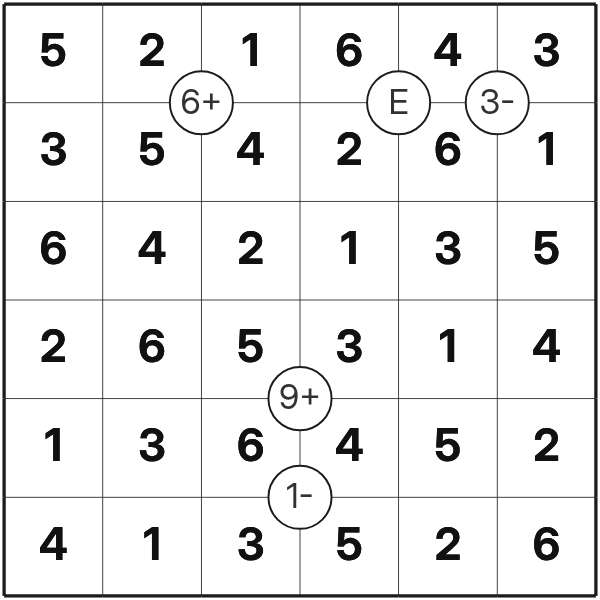
The first arithmetic hint immediately yields the next unambiguous entry.
5. Check both diagonal pairs separately
A common mistake is to sum all four cells together. A 9+-circle does not mean that the total sum of all four cells equals 9.
Instead, two separate equations must be satisfied:
top-left + bottom-right = 9
top-right + bottom-left = 9
The same principle applies for subtraction, multiplication, and division.
6. Rows and columns remain fundamental
The arithmetic circles do not replace the normal number logic. Each number can only appear once in each row or column.
A circle can allow multiple suitable values calculably. All values that already appear in the relevant row or column are then struck out. Only when exactly one possibility remains, the entry is certain.
Typical Solving Process
- Look for almost complete rows and columns.
- Check arithmetic circles where one diagonal pair already has a known number.
- Calculate potential partner values within the allowed range 1 to 6.
- Use E- and O-circles early as parity filters.
- Verify each candidate against its row and column.
- Immediately transfer a new value to the second diagonal hint if the cell is touched by multiple circles.
- Check both diagonal pairs for each circle separately.
Common Mistakes
- Calculating all four cells of a circle together.
- Checking only one of the two diagonal pairs.
- Using a negative difference for subtraction.
- Allowing results outside the range 1 to 6.
- Interpreting E as "equal" instead of "even".
- Forgetting that rows and columns are fundamental rules, not just the arithmetic condition.
- Rushing to guess when multiple calculable options exist.
Tips for Beginners
- Draw a mental X at each circle: check the two diagonals separately.
- Start with addition and subtraction, as potential partner values can be quickly determined.
- Actively use the limits 1 to 6. Many calculable alternatives are immediately eliminated.
- Mark all four cells as even for E circles and as odd for O circles.
- Ask yourself at each entry which circle rule and which row or column rule make it unambiguous.
Mathrax combines a Latin number grid with pairwise arithmetic conditions. The key is to analyze the two diagonal pairs of a circle separately and to combine each calculable possibility consistently with rows, columns, number range, and parity.