
Minesweeper – Medium
Download puzzle & solution
Share puzzle
Our puzzles are completely free. Please support this website by recommending it to your friends and family. Thank you!
New puzzle
Minesweeper
Minesweeper is a logic puzzle where mines must be found in the empty cells of a grid. The given numbers indicate how many mines are in the directly adjacent cells.
All eight possible neighboring cells are considered adjacent: horizontally, vertically, and diagonally. Number cells themselves do not contain mines. Unlike the well-known computer game, in a logic puzzle version of Minesweeper, all necessary clues are shown from the start, and mines are to be identified without guessing.
Basic Rules
- Each empty cell either contains a mine or not.
- Predefined number cells are safe and contain no mines.
- A number exactly indicates how many mines are in the neighboring cells.
- Horizontal, vertical, and diagonal neighbors are counted.
- An corner cell has at most three neighbors, an edge cell at most five, and an inner cell at most eight.
- If the required mine count of a hint is already reached, all other neighboring cells are safe.
- If the number of still unknown neighbors exactly matches the remaining mine count, all those cells are mines.
- The puzzle is solved when all mines are marked and all other cells are recognized as safe.
Strategies for Solving
1. When a hint has exactly as many possible cells as mines
In the following example, at the top right in the first row, there is a 2. Among its neighboring cells, some are already number cells and safe. Only two neighboring cells remain unknown: the cell directly to the left and the cell directly to the right.
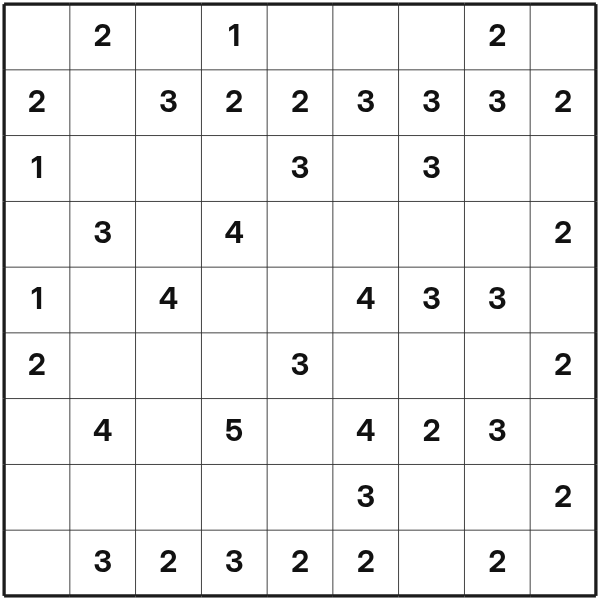
The 2 requires two mines, and there are exactly two possible cells. Both must be mines.
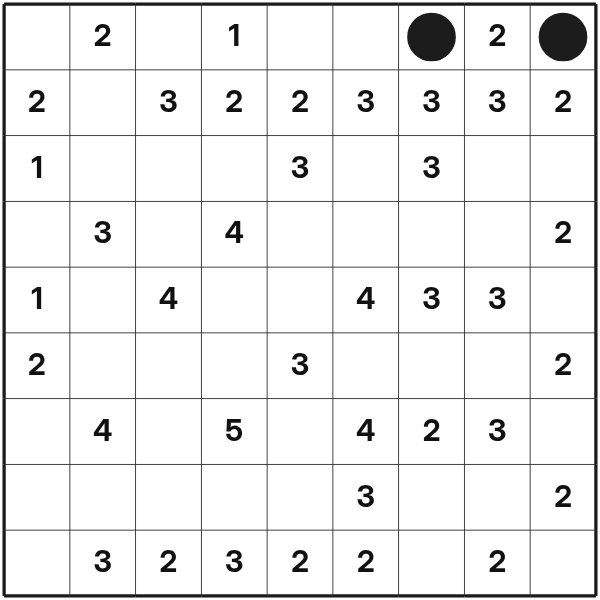
This conclusion is immediately clear: two mines are needed and exactly two unknown neighbors are present.
2. A hint at the bottom edge can set multiple mines simultaneously
In the last row of the following example, the fourth cell shows a 3. Since the hint is at the bottom edge, it only has neighbors in the same row and the row above.
The neighboring cells to the left and right in the same row are already number cells. Exactly three unknown neighbors remain: the three cells diagonally up-left, directly above, and diagonally up-right.
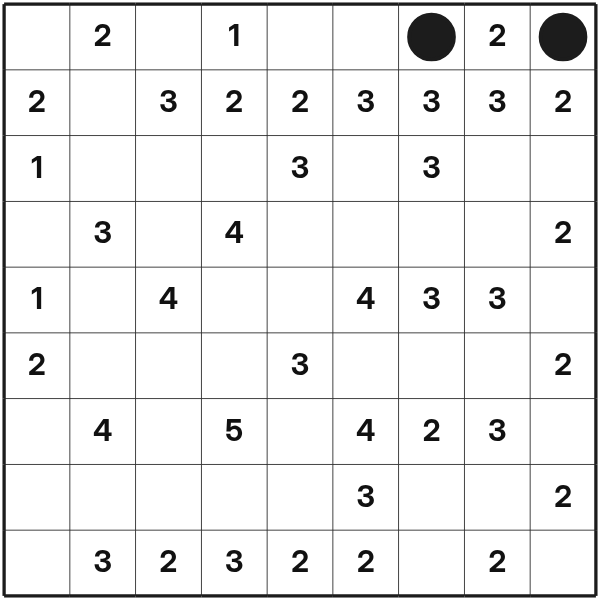
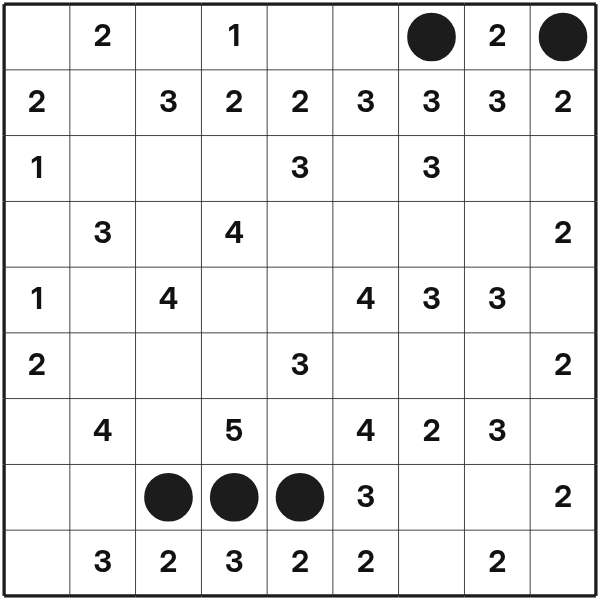
Because the hint states 3, all three cells must be mines.
3. When the mine count is reached, remaining cells are safe
Now let's look at the 2 in the third cell of the last row. Its neighbors include two of the mines just set in the row above.
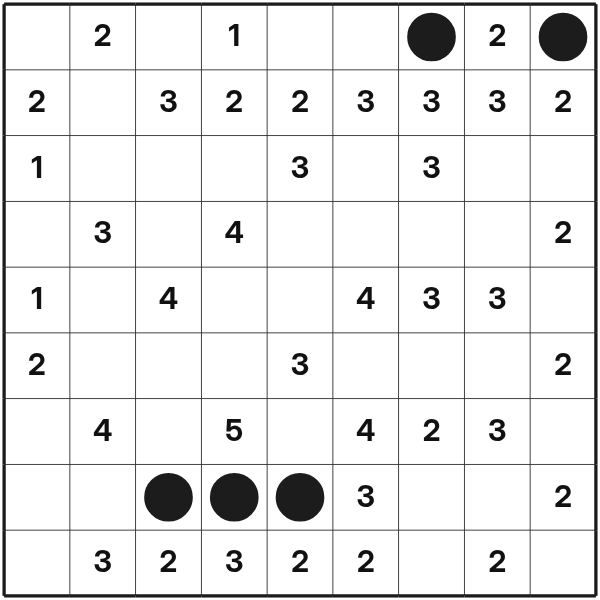
The 2 already sees exactly two mines. The still unknown cell diagonally up-left should therefore not contain a mine and is marked as safe.
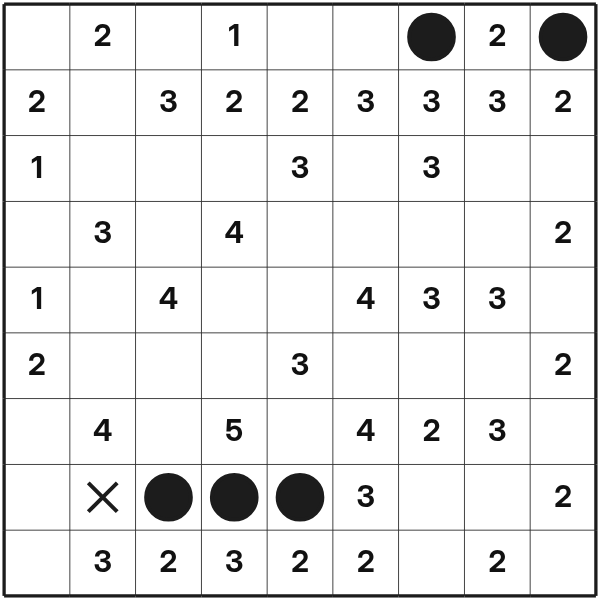
A satisfied number not only indicates mines but often also important safe cells.
4. Safe exclusions can fully determine the next hint
Next, consider the 3 in the fourth cell of the last row. In its neighborhood, one mine and one safe cell are already known.
The 3 sees the mine in the row above. The safe cell next to it does not count as a mine. Therefore, exactly two mines are missing, and only two unknown neighbor cells remain: the left cell in the row above and the left corner cell of the last row.
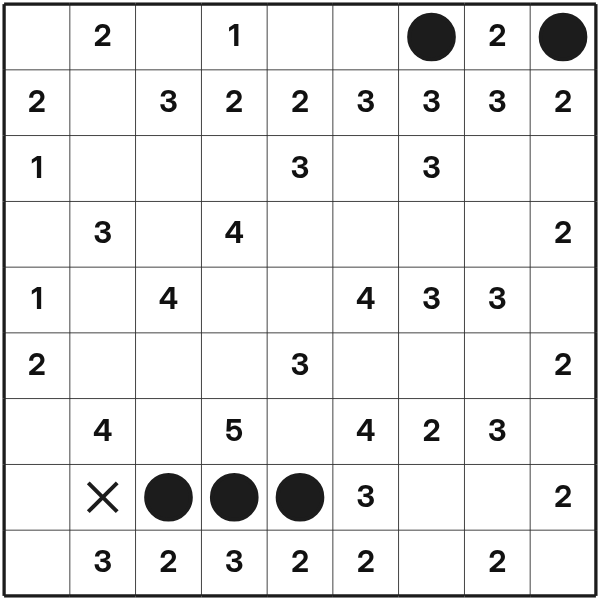
Both unknown cells must be mines.
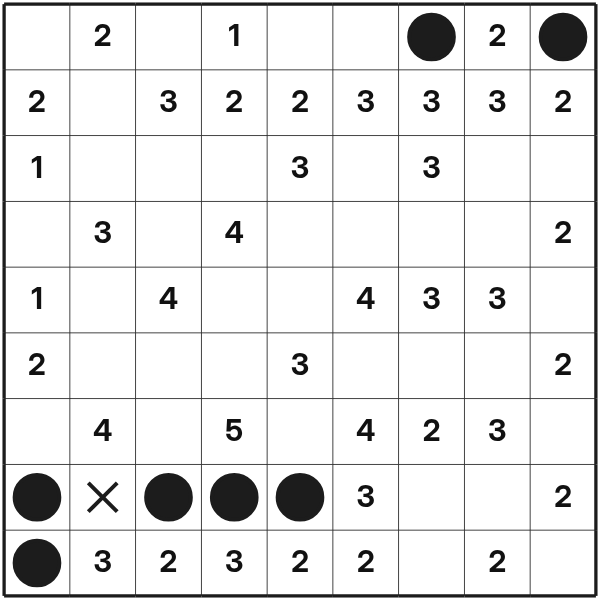
This subsequent step results from combining a known set of mines with a safe exclusion.
5. Comparing neighboring clues
Sometimes, a single clue does not give a direct conclusion. Then, two numbers with partially overlapping neighbors are compared.
Example: A 2 and an adjacent 3 see the same two unknown cells, and the 3 also sees a third cell. If the shared cells must contain exactly two mines, the additional cell of the 3 is safely a mine.
Conversely, an area can be safely identified if two clues with different neighborhoods still share the same remaining mine count.
6. Mark mines and safe cells consistently
Just marking mines is not enough. Safe cells reduce the number of potential neighbors, often creating new clear steps.
After each marking, each neighboring number clue should be re-checked:
- How many mines are already known?
- How many mines are still missing?
- How many unknown neighbors remain?
Typical solving procedure
- Look for clues whose number matches the count of their unknown neighbors.
- Mark all these neighbors as mines.
- Next, look for clues whose mine count is already reached.
- Mark all other neighbors of these clues as safe.
- Compare neighboring clues with overlapping neighborhoods.
- After each new mine and safe cell, check all adjacent number clues again.
- Repeat until all empty cells are definitively determined.
Common mistakes
- Not counting diagonally adjacent cells.
- Treating number cells as possible mines.
- Only marking mines and ignoring safe cells.
- Guessing when two possible distributions exist.
Tips for Beginners
- Start at corners and edges, where fewer neighbors exist.
- Keep a counter for each important clue: "Mines known / mines missing".
- Mark safe cells with your own symbol.
- Count each hint's neighborhood slowly and thoroughly.
Minesweeper is purely a neighborhood puzzle. Each clue provides an exact equation about its surrounding cells. By consistently placing mines, marking safe cells, and comparing overlapping clues, the entire grid can be solved without guessing.