
Download puzzle & solution
Share puzzle
Our puzzles are completely free. Please support this website by recommending it to your friends and family. Thank you!
New puzzle
Nonogram
A nonogram is a picture logic puzzle on a rectangular grid. Numbers to the left of rows and above columns describe contiguous groups of black cells. When all clues are correctly interpreted, a pixel image emerges from the filled cells.
Depending on the provider, the same basic mechanism is also known under terms like Picross, Pic-a-Pix, or Griddlers. This tutorial covers the classic black-and-white variant: each cell is either filled or definitely empty at the end.
The numbers are not coordinates. They indicate the lengths of black blocks in sequence. A clue like 3 1 2 means: first three contiguous black cells, then a single black cell, followed by a pair of black cells.
Basic Rules
- Each clue number represents a contiguous block of filled cells.
- Multiple numbers in a row are read from left to right; multiple numbers in a column are read from top to bottom.
- Between two consecutive black blocks, at least one empty cell lies.
- Any number of empty cells can lie before the first and after the last block.
- Each row and column must match its own sequence of clues simultaneously.
- A cross
xmarks a cell that is definitely empty.
Terms and Notation
A contiguous sequence of black cells is called a block. The minimum length of a line is obtained by adding all clue numbers and the required separators. For 3 1 2, this is 3 + 1 + 2 + 2, totaling eight cells.
The difference between the line length and the minimum length is the "playroom." The smaller this room, the more cells can be immediately determined. Any previously known black or empty cells further reduce this room later.
Strategies for Solving
Start by looking for large single numbers and clue sequences whose minimal length almost spans the entire row or column. Fill in sure empty and black cells consistently, as crosses limit possible block placements.
Switch your perspective after each entry. A cell found in a row provides new information for its column. The following seven steps illustrate this switch using an unambiguously solvable 15×15 nonogram.
In each line, consider not only the clue numbers but also the crosses and black cells already placed. These divide the line into smaller sections, restrict possible block positions, and can determine which clue block a black cell belongs to. Progress is possible even when no sequence perfectly fills the entire line.
Only work with certain intersections and exclusions. If multiple block placements remain possible, only fill cells that have the same state across all allowed positions. Everything else remains undecided for now and will be clarified by the cross-checking perspective later.
1. One clue fills the entire line
Line 2 has only the clue 15. Since the line is exactly fifteen cells long, there is no space before or behind the block. Any other arrangement would be too short or leave the grid.
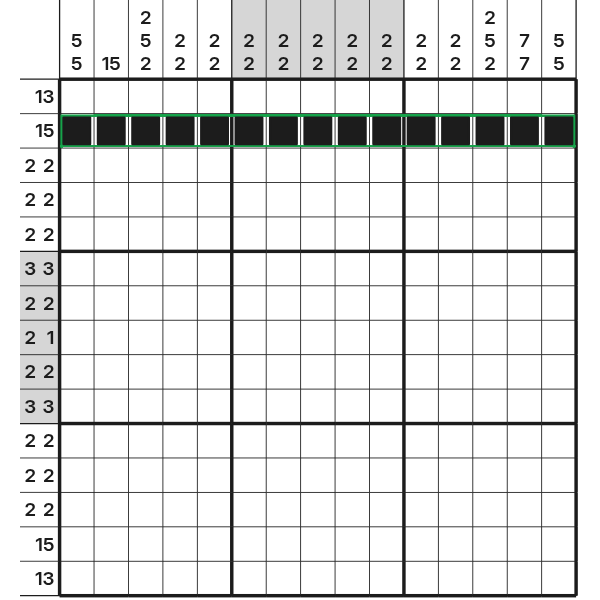
All fifteen cells in the second row are therefore black. Such complete lines are ideal starting points, because each new black cell immediately influences its column.
When a clue exactly matches the line length, guessing is not necessary: there is only one possible position for the block.
2. Multiple blocks fit exactly
Column 14 has the clues 7 7. Two seven-cell blocks require fourteen black cells; combined with the necessary separator, this fits exactly into the fifteen-cell column.
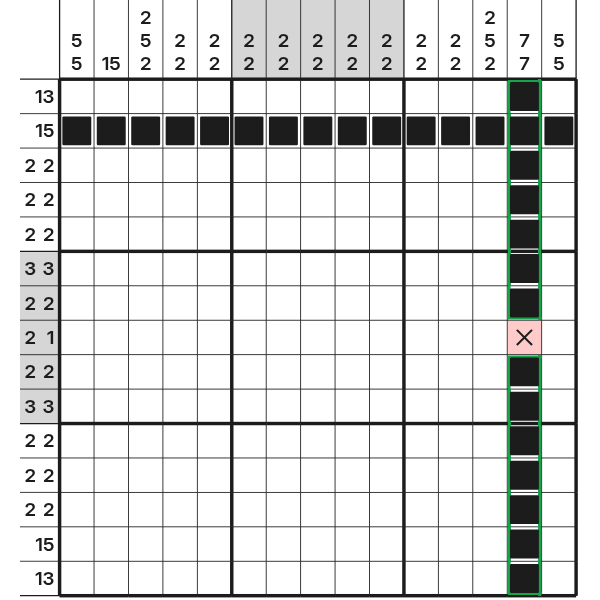
The first seven cells and the last seven cells are black. The cell in row 8, column 14 must be empty, as it separates the two blocks.
This technique applies to any precisely fitting sequence. Sum the block lengths and add separator cells between each adjacent pair. If the total equals the line length, the entire line is determined.
3. Overlap with a known anchor
Row 1 has the clue 13. The previous column step has already made cell in column 14 black. The thirteen-cell block must include this cell and can only start in column 2 or 3.
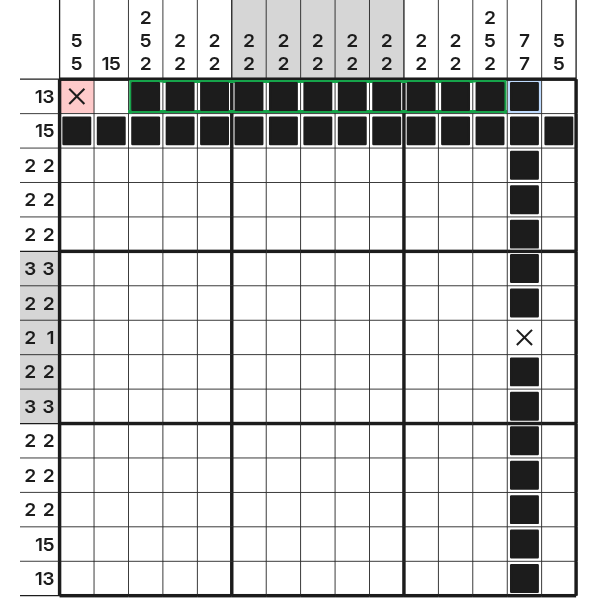
Both possible placements overlap columns 3 to 14. Therefore, the new cells in columns 3 to 13 are definitely black. Column 1 is not in any permissible position and is excluded with a cross.
This is the overlap technique with an anchor: move the block mentally as far left and right as possible without violating known information. The intersection of all positions is surely filled.
4. Limit a complete block
Column 2 has the clue 15 and is made fully black by the earlier method. Now, row 1 contains exactly thirteen contiguous black cells from column 2 to 14—the only required block is complete.
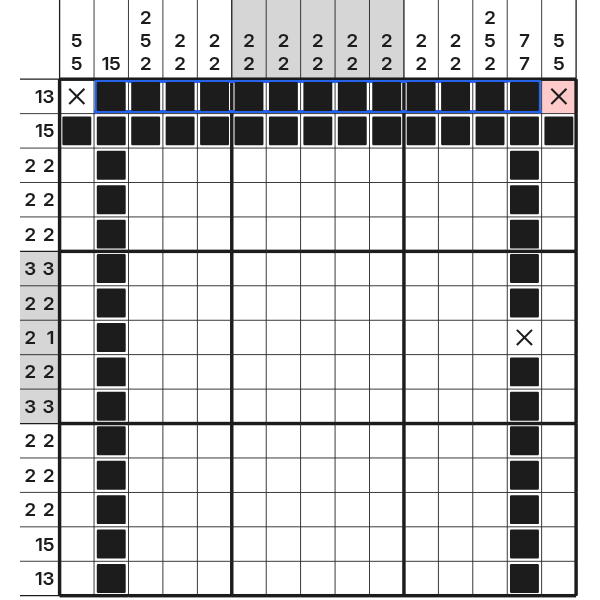
The cell directly to the right, in row 1, column 15, must be empty. If it were black, the block would be fourteen cells, contradicting the clue 13.
Immediately mark boundary cells reachable after completing a block with crosses. This prevents two separate blocks from accidentally merging, especially with multiple clues.
5. Two known blocks exclude the middle
Row 3 has the clues 2 2. Black cells in columns 2 and 14 are already known from the columns. Due to their distance, they cannot belong to the same pair of twos; each anchors one of the blocks.
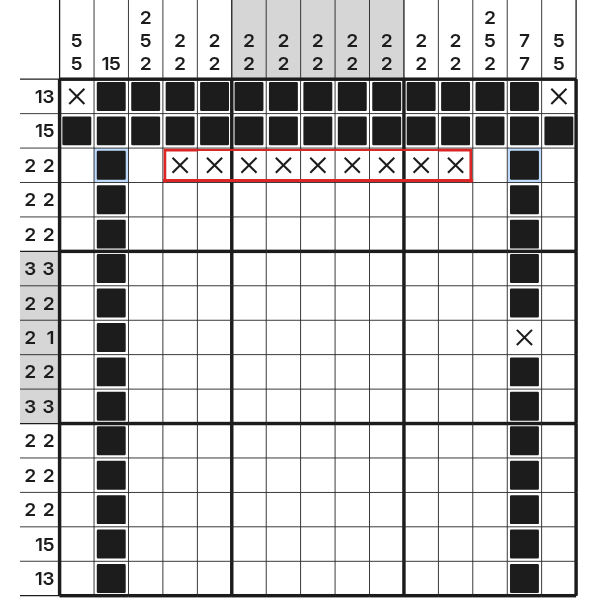
The left pair can only occupy columns 1–2 or 2–3. The right can only be in 13–14 or 14–15. No block can reach any field between columns 4 and 12.
The entire middle area is safely marked empty. Exact positions of the two pairs remain open, but the unreachable cells are already decided.
6. Complete clues and re-evaluate the rest
Column 3 has the clues 2 5 2. The first two rows already contain two connected black cells. Since the sequence starts with a pair block and there's no room above, this first block is complete.
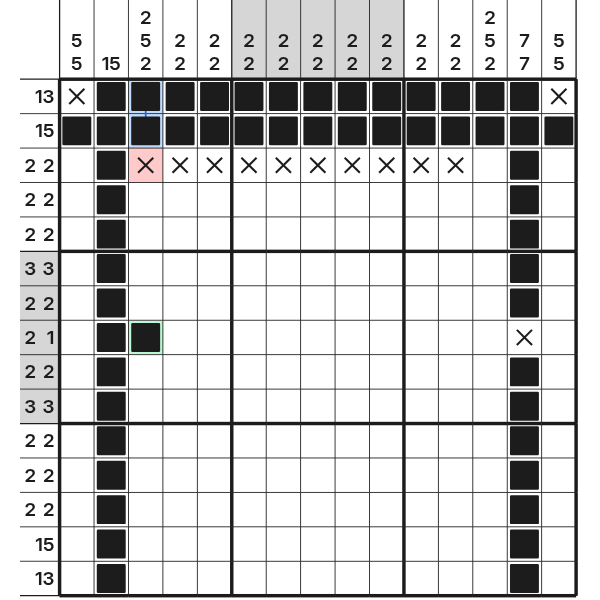
Cell in row 3, column 3, must be an empty separator. The remaining clues 5 2 have twelve cells left. The five-cell block can only be shifted to include row 8, column 3 in all possible positions; this cell then is black.
This step combines two core ideas: finalize a completed block with a cross, then only consider the remaining clues in the remaining line section. This makes long clue sequences manageable.
7. Extend a block from a blocked side
In row 3, the clues 2 2. The black cell in column 2 belongs to the first pair block; the adjacent cell in column 3 is already marked empty. The block cannot extend further to the right.
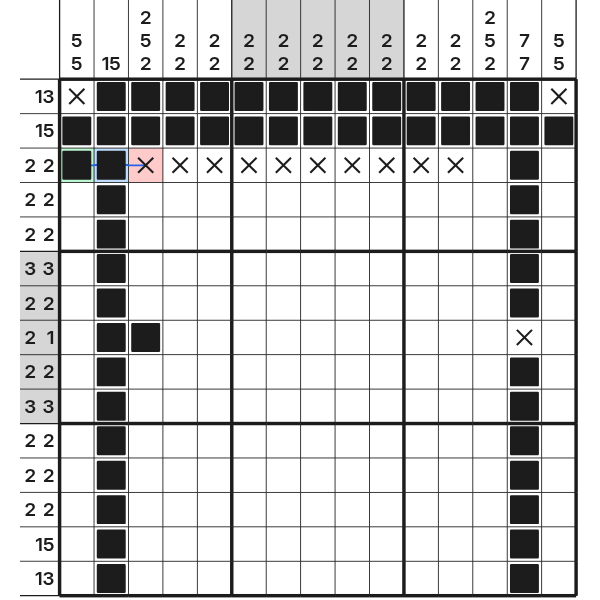
A pair block needs another black cell besides the one in column 2. Since there's a cross to the right, only column 1 remains. Mark cell in row 3, column 1 as black and the first pair block is complete.
This boundary reasoning also works in the middle of a line: once a black cell belongs to a specific clue block and a side is blocked by a cross or grid edge, the remaining part of the block must grow toward the other side. Check the open outer side for a necessary separator.
Typical Solution Process
- Calculate the minimum length of conspicuous lines from block lengths and separator cells.
- Fill lines exactly matching their clues completely.
- Use overlap of the outermost possible positions for large blocks.
- Immediately mark sure empty cells and boundaries of completed blocks with crosses.
- Switch perspectives between rows and columns after each step.
- Mentally dismiss completed clues and re-examine the remaining line section.
- Before filling, verify that the order of all blocks remains consistent.
Common Mistakes
- Forgetting separator cells: Two blocks in a row must not touch in the black-and-white variant.
- Mixing up order: Clues must not be placed arbitrarily; their sequence is fixed.
- Not marking empty cells: Undecided and certainly empty cells must be distinguishable.
- Deciding a block too early: Overlap often only proves the common core, not the exact start and end points.
- Working in only one direction: Many progressions result from constantly switching between rows and columns.
Tips for Beginners
- Start with the largest number or the smallest remaining gap, not necessarily with the first line.
- Count including separator cells and double-check longer gaps.
- Use crosses consistently as strict boundaries for future block placements.
- If a line stalls, do not guess; switch perspective to the crossing direction.
- When a black cell is known, check which clue block it can belong to.
Conclusion
Nonograms are solved by placing, overlapping, and constraining blocks. Confirmed black and empty cells are equally valuable: together, they reduce the possible arrangements of crossing lines until each clue sequence has only one feasible configuration and the hidden image fully appears.