
Download puzzle & solution
Share puzzle
Our puzzles are completely free. Please support this website by recommending it to your friends and family. Thank you!
New puzzle
Paint by Pairs
Paint by Pairs is a picture logic puzzle where the same numbers are connected in pairs by paths. Each completed path is colored in; from all the colored path cells, a hidden pixel image ultimately emerges.
The same puzzle type is often called Link-a-Pix and is also known as Number Net by some providers. This tutorial covers the black-and-white version. In colored editions, the color of the clues and paths is additionally a condition.
The number does not describe the geometrical distance between the two endpoints, but the total number of cells in the path. Both number cells are included in the count. A path with the number 5 thus includes the two endpoint cells and exactly three other cells.
Basic Rules
- Each number greater than
1is connected to exactly one identical number. - The connecting path contains exactly as many cells as the number indicates. Both number cells are included in the count.
- A path runs only horizontally or vertically from cell to cell; diagonal steps are not allowed.
- A path may not use a cell twice and may not cross over another number except as part of the path.
- Different paths may not share cells or cross each other. However, in the black-and-white version used here, they may lie directly next to each other.
- A
1has no partner. It forms a one-cell path and is immediately colored in. - Cells that do not belong to any path remain white. All path cells together form the image.
Solving Strategies
Start with 1 and 2, then with pairs whose endpoints are exactly n - 1 steps apart. In case of multiple occurrences of the same number, first check which partners are reachable at all. Only when the pairing is fixed do you examine the possible routes.
Consider each foreign number and each already drawn path as an obstacle. After each bend, count the used cells and the remaining steps to the target. This way, you can early identify if a route is too short, too long, or impossible due to parity.
The following ten steps use the same uniquely solvable 15×15 puzzle. The images build upon each other; rules shown before the last image were repeated for the other pairs.
1. Ones are completed single-cell paths
In the grid, four clues with the value 1 are present. Such a clue has no second endpoint: the number cell itself is already the complete, one-cell-long path.
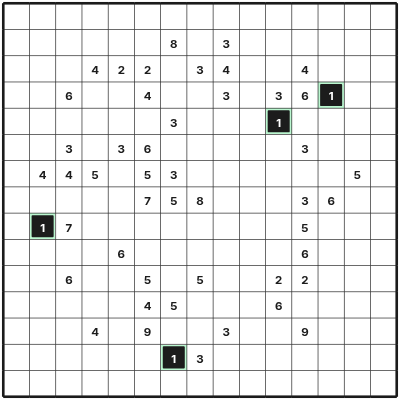
All four ones are immediately colored in. There is no alternative route, because an additional cell would exceed the allowed length.
Ones are not only free start cells. When occupied, they later block potential routes of other pairs.
2. Adjacent twos are directly connected
In row 3, columns 5 and 6, there are two adjacent twos. A path of length 2 has exactly two cells and only one step between its endpoints.
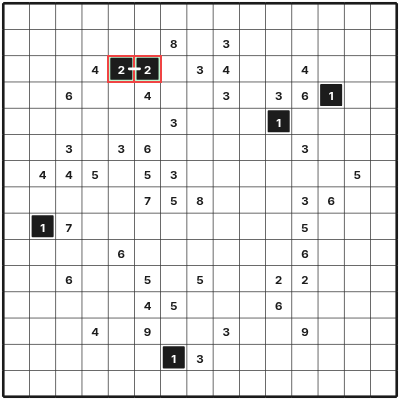
Thus, the two number cells form the entire path. A bend or detour would require at least two additional steps and would be too long.
In the case of twos, a complete scan of the grid is worthwhile: only orthogonally adjacent identical numbers can form a pair; diagonal neighbors are not directly connected.
3. Exact distance results in a straight path
The threes in row 6, column 3 and row 6, column 5 are two steps apart. A three path also requires exactly two steps because it consists of three cells including endpoints.
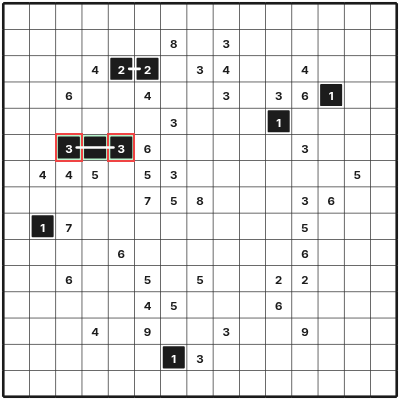
No step remains for a detour. The cell in row 6, column 4 must be between the two endpoints, creating a straight three path.
If Manhattan distance and required number of steps match, each step only brings you closer to the target. For endpoints in the same row or column, the route is thus fully determined.
4. Find the only reachable partner first
The 3 in row 4, column 11 can reach only the 3 in row 4, column 9 within two steps. All other threes are too far away or have an incorrect distance.
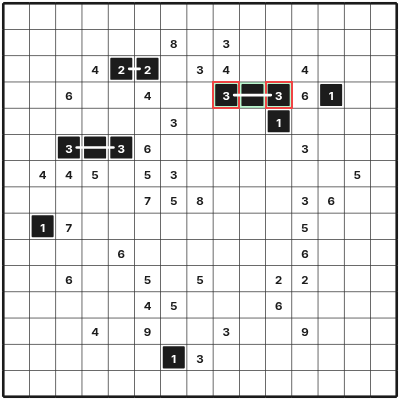
This fixes the pairing. Since both numbers in the same row are exactly two steps apart, the route is also immediately clear: the field in row 4, column 10 is in between.
Think of two questions separately: which identical number is the partner, and which cells does the path use? Sometimes, reachability answers both questions at once; sometimes only the first.
5. A foreign clue forces a bend
After fixing the previous three-path pair, in the upper area the 3 in row 2, column 9 and the 3 in row 3, column 8 are connected. Their distance is two steps, so a shortest path with exactly one bend must exist.
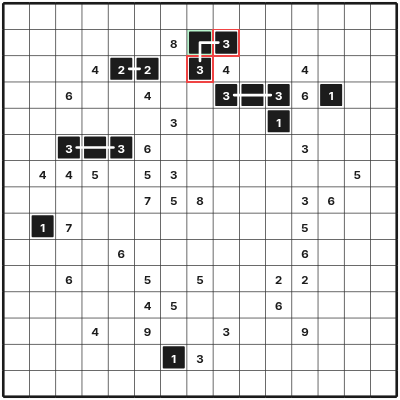
The middle cell could geometrically be either row 2, column 8 or row 3, column 9. The second cell contains a 4 and must not be used as an internal cell of a three-path. Only row 2, column 8 remains.
Other numbers are thus not neutral grid cells. They are endpoints of their own paths and block any route to which they do not belong as a suitable endpoint.
6. Exclude blocked shortest routes
The two fours in row 3, column 4 and row 4, column 6 are three steps apart. Exactly three steps are available for a four path. The first step to the right would lead to the foreign 2 in row 3, column 5.
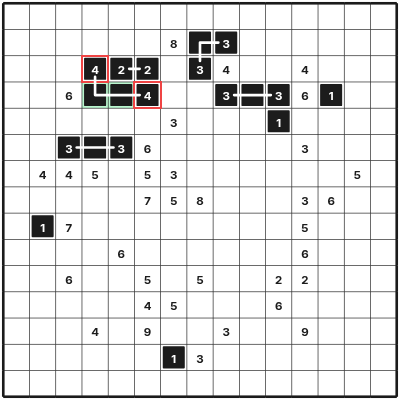
This rules out all shortest routes starting to the right. The path must first go down and then twice to the right. The two internal cells in row 4, columns 4 and 5 are safe.
With exact distance, systematically test possible step sequences. As soon as a necessary step hits a foreign clue or completed path, the entire route is excluded.
7. Adjacent fours need a detour
The fours in row 7, columns 2 and 3 are directly adjacent. The direct distance is only one step, but a four path requires three steps. Exactly two additional steps must be added as a small detour.
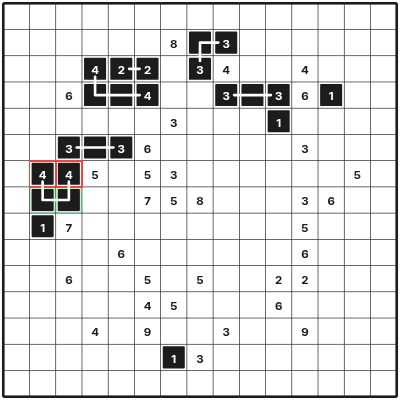
This path can only bypass the number pair on one side in the form of a U. Above, in row 6, column 3, there is a foreign three clue that blocks the upper detour. Therefore, the path goes via row 8, columns 2 and 3.
The parity explains why exactly a two-step detour is necessary: paths always run over an odd number of steps from a cell to its neighbor. Three steps are possible, but two or four are not.
8. Recognize an unreachable attractive partner
For the 5 in row 7, column 4, initially both the 5 in row 7, column 6 and the one in row 8, column 7 seem reachable. The second candidate is exactly four steps away, so only shortest routes would be allowed.
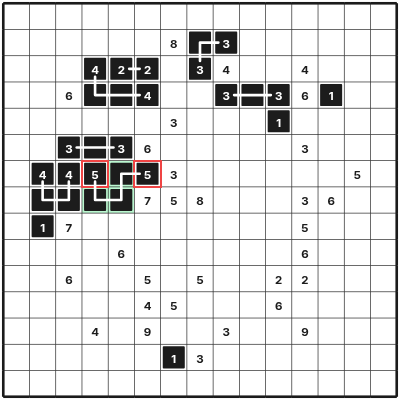
Each of these shortest routes to the cell in row 8, column 7 encounters another clue beforehand, especially the clues in row 8, column 6 or in row 7, columns 6 and 7. This candidate is completely eliminated.
Therefore, the partner is the 5 in row 7, column 6. A two-step detour is necessary between it and the start point; the clues above block it, so the five path runs via the three marked cells below.
9. Read a long path as an exact corridor
The 8 in row 2, column 7 has only the 8 in row 8, column 8 as a matching partner. Six rows down and one column to the right, it results exactly in the required seven steps.
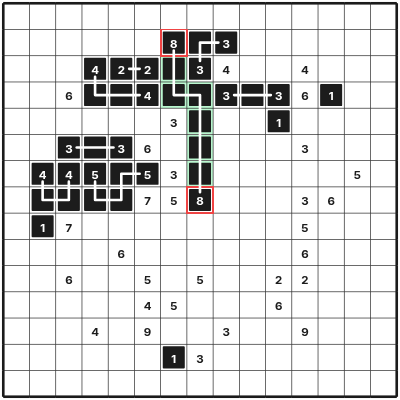
The path must not detour and must change exactly once to the right. An earlier change would hit the three clue in row 3, column 8; a later change would be blocked by other clues in column 7. Only the change in row 4 remains possible.
For long paths with exact distance, it's helpful not to draw every route completely. Instead, determine at which points the rare horizontal or vertical step can actually occur.
10. The last path completes the picture
After applying the same reach, obstacle, and length checks to the remaining numbers, the last open pair is the six in row 10, column 12, and the six in row 12, column 11. All other paths are already occupied and cannot be entered anymore.
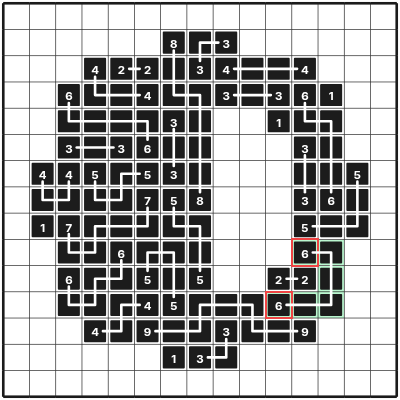
The only free route with exactly six cells passes through row 10, column 13, then row 11, column 13, and continues through row 12, columns 13 and 12, to the endpoint in column 11. Any other bend hits a completed path or cannot reach the target with the remaining steps.
With this final path, all numbers are used exactly once. The colored cells form a sun; the light lines still show which adjacent black cells belong to different paths.
Common Mistakes
- Only counting cells between numbers. Correct is: both number cells belong to the path length.
- Matching identical numbers automatically connect to the next visible instance. For multiple occurrences, the pairing must be logically determined.
- Diagonal steps are allowed. Paths must run solely horizontally and vertically.
- An unrelated number cell is used as a passage. Numbers can only be endpoints of their own matching path.
- A path is drawn longer than allowed because the starting point was forgotten in counting.
- A completed path is reused by a later path. Each grid cell can belong to at most one path.
- Only the distance is checked, not the parity. A detour always extends an orthogonal path by two, four, or more straight steps.
A systematic workflow
- Color all ones and connect directly adjacent twos.
- Calculate the Manhattan distance for identical numbers and cross out too distant or parity-mismatched partners.
- Look for a clue for which only one partner is reachable.
- Compare the required
n - 1steps with the distance of the endpoints. - Consider all foreign numbers and completed paths as obstacles.
- Draw a path completely only when pairing and route are fixed; otherwise, only record safe partial segments.
- Repeat the check after each path is completed, as new blocks may exclude further routes.
- At the end, verify that each number is used, each path length is correct, and no cell is doubly occupied.
Tips for Beginners
- Mentally keep a remaining step budget: after
kcells are used,n - ksteps remain to the endpoint. - Start working in areas with many numbers. Close clues create useful obstacles and often make routes clearer.
- If multiple routes remain, check their common cells. A cell appearing in all permissible routes can be reliably secured before the entire path is drawn.
- Do not confuse the emerging picture with a rule. The shape can be a control but should never justify an undecided route.
Brief Summary
Paint by Pairs connects identical numbers with orthogonal paths of specified lengths. Reliable solutions arise from reachability, parity, blocking clues, already occupied cells, and remaining length budget. By separately checking pair selection and route choice, the pixel picture emerges one path at a time without guessing from the grid.