
Rossini Sudoku – Hard
Download puzzle & solution
Share puzzle
Our puzzles are completely free. Please support this website by recommending it to your friends and family. Thank you!
New puzzle
Solve Rossini Sudoku: Rules and Strategies
Rossini Sudoku is a variation of Sudoku. Arrows on the edge describe the order of the three nearest cells in a row or column.
In the arrow direction, the three values strictly increase; the arrow tip points towards the largest number. If an arrow is missing on a side, the three border values there are neither strictly increasing nor strictly decreasing.
The goal is a completely and correctly filled puzzle. Each entry must be derived from the visible clues and the already placed numbers.
Rules
- The grid consists of 9 rows, 9 columns, and nine 3×3 blocks.
- In each row, the numbers 1 to 9 appear exactly once.
- In each column, the numbers 1 to 9 appear exactly once.
- In each 3×3 block, the numbers 1 to 9 appear exactly once.
- An arrow on the edge refers to the three closest cells in the same row or column.
- In the arrow direction, the three numbers are strictly greater; the arrow tip points to the largest number.
- The numbers do not have to be consecutive. A sequence like 1, 3, 7 is allowed.
- If an arrow is missing on a side, the three border numbers from there cannot be strictly increasing or decreasing.
- Given numbers are not changed.
- The puzzle is solved when all Sudoku rules and all existing and missing border clues are fulfilled.
Orientation in the grid
Counting is only done within the inner 9×9 solution field: rows from top to bottom, columns from left to right. For a pair of numbers, the first number indicates the row, the second the column; (4,7) is in row 4, column 7. Border clues are not part of the solution field.
The images show specific intermediate states. Blue marked cells are used for the step, red means excluded, and green shows a confirmed result. Yellow highlights the currently examined cell.
Basic idea when solving
First determine the normal Sudoku candidates. Then read the three border cells in the arrow direction and cross out values that do not fit the order. A side without an arrow also provides an exclusion.
After each confirmed entry, check the affected row, column, block, and all additional clues again. Often, this already reveals the next step.
1. Numbers do not have to be consecutive
A Rossini arrow only requires a fixed order. There can be gaps between the numbers. The left arrow in the picture points to the sequence 2 < 3 < 5 in row 6. The lower arrow in column 1 points to 4 < 6 < 8.
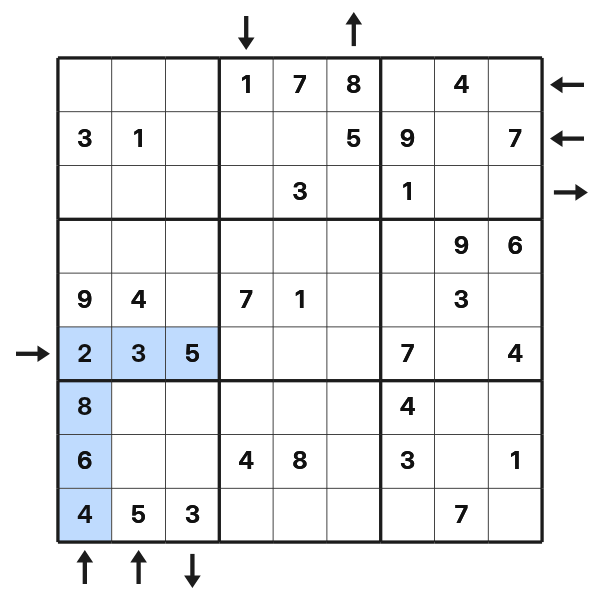
Both sequences are valid. It is not necessary for 2, 3, 4 or 4, 5, 6 to be present. The only important thing is: each value is greater in the arrow direction than the previous one.
2. Read an arrow from the correct side
The arrow next to row 1 starts at the right edge. Therefore, the three cells are read from right to left: (1,9), (1,8), and (1,7). They contain 3, 4, and 6.
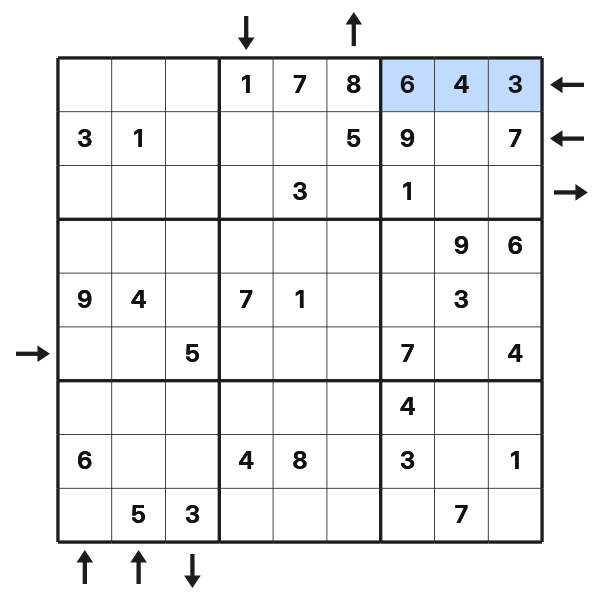
In the arrow direction, this is 3 < 4 < 6. From left to right, you see 6, 4, 3; the same sequence in reverse reading order. The arrow only affects these three border cells, not the entire row.
3. Derive simple bounds from position
The arrow points downward over column 4. Therefore, the three values are increasing from top to bottom. The sequence is 1 < 6 < 9.
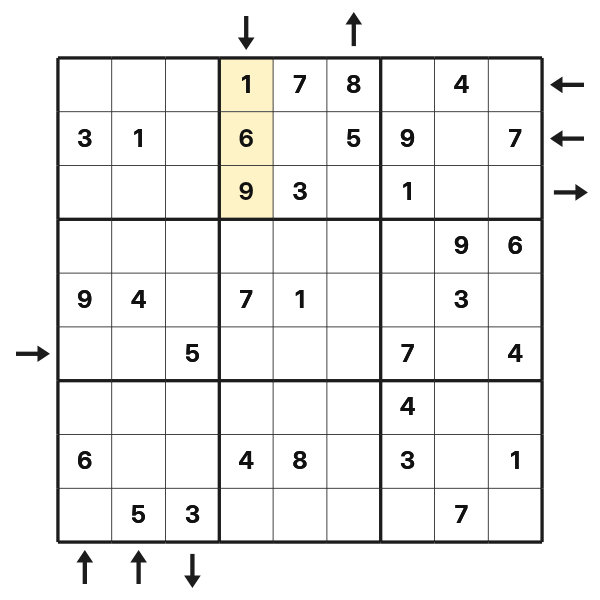
Even without precise numbers, fixed bounds apply: The first value can be at most 7 because two larger values must follow. The middle value cannot be 1 or 9. The last value is at least 3 because two smaller values must precede it.
4. Decide between two candidates using an arrow
In column 4, the first two arrow values are 1 and 6. For (3,4), row, column, and block still allow 2 or 9. But the arrow requires 1 < 6 < ?
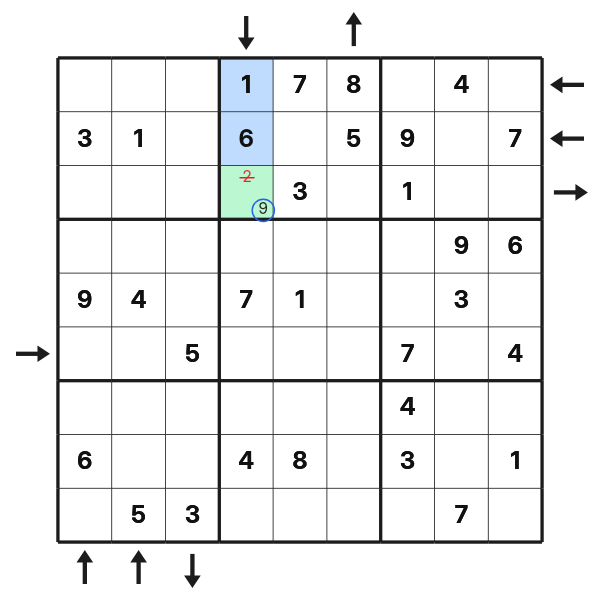
2 is less than 6 and hence does not fit at the end. The 9 satisfies both Sudoku rules and the arrow. Therefore, (3,4) must be 9.
5. Insert a value between two known numbers
The arrow next to row 2 requires 7 < ? < 9. For (2,8), the possible numbers according to normal Sudoku rules are 2, 6, and 8.
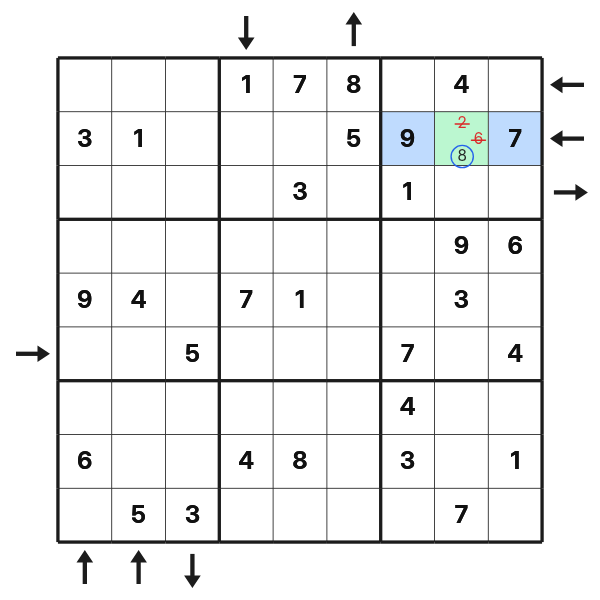
2 and 6 are not greater than 7. Only 8 fits between 7 and 9. Therefore, 8 is placed in (2,8).
6. Cross out candidates even if the cell remains open
In column 6, the arrow tip points upward. Reading from the top edge inward, it says 8 > 5 > ?. The possible values for (3,6) are initially 2, 4, 6, and 9.
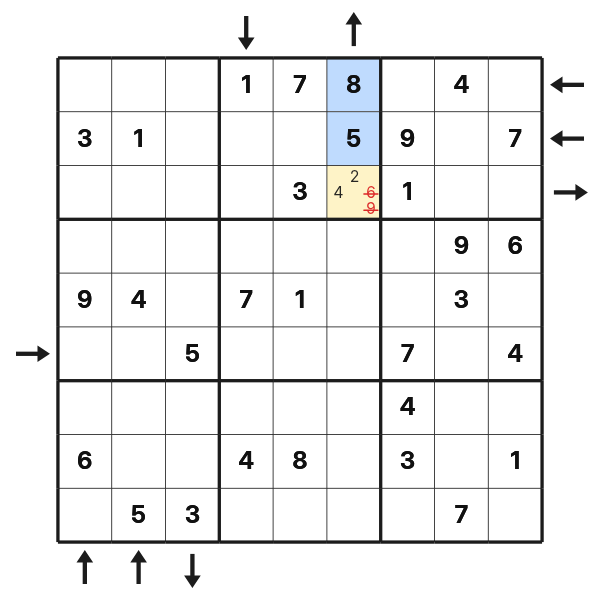
The third value must be less than 5. 6 and 9 are eliminated; 2 and 4 remain possible. The cell is not yet solved, but the arrow has safely removed two candidates.
7. Use a missing arrow as an exclusion
In column 1, an arrow is missing. Therefore, the top three values are neither strictly increasing nor strictly decreasing. For (1,1), the possible numbers are 2 and 5; below are 3 and 7.
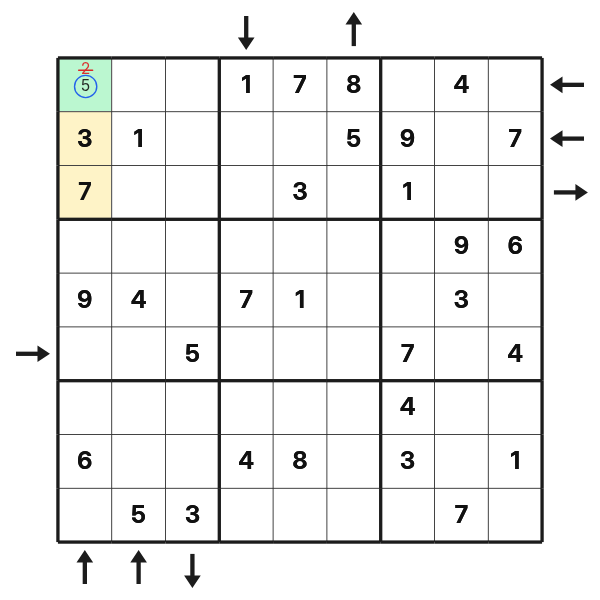
With 2, it would be 2 < 3 < 7, which requires an arrow but none exists, so 2 is excluded. With 5, the sequence is 5, 3, 7; neither strictly increasing nor decreasing. Hence, (1,1) is 5.
8. Use candidates elimination with a missing arrow
In column 3, there is also no arrow. In (1,3), the possible numbers are 2, 6, and 9; below are 4 and 8.
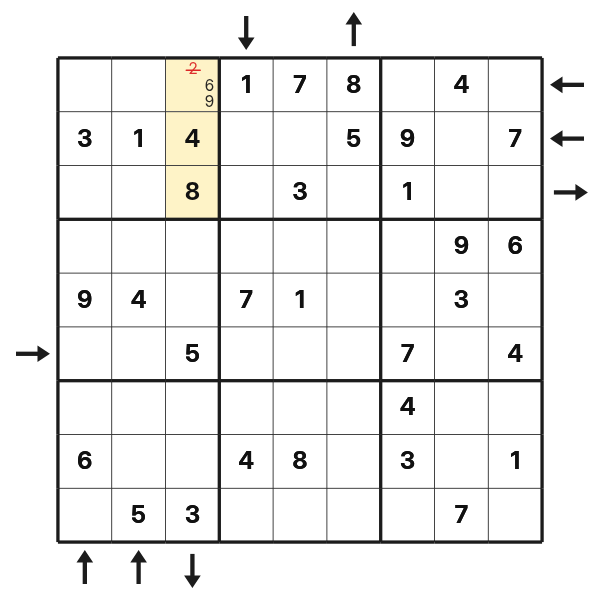
2 would form an increasing sequence 2 < 4 < 8 and is therefore excluded. 6, 4, 8 and 9, 4, 8 are neither strictly increasing nor decreasing. Both remain possible until further Sudoku or Rossini clues resolve them.
Typical solving process
- Start by looking for arrows where two of the three numbers are already known.
- Always read the three cells from the arrow side and note the arrow direction.
- Determine the normal Sudoku candidates for open cells first.
- Then eliminate candidates that do not fit the required order.
- Check sides without an arrow and prevent strictly increasing or decreasing triples there.
- Enter a number only when only one possibility remains according to both rule types.
- After each entry, recheck affected row, column, block, and all clues.
Common mistakes
- Requiring consecutive numbers: An arrow only orders values by size; gaps are allowed.
- Ordering the entire sequence: The arrow only involves the three border cells.
- Reading from the wrong side: Start on the side where the arrow is placed.
- Overlooking the arrow tip: It points to the largest number in the triple sequence.
- Ignoring missing arrows: They exclude strictly increasing and decreasing triples.
- Checking only the arrow rule: Each candidate must still fit in row, column, and 3×3 block.
- Rushing into guesses: If multiple numbers are possible, the cell is not yet solved.
- Not rechecking after each entry: A new number can immediately solve other cells.
Tips for beginners
- Mentally mark exactly the three cells next to an edge clue.
- Write the three values in arrow order as size chain, e.g., 2 < 5 < 8.
- Start with arrows where two numbers are already fixed.
- Use simple bounds: at the small end, 8 and 9 are impossible; at the large end, 1 and 2.
- Crossing out even one candidate can enable the next Sudoku step.
- Check sides without arrows as carefully as those with arrows.
Solve Rossini Sudoku in small, safe steps. Recheck affected row, column, block, and clues after each entry. This way, you often reach the solution without guessing.