
Skyscraper Sudoku – Hard
Download puzzle & solution
Share puzzle
Our puzzles are completely free. Please support this website by recommending it to your friends and family. Thank you!
New puzzle
Skyscraper Sudoku Solution: Rules and Strategies
Skyscraper Sudoku is a Sudoku variant. Edge numbers connect Sudoku with the visibility logic of the puzzle type Skyscrapers.
Each number represents a building height. A building is visible from one side if no taller building is in front; the edge number indicates the number of visible buildings.
The goal is a fully and correctly completed puzzle. Each entry must follow from the visible clues and the numbers already placed.
Rules
- Each cell contains exactly one number from 1 to 9.
- Each row contains numbers 1 through 9 without repetition.
- Each column contains numbers 1 through 9 without repetition.
- Each normal 3×3 block contains the numbers 1 through 9 exactly once.
- Each number is a building height. A building is visible from one side if no taller building is in front; the edge number indicates the number of visible buildings.
- Predefined numbers are not changed.
- Each entry must satisfy all rules.
Orientation in the Grid
Only the inner 9×9 solution field is counted: rows from top to bottom, columns from left to right. For a pair of numbers, the first number indicates the row, and the second the column; (4,7) lies in row 4, column 7. Edge clues are not part of the solution field.
The images show specific intermediate states. Blue marked cells are used for the step; red means excluded, and green indicates a secure result. Yellow highlights the currently considered cell.
Basic Idea for Solving
Count only new maximums from the given side. Start with edge numbers 1 and with high edge numbers, then check both ends of the same row or column together.
After each secure entry, recheck the affected row, column, block, and all additional hints. Often, this alone leads to the next step.
1. Count visible buildings step by step
From above, the marked line reads as 2, 7, 3, 9, 1, 4, 5, 8, 6. The first building is always visible. Afterwards, only a number larger than all previous ones counts.
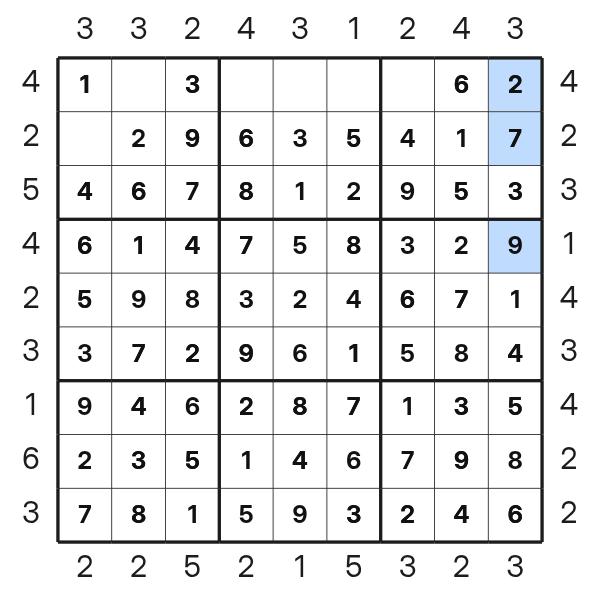
Exactly 3 new maximums are marked in blue. Smaller numbers behind a taller building remain hidden. Once 9 is reached, no further value can be visible.
2. Read the same line from the opposite side
From below, the same sequence is 6, 8, 5, 4, 1, 9, 3, 7, 2. The order reverses, so the visible buildings must be recounted.
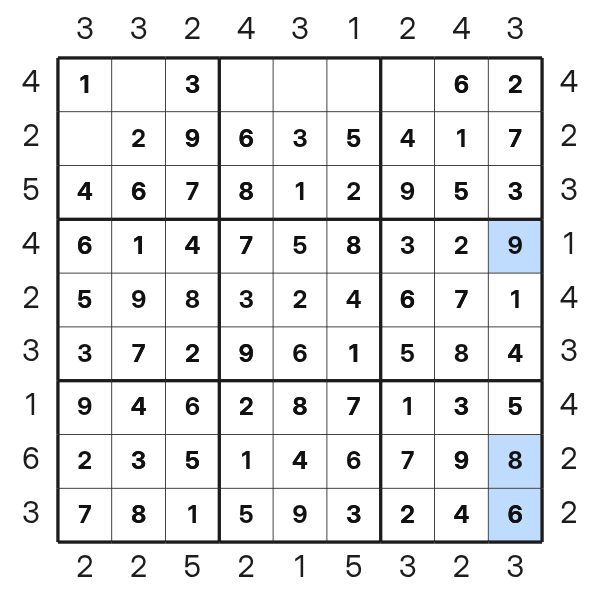
From this direction, 3 buildings are also visible. An edge number always corresponds precisely to the viewing direction where it is on its side.
3. Set 9 immediately when edge number is 1
The 1 on the top side allows only one visible building. The first cell from this direction is (1,6).
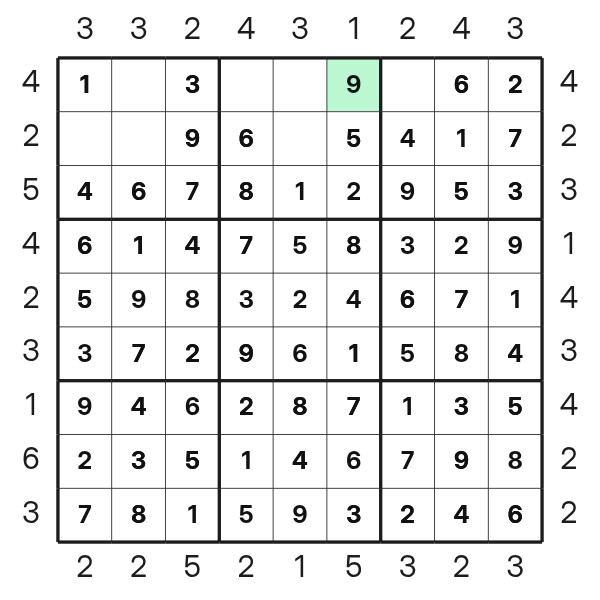
Here, the 9 must be placed. Any smaller number would be visible itself, and the 9 further back would be a second visible building.
4. Arrange two missing numbers with the edge number
In this line, only 2 and 8 are missing at the first two positions. With 2 before 8, 2, 8, and then 9 are visible: three buildings, though the clue 2 requires only two.
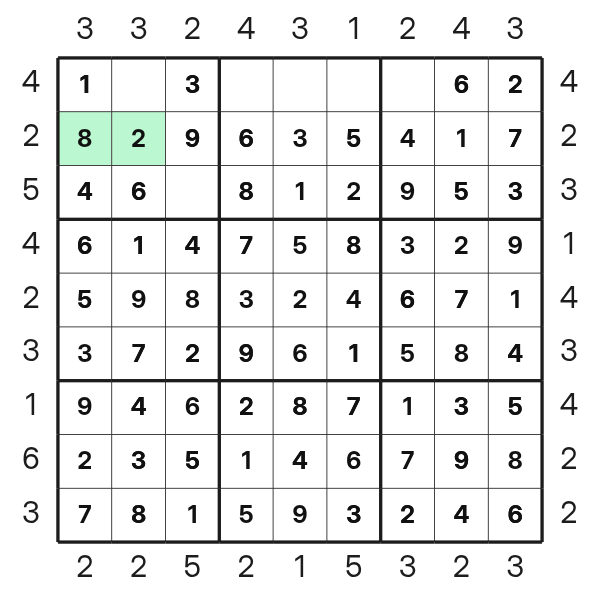
Thus, 8 is placed at (2,1) and 2 at (2,2). The 8 hides the 2; then only the 9 is visible. The full sequence is 829635417.
5. Use opposite edge clues together
This row has an edge clue 4 on both left and right. Only 2 and 5 are open for the two marked cells. One arrangement must fulfill both viewing directions simultaneously.
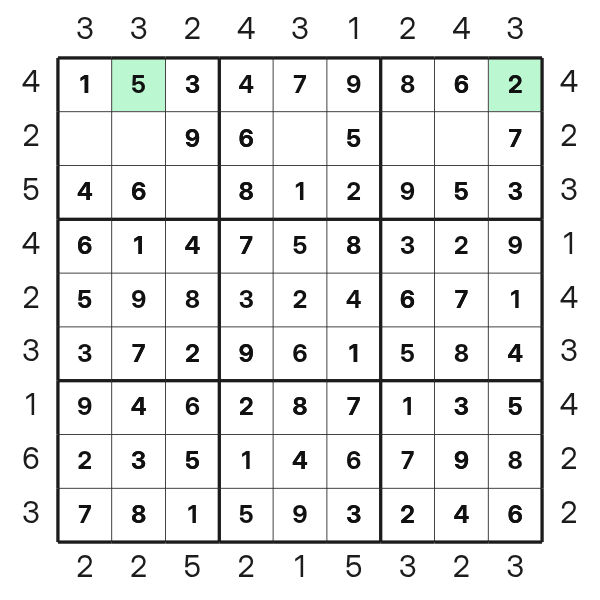
With 5 at (1,2) and 2 at (1,9), from the left 1, 5, 7, and 9 are visible; from the right 2, 6, 8, and 9. The reversed order results in too many visible buildings from the left.
6. Move 9 back with a high edge number
The clue 6 on the left side requires at least 6 visible buildings up to including the 9. Therefore, 9 cannot be among the first 5 cells.
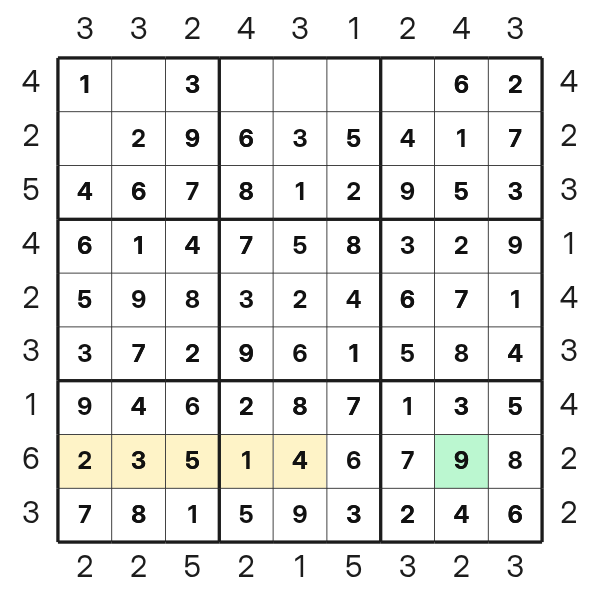
In the image, 9 is at position 8 in the viewing sequence. The early positions marked in yellow are excluded for the 9. This position limit is useful even if the exact number is not yet known.
7. Limit possible height at the edge
For 6 visible buildings, after the first value, there must be 5 larger values remaining. So, the first value in this line can be at most 4.
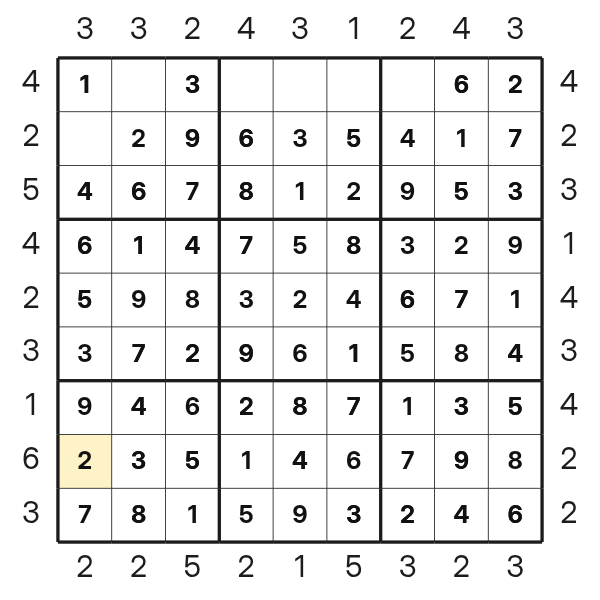
Numbers 5 through 9 are excluded at the edge cell (8,1). The shown value 2 is within the allowed range.
8. Count only new maximums before 9
In the viewing sequence 3, 9, 7, 4, 8, 2, 6, 5, 1, 9 is at position 2. Before it, exactly 1 new maximum must be visible for the hint 2 to be correct.
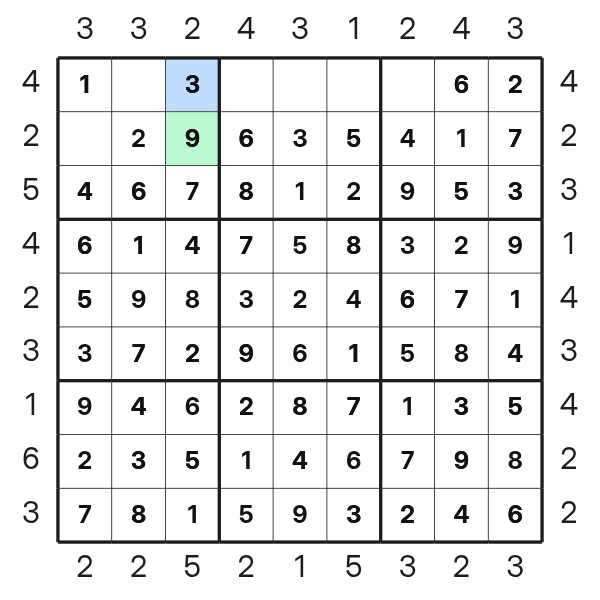
The sequence before the 9 is 3. After the 9, everything is hidden. This allows checking partial sequences without knowing the full line.
9. Check a complete line from both sides
Finally, a fully solved line is read once from above and once from below. The clues are 3 and 2.
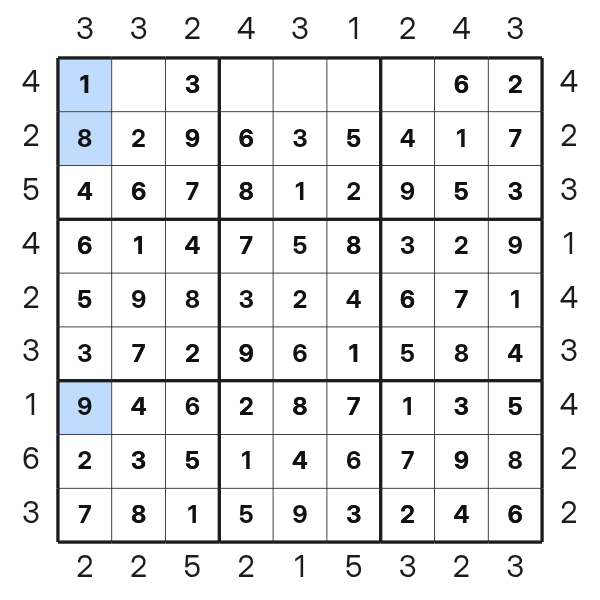
The blue-marked new maximums meet the first viewing direction; reading backward, it also exactly yields 2. The line is only complete when both counts and the Sudoku rules match.
Typical Solution Process
- Start by looking for edge clues 1 and especially high edge clues.
- Always read the relevant row or column from the hint side.
- Count only numbers larger than all previously seen values.
- Limit the position of 9 and possible edge values.
- When two cells are open, check both sequences against the edge number.
- Connect opposite clues of the same line.
- Check each visibility conclusion additionally with row, column, and 3×3 block.
Common Mistakes
- Counting all buildings: Shorter buildings behind taller ones are not visible.
- Checking only one viewing direction: Opposite edge numbers count at the same time.
- Reading the edge number as a sum: It indicates the number of visible buildings, not their total height.
- Starting from the wrong side: Each number is read from its own edge.
- Continuing to count after the 9: Nothing more can be visible behind the tallest building.
- Deriving a value too early from a middle edge number: Several sequences are often possible; at first, only an exclusion is certain.
- Rushing too early: If multiple numbers are possible, the cell is not yet solved.
- Not rechecking after an entry: A new number can immediately solve further cells.
Tips for Beginners
- Mentally mark the highest value seen while counting.
- Start with edge numbers 1; they immediately place a 9 at the edge.
- For high clues, it’s worth first restricting possible positions of 9.
- If two numbers are missing, write both sequences and count visible buildings each.
- Always check a completed line from both sides.
- A exclusion via the visibility rule may suffice to solve a normal Sudoku step afterward.
Solve Skyscraper Sudoku in small, safe steps. Recheck the affected row, column, block, and additional hints after each entry. This way, you often reach the goal without guessing.