
Skyscrapers – Hard
Download puzzle & solution
Share puzzle
Our puzzles are completely free. Please support this website by recommending it to your friends and family. Thank you!
New puzzle
Skyscrapers
Skyscrapers is a number logic puzzle where each number represents the height of a building. The puzzle is solved on a square grid. In the 6x6 variant used here, building heights 1 to 6 are entered.
Each row and each column must contain each height exactly once. Numbers at the edges also indicate how many buildings are visible from that viewing direction. A taller building blocks the view of all shorter buildings behind it.
Skyscrapers is not Sudoku: there are no additional regions or blocks. Only rows, columns, and visibility clues matter.
Basic Rules
- A number from 1 to 6 is entered into each cell.
- Each row contains the numbers 1 to 6 exactly once.
- Each column contains the numbers 1 to 6 exactly once.
- Each number represents the height of a building.
- An edge clue indicates how many buildings are visible from that side.
- The first building from the viewing direction is always visible.
- After that, a building is only visible if it is taller than all previous ones.
- A taller building blocks all shorter buildings behind it.
- Once the tallest building 6 is reached, no further buildings can be visible behind it.
- All row, column, and visibility conditions must be satisfied simultaneously.
Strategies for Solving
1. A clue of 1 places the 6 directly on the edge
If only one building is visible from a direction, that building must be the maximum height 6. Any smaller number would itself be visible, and the subsequent 6 would create a second visible building.
The following example has multiple clues with the value 1:
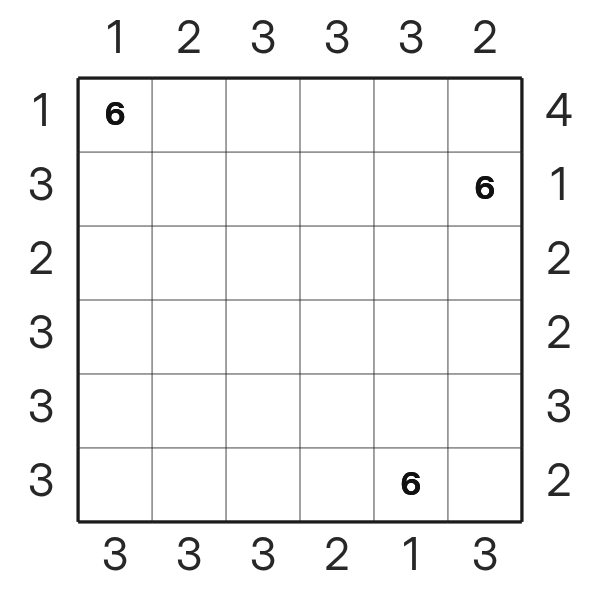
These entries are immediately certain and require no further numbers.
2. Visible buildings count as new height records
A building is only counted as visible if it is taller than all previous buildings. When reading a row, you can thus keep track of a running maximum height.
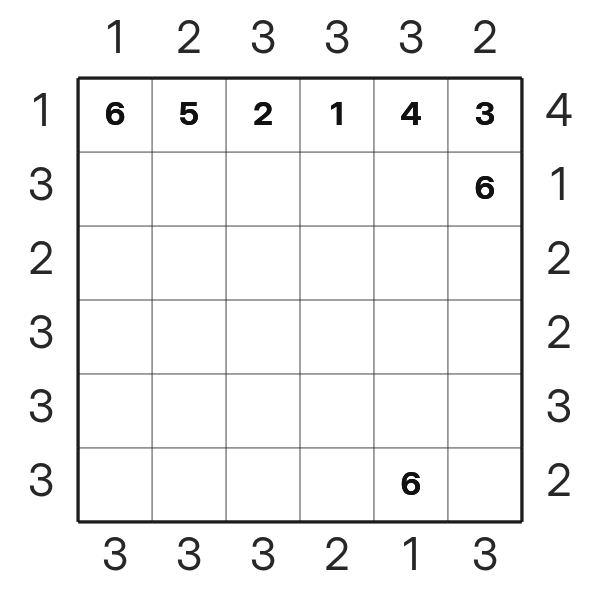
The fully solved first row in the example above would be:
6 5 2 1 4 3Only the 6 is visible from the left. It is already the tallest and blocks all following values. The left clue of 1 is satisfied.
From the right, you read 3, 4, 1, 2, 5, 6. Visible are 3, 4, 5, and 6 in succession. The right clue of 4 is also satisfied.
3. The two missing heights are ordered by both edge clues
In the third row of the example below, only the heights 5 and 6 are missing. The other cells are known. The left and right clues each read 2.
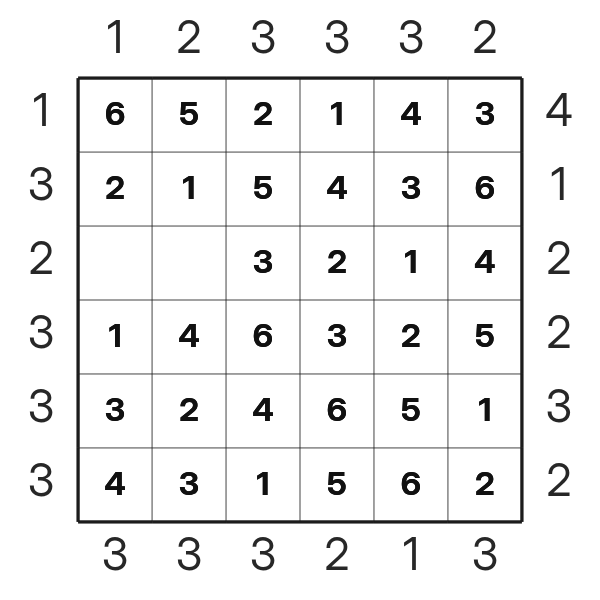
There are initially two possible sequences.
Variant A:
5 6 3 2 1 4From the left, 5 and 6 are visible: exactly two buildings. From the right, 4 and 6 are visible: also two buildings. Both clues are satisfied.
Variant B:
6 5 3 2 1 4From the left, only 6 is visible. From the right, 4, 5, and 6 are visible. Both clues of 2 are violated.
Therefore, the third row must begin with 5 and 6.
4. A middle clue can determine the order of a pair of numbers
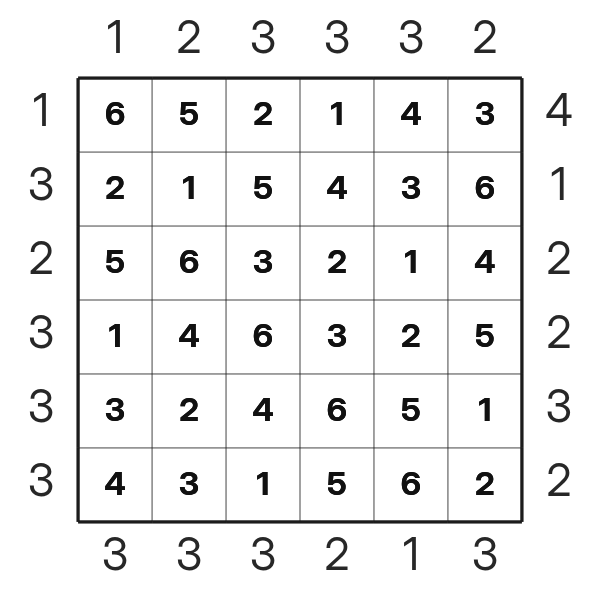
In the last row of the example below, only 3 and 4 are missing. The left clue is 3, and the right is 2.
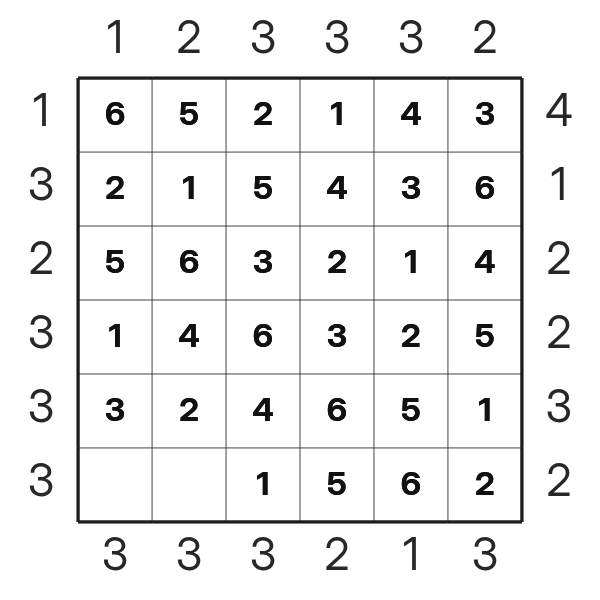
If 3 and 4 are arranged in ascending order, the sequence is:
3 4 1 5 6 2Visible from the left are 3, 4, 5, and 6. That’s four buildings, which is too many.
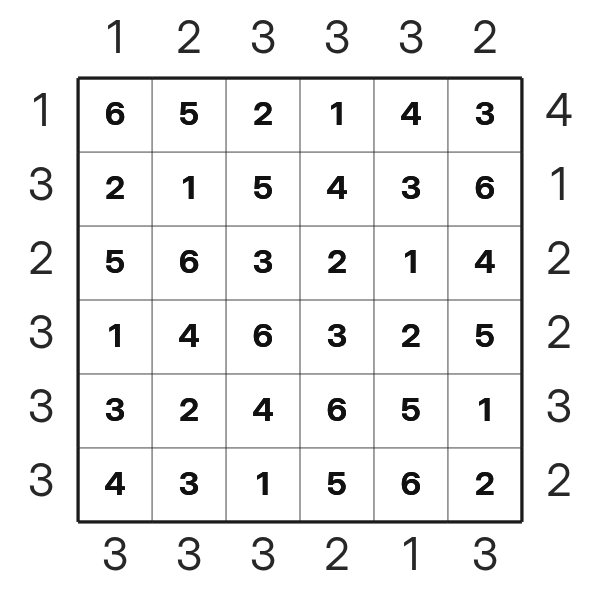
In the reversed order:
4 3 1 5 6 2Visible from the left are 4, 5, and 6: exactly three. Visible from the right are 2 and 6: exactly two. Both clues fit.
5. An edge clue of 4 determines between two candidates
In the fourth column of the example below, only 1 and 4 are missing in the top cells. Both rows can initially contain these two values. The edge clue is 3.
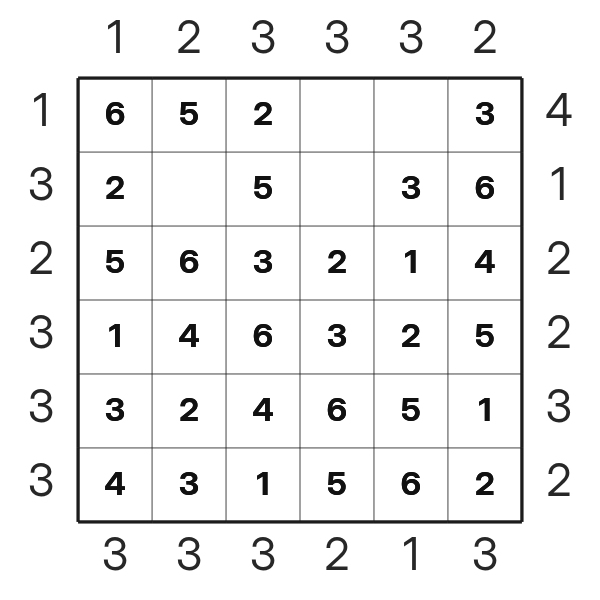
With 1 at the top and 4 below, the column is:
1 4 2 3 6 5Visible from above are 1, 4, and 6. The clue of 3 is satisfied.
With 4 at the top and 1 below, the column is:
4 1 2 3 6 5From above, only 4 and 6 are visible: two buildings instead of 3.
Thus, 1 is on top, and 4 below. The remaining open cells in the rows are then uniquely determined by the row rules.
6. An edge clue of 6 indicates a strictly increasing sequence
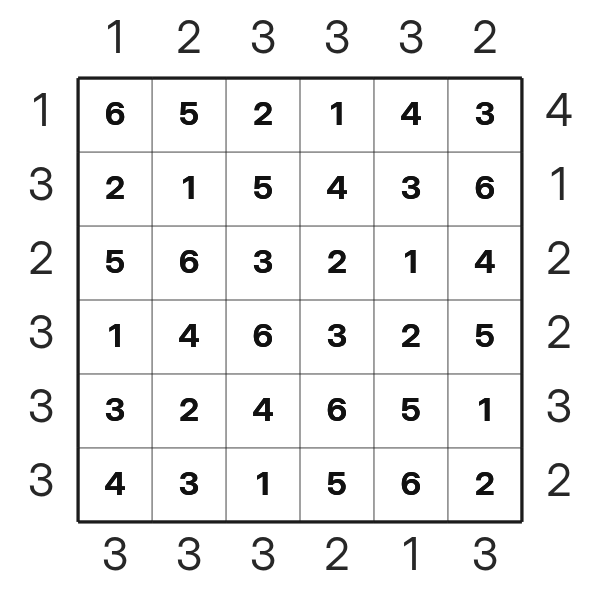
For a 6x6 puzzle: if all six buildings are visible from one side, the row must be exactly 1, 2, 3, 4, 5, 6 from that direction.
Each building must set a new height record. This extremity rule is also useful if no 6 clue is present in the specific puzzle.
7. The position of 6 greatly limits visibility
The 6 is the tallest building. Everything behind it is invisible. If 6 is in the second cell of a row, at most two buildings can be seen from that side: the first cell and the 6.
In a clue of 2 with a fixed 6 in the second cell, the visibility condition is automatically satisfied, regardless of the order of smaller buildings behind it.
8. Using opposite clues together
A single middle clue often allows multiple number sequences. The clue on the opposite side can significantly narrow these possibilities.
From each possible sequence, count from both sides. Only when both values match and the row or column rule is satisfied, the arrangement is valid.
Typical Solving Process
- Enter all 6s fixed by clues of 1.
- Check rows and columns with few open cells.
- Determine missing numbers via row and column rules.
- Test possible sequences against both edge clues.
- Use the position of the 6 to limit maximum visibility.
- Immediately propagate new numbers across intersecting rows and columns.
- Finally verify complete rows from both sides.
Common Mistakes
- Interpreting the edge number as the sum of building heights.
- Counting a building when a taller one stands before it.
- Reading the clue from the wrong side.
- Checking only one of the two opposite clues.
- Using a visibility sequence that contains duplicate numbers in a row or column.
- Rushing into guesses with multiple possible sequences.
Tips for Beginners
- Start with all clues of 1.
- Keep a running maximum height while counting: only a new high is visible.
- Note both possible sequences when two numbers are missing and count from both sides.
- Utilize row and column exclusions before testing longer sequences.
- Remember: behind a 6, nothing more is visible from that side.
Skyscrapers combines the uniqueness of a Latin number grid with visibility logic. Rows and columns determine which heights are missing, while edge clues set their order. Especially strong deductions come from clues of 1, the position of the highest number, and comparing both directions.