
Download puzzle & solution
Share puzzle
Our puzzles are completely free. Please support this website by recommending it to your friends and family. Thank you!
New puzzle
Sudoku 4x4
Sudoku 4x4 is a variation of classic Sudoku with a 4x4 grid. The puzzle consists of 4 rows and 4 columns. Some cells are already filled in, the remaining cells are empty. The goal is to fill all empty cells so that each area is complete and free of contradictions. The numbers 1 to 4 are used.
Sudoku 4x4 is not a calculation puzzle. The inserted characters are not added, multiplied, or otherwise computed. They serve only as distinguishable symbols. What matters is where a number can be placed and where it is excluded by row, column, or region.
Basic Rules
- The game board consists of 4 rows and 4 columns.
- Exactly four different numbers are used: 1 to 4.
- The game board is additionally divided into regions. In this variant, they are regions of 2 rows x 2 columns.
- Exactly one number is entered in each empty cell.
- Each number must occur exactly once in each row.
- Each number must occur exactly once in each column.
- Each number must occur exactly once in each region.
- Pre-filled entries may not be changed.
- The puzzle is solved when all cells are filled and no row, column, or region contains duplicate entries.
- A well-constructed Sudoku has exactly one solution. Therefore, guessing should be avoided in favor of logically secured entries.
Strategies for Solving
The most important concept is elimination. An entry is only certain if all other possibilities have been excluded by the rules or if a particular number can only be placed in one position within a region, row, or column.
1. Start with nearly complete regions
The easiest way to start is with rows, columns, or regions that already contain many numbers. The more entries are present, the fewer options remain open.
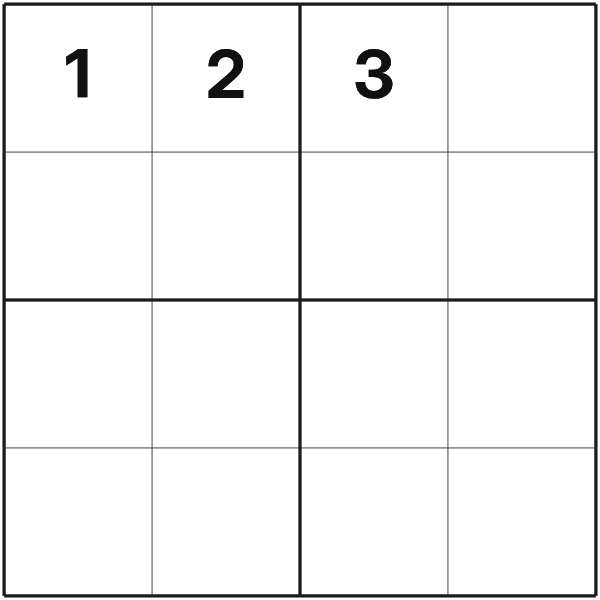
In the first row, only the number 4 is missing from the four possible numbers. Therefore, the last cell of the first row must be 4.
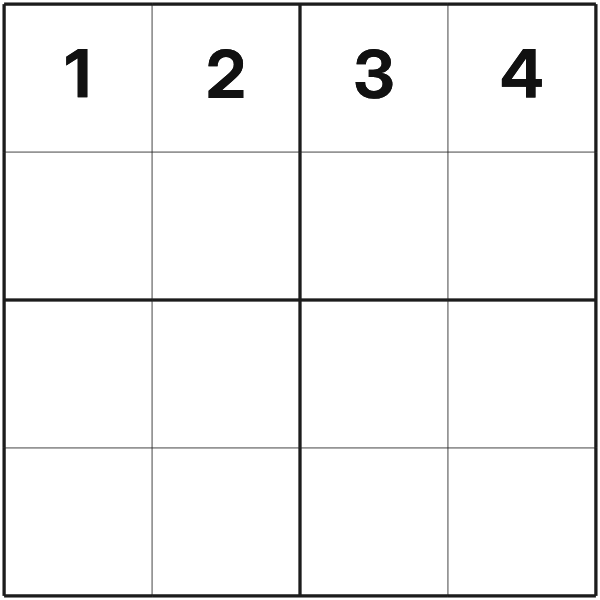
This conclusion is clear because only one number is missing in this region. Such obvious gaps are especially good starting points.
2. Single candidate: When a cell has only one possibility
A cell always belongs to three regions: its row, its column, and its region. All numbers already present in these regions are excluded for this cell.
In the following grid, considering the top-left cell, the first row initially lacks the entries 1, 2, 3. The first column eliminates all these possibilities except 1. Therefore, only 1 remains for the top-left cell.
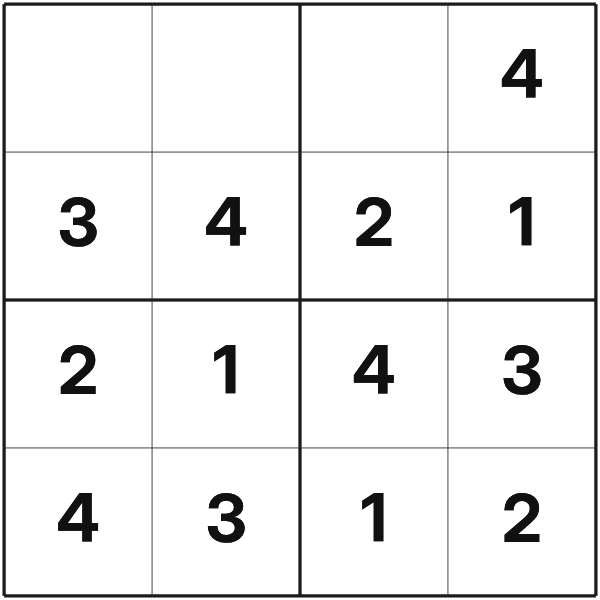
The top-left entry is therefore certain. It is not guessed but deduced because all other candidates are excluded by the column, and it fits the region.
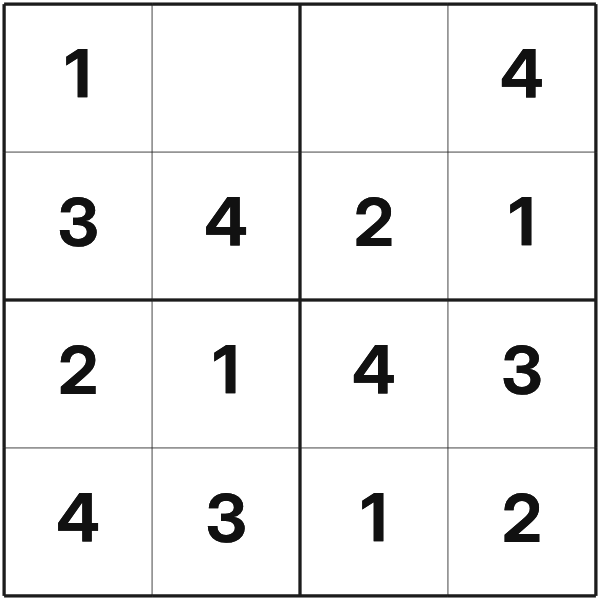
3. Hidden single candidate: When a number fits only in one place
Sometimes an empty cell has multiple possible candidates. Still, a certain number can only be in one position within a row, column, or region. This entry is then also certain.
In the next example, we consider the top-left region and look for the number 4. The existing 4s outside the region block certain rows and columns. As a result, only the top-left cell remains available in the top-left region.
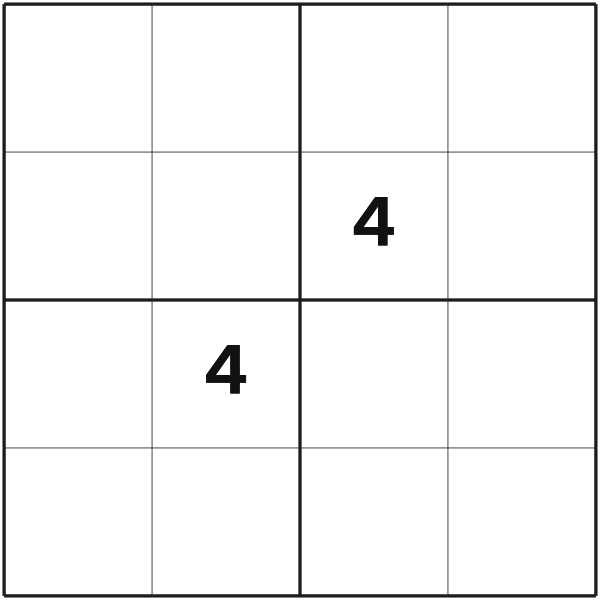
Since 4 can only be placed in the top-left in this region, it must be entered there.
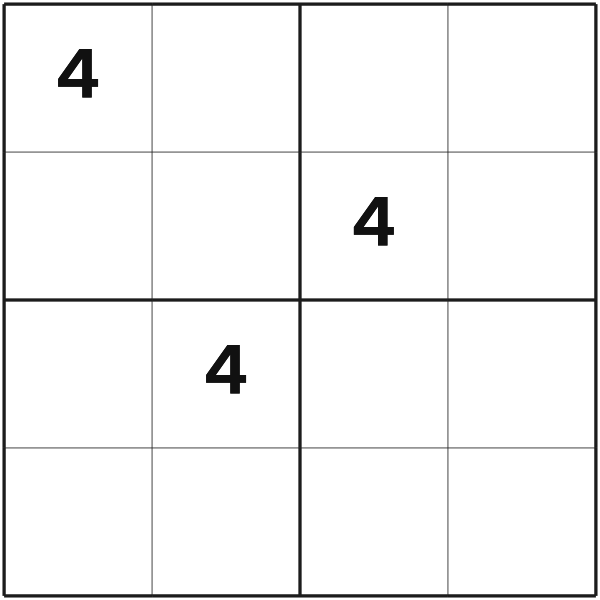
The difference from the single candidate is important: the cell itself did not necessarily have only one possibility. Instead, the sought-after number had only one possible position within the considered region.
4. Track a number systematically across the entire grid
A very typical Sudoku technique involves systematically tracking a specific number. For example, choose 4 and check in which rows, columns, and regions this entry already appears. Each position found blocks further positions in the same row, column, and region.
This technique is helpful especially in Sudoku 4x4 because the grid has more cells than a classic 9x9 Sudoku. Instead of checking each cell individually, you can follow a number throughout the grid and find safe eliminations.
5. Note and update candidates
If no immediately certain entries are visible, it is useful to note candidates. Candidates are all numbers that are still allowed in a cell based on the current state. After each new entry, update these candidates in the affected row, column, and region.
Important: A candidate is not a guess. It simply means that an entry is not yet excluded. Only when only one candidate remains or a candidate can only be in one position within a region is it safe to enter it.
In 4x4 Sudoku, candidate pairs are less often needed because the grid is very small. Still, the mindset is useful: if two cells in the same row only allow the same two numbers, these two numbers are reserved for these cells.
6. Check all three conditions before each entry
An entry is only correct if it fits the row, column, and region simultaneously. A common mistake is checking only a row and overlooking that the same number already appears in the column or region.
- Does the number already exist in the row?
- Does the number already exist in the column?
- Does the number already exist in the region?
- Is the entry truly unique, or is there another possible position?
Only after these checks are thoroughly completed should the cell be filled.
Typical Solution Process
A Sudoku is not solved mindlessly from left to right. It is more effective to look for the strongest hints repeatedly: nearly complete rows, nearly complete columns, nearly complete regions, and entries that already occur frequently.
- First, check rows, columns, and regions with many clues.
- Look for areas where only a few numbers are missing.
- Check individual cells by combining row, column, and region information.
- Seek single candidates: cells where only one number is possible.
- Look for hidden single candidates: numbers that can only be in one position within a region.
- Track individual numbers across the entire grid systematically.
- Note candidates when no immediately certain entries are visible.
- Update candidates after each certain entry.
- Use region-row and region-column logic to exclude further candidates.
- Regularly verify that no row, column, or region contains duplicate entries.
Common Mistakes
- Guess too early instead of drawing secure conclusions.
- Check only rows and columns, forgetting the regions.
- Note candidates but do not update after new entries.
- Overlook hidden single candidates by checking only individual cells instead of entire regions.
Tips for Beginners
- Get used first to the numbers used: 1 to 4.
- Start with regions that already contain many entries.
- Always check row, column, and region for each entry.
- Not only look for cells you can fill but also for secure exclusions.
- Note candidates when you no longer can proceed immediately.
- Exclude candidates only if justified by a rule.
- Ask yourself: Why must this specific number be exactly here?
- Regularly change your perspective: from rows to columns, columns to regions, and regions to individual numbers.
- Keep the grid clear. Larger Sudokus with unclear notes can quickly lead to errors.
- Work slowly and securely rather than quickly and guessingly.
Sudoku 4x4 follows the same logical principles as classic Sudoku but adapted to a 4x4 grid. Those who consistently combine rows, columns, and regions can solve this variant step by step without guessing.