
Sudoku 8×8 – Hard
Download puzzle & solution
Share puzzle
Our puzzles are completely free. Please support this website by recommending it to your friends and family. Thank you!
New puzzle
Sudoku 8×8
Sudoku 8×8 translates the well-known Sudoku principle to a grid with 8 rows and 8 columns. The grid is additionally divided into 8 clearly bordered regions, each with 2×4 cells. Some digits are given; all others are completed by logical exclusion.
The puzzle type was originally also published under the name Number Place. Despite the digits and letters, no calculation is involved: each character is only a distinguishable symbol. The only requirement is that each appears exactly once in each row, column, and region.
In this size, the digits 1 to 8 are used.
Basic rules
- Each empty cell must contain exactly one of the 8 allowed digits.
- Each row contains each allowed character exactly once.
- Each column contains each allowed character exactly once.
- Each 2×4 region contains each allowed character exactly once.
- Given entries must not be changed.
- A candidate is only allowed if the character does not already occur in the corresponding row, column, or region.
Regions, symbols, and units
Row, column, and region are collectively called units. Each unit contains 8 cells and ultimately the same complete set of symbols. Two cells influence each other if they share at least one unit.
The regions in this size are 2×4 cells large. Their shape is part of the rule: they are rectangular and encompass 2 rows and 4 columns. Always follow the bold boundary lines when scanning; a cell neighboring visually can already belong to another region.
The symbol set is small enough to compare missing digits directly in the head. Nevertheless, row, column, and region apply simultaneously; a digit missing in the row can be forbidden in the column or region of a cell.
Strategic overview
Start with almost complete units and cells with few candidates. Then look for a specific character across a whole unit. If direct placements are not possible, examine the interfaces between regions and lines and small candidate groups.
The illustrations use circled candidates for confirmed or reserved possibilities. Candidates marked in red are excluded by the respective conclusion. A red result is not a final entry until more than one candidate remains.
Each technique answers a different question: the last missing character completes a unit, a naked single checks a cell, a hidden single tracks a character. Pointing and Claiming utilize the overlapping of region and line; pairs reserve two characters for two cells.
1. The last missing character of a row
In the first intermediate state, row 1 is complete except for the cell in row 1, column 7. All allowed digits except 3 are already visible there. Therefore, the only empty cell must have the value 3.
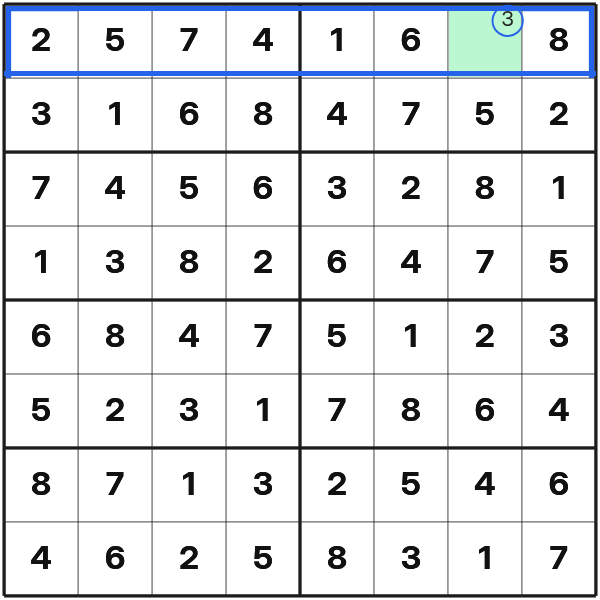
No lengthy candidate analysis is needed: a complete row must contain each character exactly once. Since only 3 is missing, any other entry already violates the row rule.
The same pattern can occur in a column or region. Immediately verify the crossing column and the associated 2×4 region after placing, as the new character may eliminate further candidates there.
2. Recognizing a naked single
Now consider row 1, column 2. In the visible row, column, and region, all allowed characters except 5 have already appeared. Although several cells in these units are still empty, only one candidate remains for this specific cell.
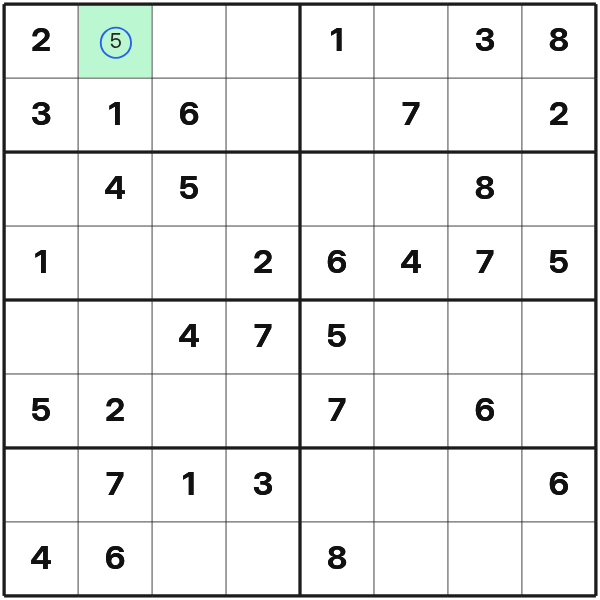
This allows 5 to be entered. A cell with exactly one possible candidate is called a naked single. The candidate is "naked" because it is directly visible as the only note in the cell.
Always check naked singles against all three units. Considering only the row and column can overlook a digit excluded by the region, leading to an incorrect candidate list.
3. Finding a hidden single in a unit
In row 1, the character 4 is missing. The cell in row 1, column 4 has candidates {4, 5} and is therefore not a naked single. However, in all other empty cells of this unit, 4 is blocked by their crossing units.
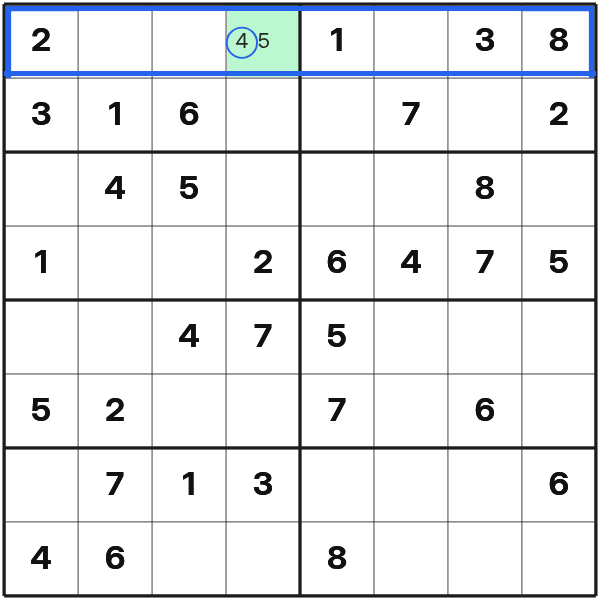
Since row 1 must contain the character 4, only row 1, column 4 remains as a position. This is a hidden single: The uniqueness only becomes visible when tracking a specific character across the entire unit.
Scan through the missing characters one by one. A long candidate list in the target cell is not an obstacle; it crucially depends on whether the character under consideration remains possible elsewhere in the same unit.
4. Pointing: A region points to a line
In region 2, 4 can only be in row 2, column 5, and row 2, column 7. All these possibilities are in row 2. Which one is correct is still unknown; but it is certain that the region places its 4 on this line.
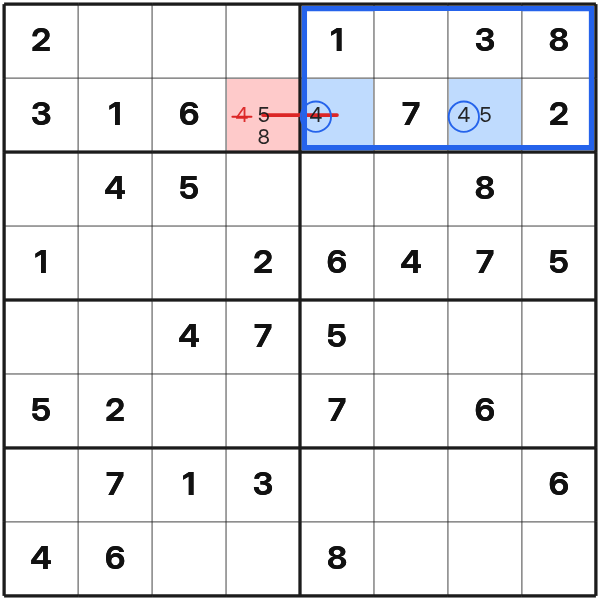
Therefore, no other cell in row 2 outside the region can keep 4 as a candidate. It is eliminated from row 2, column 4. Afterward, only 5, 8 remain as allowed candidates.
This block-line interaction is called Pointing or Locked Candidates Type 1. The observation begins in a region and affects exactly one line or column outward.
5. Claiming: A line claims a region
The reverse also works. In row 5, 1 can only be in row 5, columns 6, 7, and 8. All possible positions of the line are within region 6.
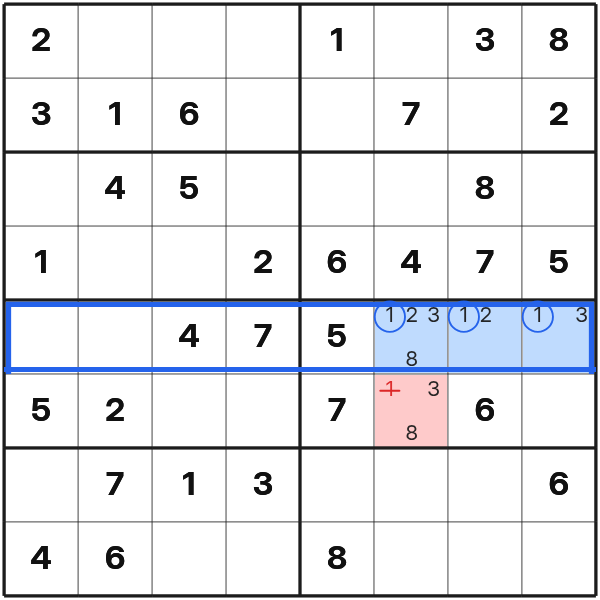
Row 5 claims the character 1 within this region. Other cells in the region not in row 5 lose this candidate; in the example, this affects row 6, column 6. The candidate list thus shortens to {3, 8}.
This technique is called Claiming, line-region interaction, or Locked Candidates Type 2. Remember the direction: Pointing starts in a region, Claiming starts in a line or column.
6. Discovering a naked pair
In column 8, row 3 and row 5, column 8 each have exactly the two candidates {1, 3}. No other possibility exists in these two cells.
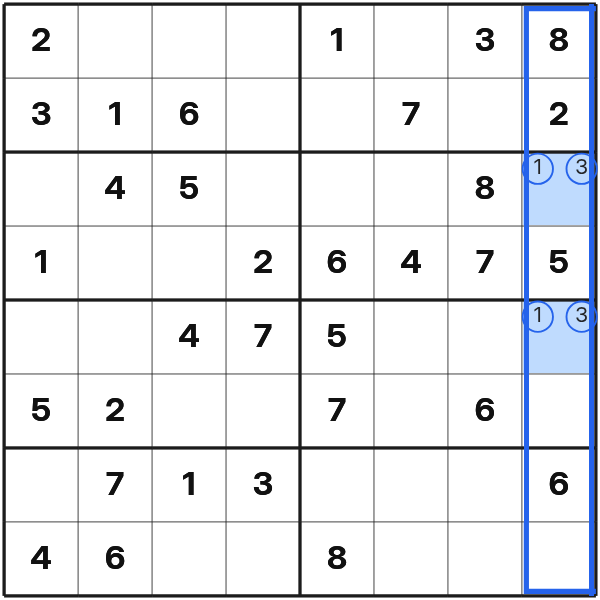
The two characters must therefore be distributed across these two cells. It has not yet been decided which cell gets which character; but it is already proven that both characters are bound there within the unit.
A naked pair consists of two cells in the same unit, whose shared candidate set contains exactly two characters. Only this exact restriction allows eliminating candidates in the remaining cells of the unit.
7. Applying the naked pair
Now consider row 6, column 8 in the same unit. Before the pair deduction, this cell had candidates {1, 3, 4}. It contains 1 and 3 already fully reserved for the pair cells.
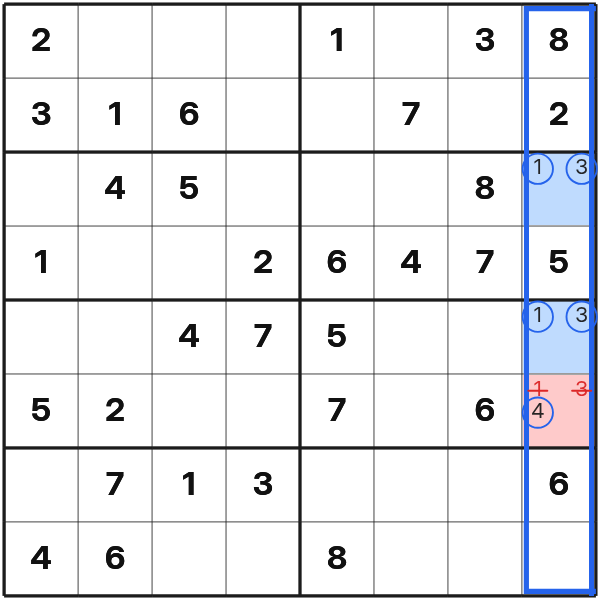
The reserved candidates are removed from the target cell. Only 4 remains; thus, the target cell is solved. The elimination applies only in units that contain both pair cells and the target cell.
This second view clearly separates discovery and consequence: the pair itself does not yet solve its two cells, but outside the pair cells, candidates can be eliminated, potentially creating a new single or a smaller candidate set.
8. Revealing a hidden pair
In row 6, 1 and 8 can only be in row 6, column 4, and row 6, column 6. At least one of these cells has additional notes; therefore, the pair is initially hidden in larger candidate lists.
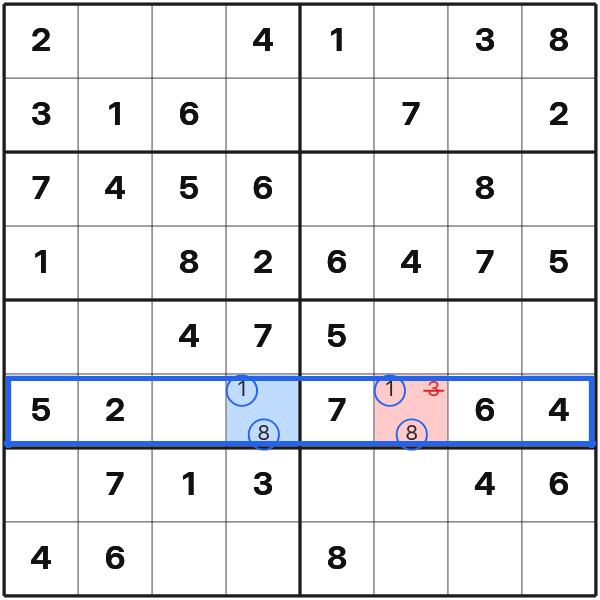
The two pair characters must be distributed across these two cells. Consequently, from row 6, column 4, no further candidates are left, and from row 6, column 6, 3 is removed. The order of the pair characters remains open, but all external notes in the pair cells are eliminated.
In the hidden pair, you do not look for two identical candidate lists already existing. Instead, you track two characters that only appear in the same two cells within a unit. Only removing the external notes makes this a visible naked pair.
Proven solution process
- Scan rows, columns, and regions with few gaps for the last missing character.
- Calculate candidates of strongly restricted cells and place naked singles.
- Track each missing character within a unit and look for hidden singles.
- Check regions for candidates lying in a single line or column, and apply Pointing.
- Check lines and columns for candidates fully within a region, and apply Claiming.
- Compare candidate lists for naked pairs; additionally, search for hidden pairs in larger grids.
- After each entry or elimination, return to singles before looking for more complex patterns.
Common mistakes
- Forgetting the region: A character may be missing in row and column but still forbidden by the 2×4 region.
- Misreading region boundaries: Especially rectangular regions are easily confused with neighboring cells. The bold lines are decisive.
- Not fully noting candidates: A supposed pair is invalid if a third candidate is still possible in one pair cell.
- Confusing Pointing and Claiming: Pointing eliminates outside a region on the same line; Claiming inside the region but outside the considered line.
- Misunderstanding a reservation as order: A pair determines which two characters occupy which cells, but not which character in which cell.
- Retaining outdated notes: Candidates in the cell's row, column, and region change after each new clue.
- Guessing: When no step is visible, a systematic re-scan is more reliable than an arbitrary attempt placement.
Tips for beginners
- Use a fixed order, e.g., regions, rows, columns, then individual symbols.
- Mark candidates small but complete. Note not only a favorite but all possibilities allowed by the three units.
- Formulate a brief proof before each entry: which unit enforces the character or what pattern allows elimination?
- Check for new singles after each result; a pair or interface elimination often prepares an easier deduction.
- Verify completed units against the full symbol set and look for duplicates immediately.
- Utilize the small symbol set: mentally review missing digits of a unit before adding extensive notes.
Conclusion
Sudoku 8×8 relies entirely on the interplay of rows, columns, and 2×4 regions. Last missing characters and singles provide direct entries; Pointing, Claiming, and pairs produce reliable candidate eliminations.
The grid size changes the number of symbols and the shape of regions, but not the logic. Those who update candidates carefully, base every deduction on a visible unit, and restart with simple techniques after each result can solve the puzzle step by step without guessing.