
Download puzzle & solution
Share puzzle
Our puzzles are completely free. Please support this website by recommending it to your friends and family. Thank you!
New puzzle
Sudoku DG Solving: Rules and Strategies
Sudoku DG is a Sudoku variant. Similarly colored positions within the nine 3×3 blocks form additional groups.
Sudoku DG stands for Disjoint Groups Sudoku.
Each of these nine disjoint groups contains the numbers 1 to 9 exactly once.
The goal is a fully and correctly filled puzzle. Each entry must be deduced from the visible clues and the numbers already placed.
Rules
- Each cell contains exactly one number from 1 to 9.
- Each row contains the numbers 1 to 9 without repetition.
- Each column contains the numbers 1 to 9 without repetition.
- Each normal 3×3 block contains the numbers 1 to 9 exactly once.
- Each of these nine disjoint groups contains the numbers 1 to 9 exactly once.
- Given numbers are not to be changed.
- Each entry must comply with all rules.
Grid Orientation
Rows are counted from top to bottom, columns from left to right. (4,7) means row 4, column 7.
The images show specific intermediate states. Red frames mark the cells considered in each step. Cell colors remain visible, indicating the nine additional groups. Small numbers in empty cells are candidates; a circle indicates the logically determined value.
Basic Solving Idea
In addition to row, column, and 3×3 block, also check the color of the cell. Similarly colored cells form a complete group, even if spread across the grid.
After each certain entry, recheck the affected row, column, block, and all supplementary hints. Often, this immediately reveals the next step.
1. Recognize a Complete Color Group
All cells with the same color form an additional nine-group. The cells are spread across the nine normal 3×3 blocks.
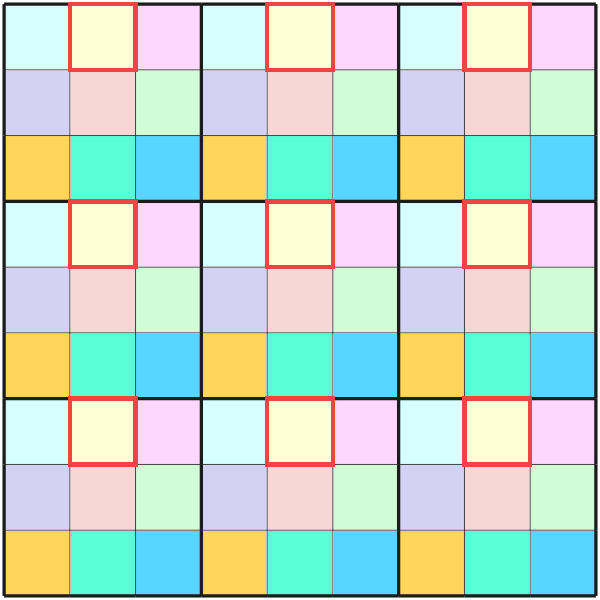
The red frames show the nine cells of Disjoint Group B. The numbers 1 to 9 must appear exactly once in this group.
2. Complete an Almost Full Supplementary Group
In Disjoint Group B, the numbers 1, 3, 4, 5, 6, 7, 8, 9 are already present. Only 2 is missing; the cell (1,2) is still empty.
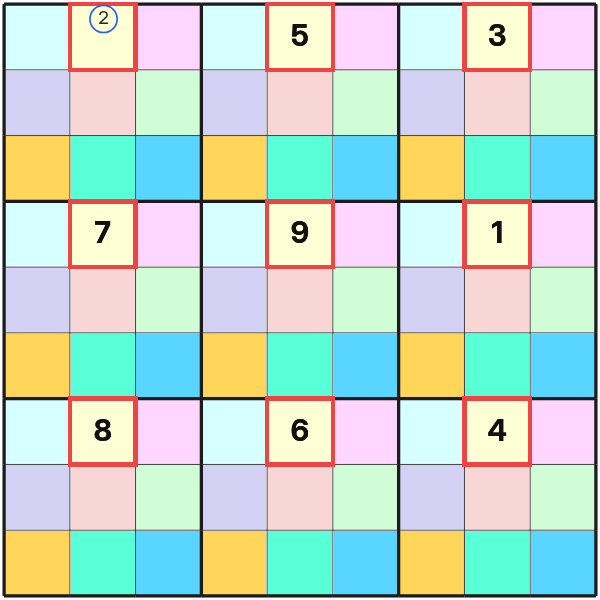
This means 2 belongs in (1,2). The image shows the gap intentionally still open; the circled candidate is the subsequent entry.
3. Use the Supplementary Rule as Candidate Elimination First
Row, column, and normal block initially allow 1, 4, 6 in (1,1). However, 6 is already in (4,4) in Disjoint Group A.
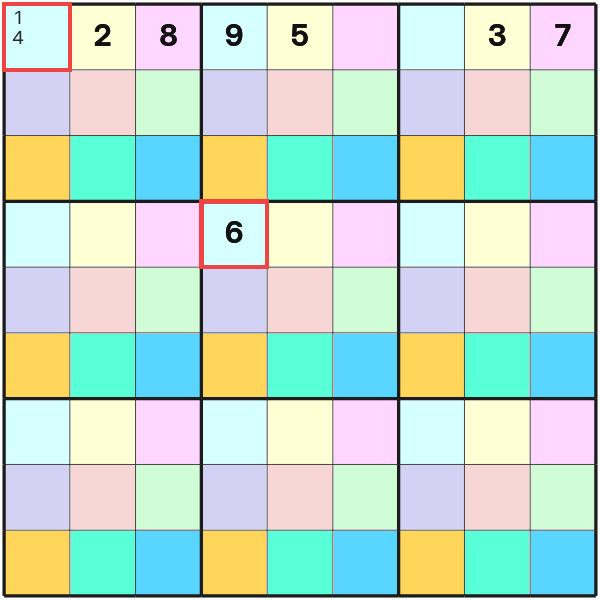
Hence, 6 is eliminated. Only 1 and 4 remain candidates in the open cell. This step does not fill the cell yet but visibly reduces its candidate list.
4. Find the Last Candidate Using the Supplementary Group
Without the supplementary rule, 4 and 6 could still be in (1,1). Since 6 is already in (4,4) via the same supplementary area, only 4 remains.
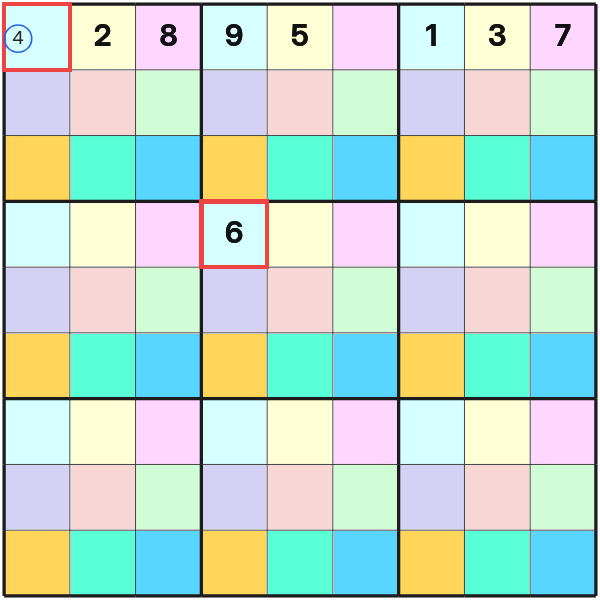
The field remains empty in the image, with the circled candidate 4; only after this is the number entered.
5. Find the Only Place for a Number in the Supplementary Group
In Disjoint Group A, four cells are still open for 4. Three are eliminated by normal Sudoku units: (1,4) by 4 in (3,5); (1,7) by 4 in (2,7); (4,1) by 4 in (4,3).
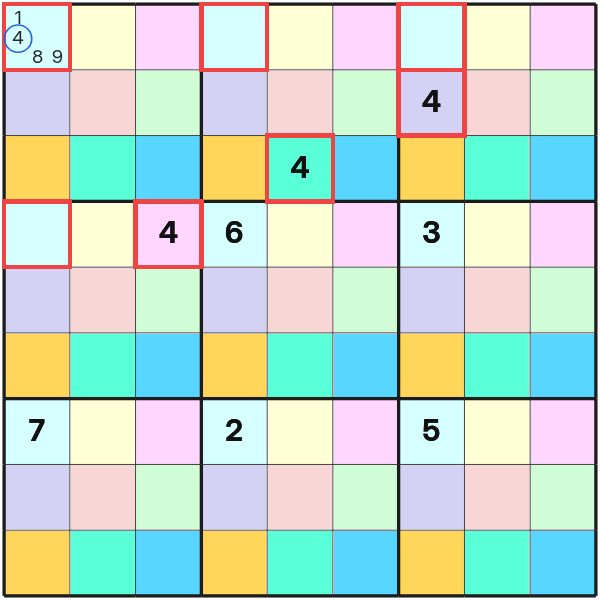
Only (1,1) remains as the place for 4. This cell has candidates 1, 4, 8, 9; the number is determined by its only position in the supplementary group.
6. Insert Two Missing Numbers in Correct Order
In Disjoint Group A, only 4 and 6 are missing; they belong in (1,1) and (4,4). At (1,6), 6 already appears in a normal Sudoku unit with (1,1).
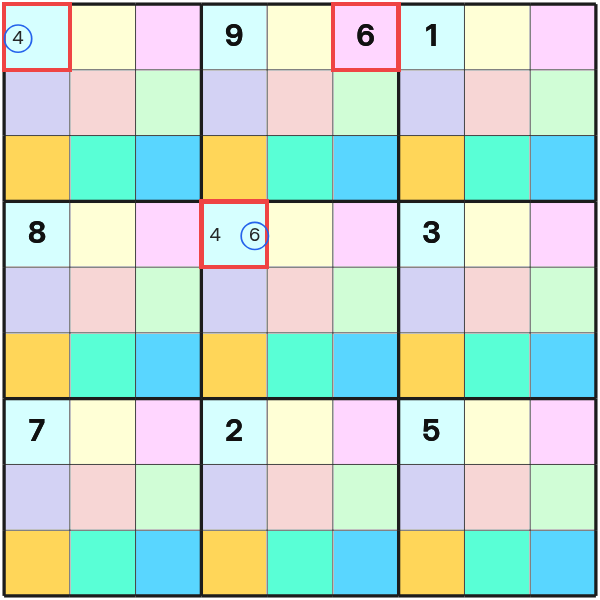
Therefore, 6 cannot be in (1,1): place it at (4,4). The 6 at (1,6) is then fixed. This normal unit determines the sequence of the pair.
7. Prepare a Following Step with the Supplementary Group
In Disjoint Group A, only 9 is missing at (1,4). The same row still has empty cells at (1,4) and (1,3).
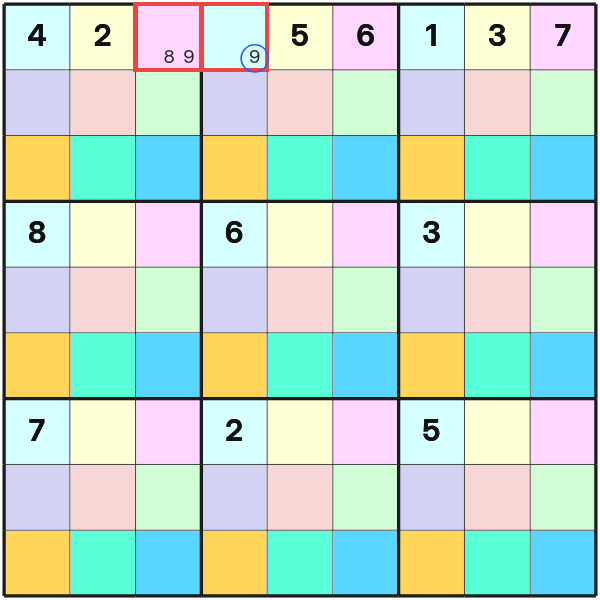
The supplementary group first sets 9 in (1,4). Before this entry, the row cannot distinguish the two open cells alone.
8. Execute the Prepared Row Step
After placing 9 at (1,4), only (1,3) remains open in the row. The other eight numbers are fully visible in the image.
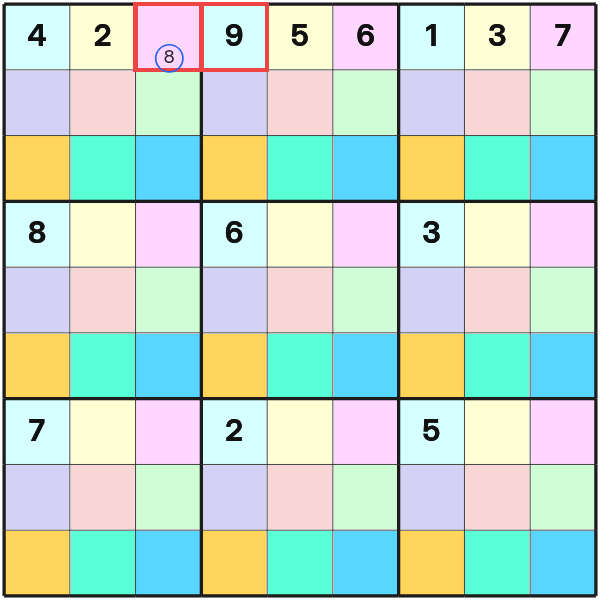
Hence, 8 is missing at (1,3). This is the first entry from the supplementary rule; it directly leads to a normal Sudoku step.
Typical Solving Process
- Solve for sure entries in rows, columns, and normal 3×3 blocks.
- Then go through each marked supplementary group completely.
- Eliminate numbers already present in the supplementary group.
- Search for a missing number with only one possible spot in the supplementary group.
- Connect pairs and other small candidate groups with normal Sudoku units.
- After each entry, recheck all normal and additional groups of the cell.
Common Mistakes
- Overlooking the marked supplementary area: A candidate allowed traditionally may already occur there.
- Comparing only neighboring marked cells: The entire supplementary area is a shared unit.
- Confusing supplementary group with a normal block: Both groups are valid simultaneously but have different boundaries.
- Searching only for complete groups: Even a single exclusion via the supplementary rule can enable the next step.
- Checking only the row after an entry: The affected supplementary group must also be read again immediately.
- Rushing too early: If multiple numbers are possible, the cell is not yet solved.
- Not rechecking after an entry: A new number can immediately solve other cells.
Tips for Beginners
- Mark or track an entire supplementary group instead of only neighboring cells.
- First look for supplementary groups with many numbers already placed.
- Check four areas for each cell: row, column, normal block, and supplementary group.
- A candidate possible by classic rules can still be forbidden by the supplementary group.
- Use two missing numbers in a supplementary group with rows or columns to fix their order.
- Scan the supplementary group immediately after each entry.
Solve Sudoku DG in small, safe steps. After each entry, recheck the affected row, column, block, and supplementary hints. This way, you often reach the goal without guessing.