
Download puzzle & solution
Share puzzle
Our puzzles are completely free. Please support this website by recommending it to your friends and family. Thank you!
New puzzle
Sudoku
Sudoku is a number logic puzzle on a grid of nine rows and nine columns. The grid is additionally divided into nine blocks of 3×3 cells by thicker lines. Some digits are given; the remaining cells are filled in solely through logical deductions.
The same puzzle type is also historically known as Number Place. Although digits are used, no calculations are performed: the crucial aspect is exclusively where each digit can still be placed within a row, column, and block.
Basic Rules
- Exactly one digit from
1to9must be placed in each empty cell. - Each digit from
1to9must appear exactly once in each row. - Each digit from
1to9must appear exactly once in each column. - In each bolded 3×3 block, each digit from
1to9must appear exactly once. - The given digits are not altered.
These three types of areas – row, column, and block – are collectively often called units. Two cells influence each other if they share at least one such unit, meaning they cannot contain the same digit.
Coordinates and Candidates
A cell is uniquely described by its row and column, for example “Row 4, Column 7”. Rows are counted from top to bottom, columns from left to right. The top-left block extends from row 1, column 1 to row 3, column 3.
A candidate is a digit that can still be placed in an empty cell according to the immediately visible row, column, and block rules. Small candidate notes help compare possibilities. After each placed digit and each confirmed elimination, these notes must be updated.
Strategic Entry
Start with almost complete units and highly restricted cells. Then search for each digit individually in the rows, columns, and blocks. Only when direct placements no longer suffice, comparing multiple candidate cells becomes worthwhile.
The following seven steps lead from immediate placements to two fundamental pair techniques. Red-marked candidates are eliminated, green or circled candidates are the result of the respective deduction.
While scanning, two questions are particularly useful: “Which digit is missing in this unit?” and “Which digits are still allowed in this cell?” The first often leads to the last missing digit or a hidden single, while the second leads to a naked single. Regularly switching between both perspectives prevents simple steps from being overlooked.
Candidate notes should always be calculated from all three units of a cell. For example, if a 6 is missing in a row, it does not automatically mean it is possible in every empty cell in that row: a 6 already present in the corresponding column or block may exclude the space. Note only actually allowed digits and treat each subsequent elimination as new information for the crossing units.
1. Placing the last missing digit
In the bottom-left 3×3 block, the digits 1, 2, 3, 4, 5, 7, 8, and 9 are already present. Only 6 is missing, and only the cell in row 7, column 2, is empty within the block.
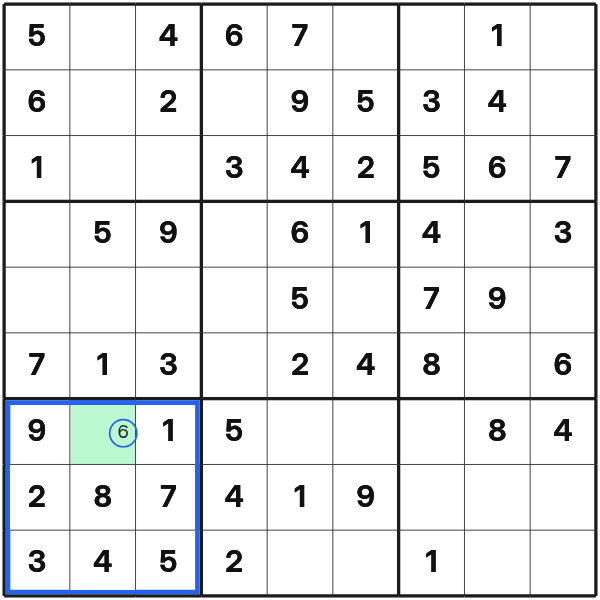
Therefore, 6 must be placed in row 7, column 2. This simplest situation is often called the last missing digit or Full House: a unit has only one empty cell, the value of which is fully determined by the missing digit.
Immediately after placing, check row 7 and column 2. The new 6 may eliminate further candidates there and generate the next direct step.
2. Recognizing a naked single
In the second example, consider the cell at row 1, column 4. The already filled cells in its row, column, and 3×3 block exclude the digits 1, 2, 3, 4, 5, 7, 8, and 9.
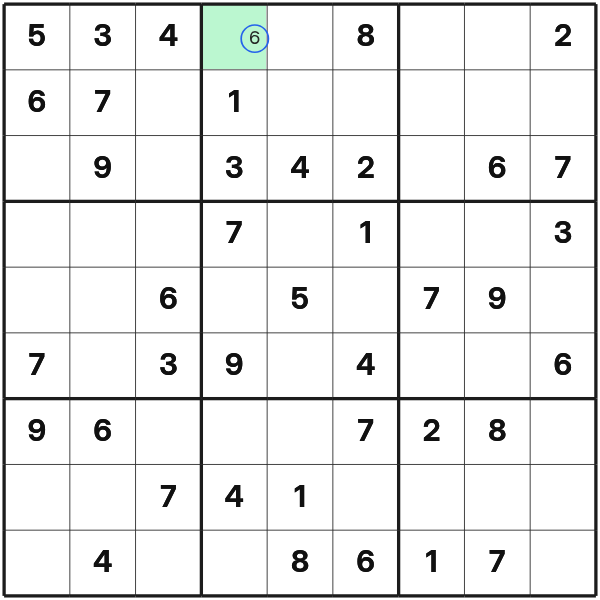
Only the candidate 6 remains for this cell; hence, 6 is placed there. A cell with exactly one remaining candidate is called a naked single. Unlike the previous step, in each of the three involved units, there may still be multiple empty cells.
The focus here is on a single cell: the decisive factor is the union of all prohibitions from row, column, and block. Once eight digits are excluded, the ninth is inevitable.
3. Finding a hidden single in a unit
Now, the entire first row is examined. Candidate notes show that the cell at row 1, column 4, could initially contain both 6 and 7. In all other empty cells in this row, 6 is excluded by their columns or blocks.
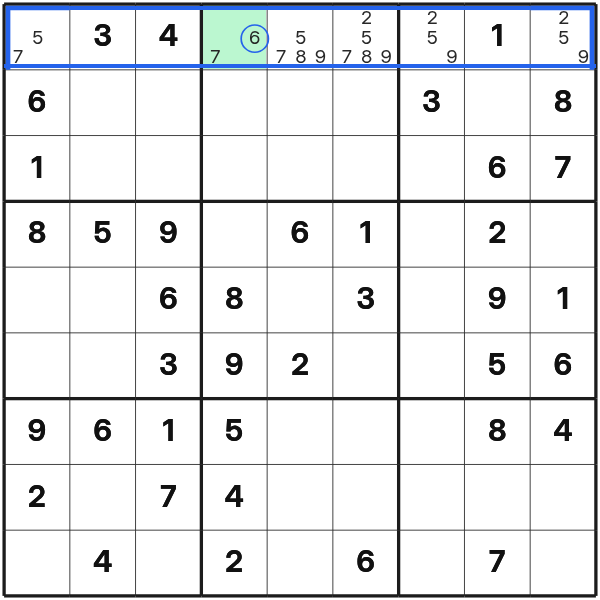
Since each row must contain a 6, only the cell at row 1, column 4, remains as a possible location for this digit. Thus, 6 is again placed there, but this time for a different reason: the candidate is not alone in the cell but has only one possible spot within the row.
This hidden single is easier to find when tracking a particular digit across the whole unit. For example, look sequentially for all possible positions of 1, then 2, and so on.
4. Block-row interaction: Pointing
In the top-left block, 1 can only be in row 1, column 1, or in row 3, column 1. Both possibilities are in column 1. Which of these cells actually gets the 1 is still open; for the remaining column, the shared alignment is enough.
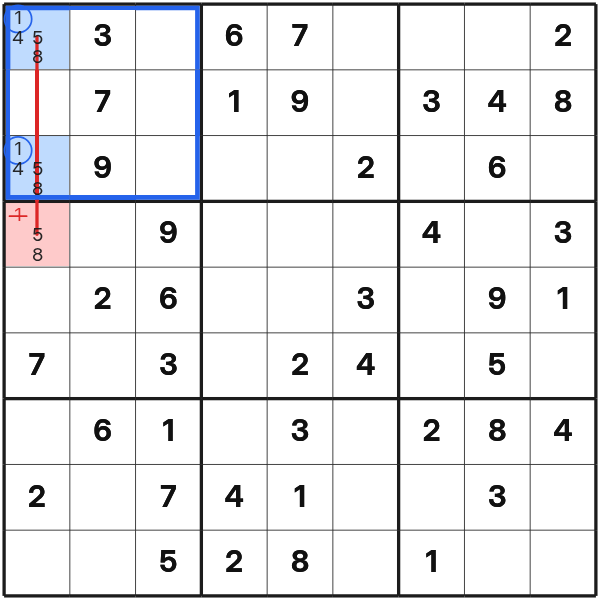
The 1 of the block will definitely be placed in column 1. Therefore, no other cell in this column outside the block can contain a 1. The candidate 1 is thus eliminated from the cell at row 4, column 1.
This technique is called block-line interaction or Locked Candidates Type 1 (Pointing): multiple candidates of a block lie together in exactly one row or column. The initial result is a elimination, not necessarily a placed digit.
5. Row-block interaction: Claiming
The reverse view also works. In row 3, 1 can only be in column 1 or column 3. Both cells are part of the top-left 3×3 block.
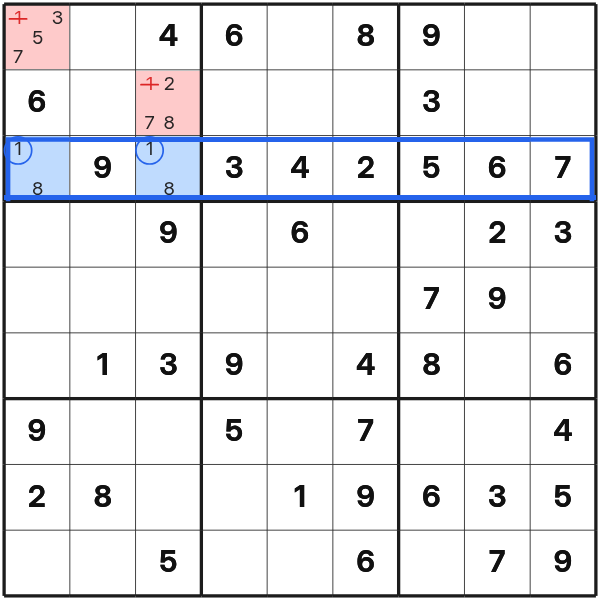
Row 3 claims the 1 within this block. Other cells of the block that are not in row 3 can no longer be 1. In the illustration, the candidates in row 1, column 1, and in row 2, column 3, are eliminated accordingly.
This variant is called row-block interaction or Locked Candidates Type 2 (Claiming). Remember the direction: pointing starts in the block and affects a line; claiming starts in a line or column and affects the block.
6. Evaluating a naked pair
In row 1, the cells in columns 1 and 3 each have exactly the candidates 4 and 5. These two cells must contain these two digits in some order.
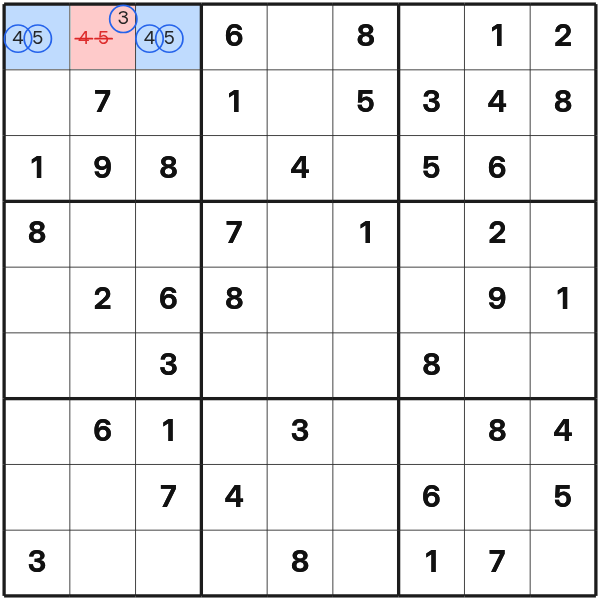
Hence, 4 and 5 are reserved for these two cells and can be removed from all other cells in the same row. The cell at row 1, column 2, therefore, loses candidates 4 and 5; only 3 remains from the original candidates 3, 4, 5.
The naked pair directly produces a naked single there: at row 1, column 2, 3 must be placed. It is important that both pair cells together contain exactly two different candidates and belong to the same unit.
7. Revealing a hidden pair
In row 3, the candidates 5 and 6 appear only in the cells of columns 7 and 8. Especially in the cell at column 8, they are hidden among the additional candidates 4 and 7.
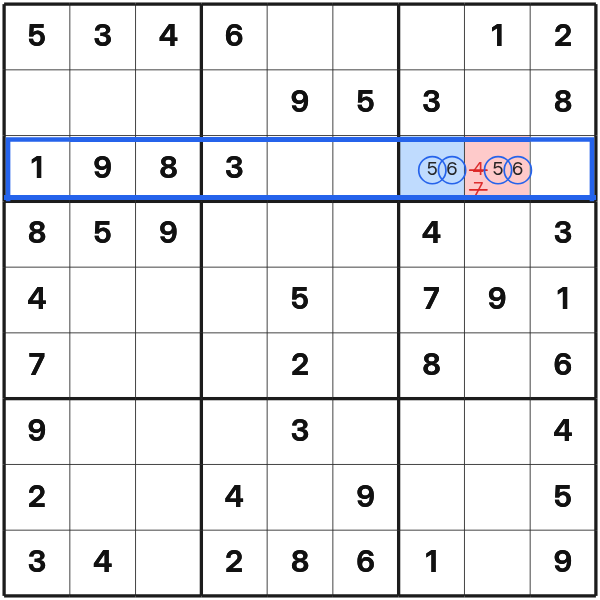
Because the row requires both a 5 and a 6, these two digits must occupy the two mentioned cells. The additional candidates 4 and 7 are thus eliminated from the cell at row 3, column 8; both cells now contain only 5 or 6.
In the hidden pair, search not for two cells with identical notes, but for two digits that occur only in the same two cells within a unit. Only after eliminating the other notes does the pair become visible.
Typical Solution Process
- Check rows, columns, and blocks with only a few gaps for the last missing digit.
- Examine highly restricted cells for naked singles.
- Follow each remaining missing digit within a unit and look for hidden singles.
- Only enter the actually still possible candidates and update them after each step.
- Look for block-line or line-block interactions at the intersections of blocks and lines.
- Compare candidate lists for naked or hidden pairs.
- After each elimination, return to singles before seeking a more complex technique.
Common Mistakes
- Only check row and column: The 3×3 block can also exclude a candidate.
- Confusing a candidate with a solution: A small note only means “still possible,” not “must be here.”
- Keep outdated notes: After entering a new digit, all affected candidates must be corrected.
- Assuming a pair too early: Two cells form a naked pair only if their combined candidate set contains exactly two digits.
- Overextending block-line eliminations: When pointing, only eliminate outside the block along the line; when claiming, only inside the block outside the line.
- Guessing: If no step is visible, a systematic re-scan is more reliable than an unsupported trial count.
Tips for Beginners
- Work with a fixed search order, e.g., blocks, rows, columns, then individual digits.
- Make candidate marks small and readable; cluttered or incomplete notes are more error-prone.
- State a brief proof before each entry: Which unit enforces the number or which candidates are excluded by what?
- After a elimination, don’t immediately proceed with pairs, but first look for newly formed singles.
- Check completed units: each digit from
1to9must appear exactly once.
Conclusion
Sudoku is solved not by calculations, but by gradually restricting possible positions. Last digits and singles offer direct placements; block-line interactions and pairs create safe eliminations. Switching between these simple tools after each result allows many classic Sudoku puzzles to be solved fully and without guessing.