
Sudoku Mine – Hard
Download puzzle & solution
Share puzzle
Our puzzles are completely free. Please support this website by recommending it to your friends and family. Thank you!
New puzzle
Sudoku Mine Solving: Rules and Strategies
Sudoku Mine is a variant of Sudoku. Sudoku Mine combines mine searching with fixed quantity conditions for rows, columns, and 3×3 blocks.
The puzzle type is also called Mine Sudoku or Minesweeper Sudoku.
Each row, each column, and each 3×3 block contains exactly three mines. A number indicates the mines in its up to eight neighboring fields.
The goal is to identify all mines without guessing. Safe empty fields are marked with a cross so they are not considered potential mines in later steps.
Rules
- Exactly three mines in each row.
- Exactly three mines in each column.
- Exactly three mines in each 3×3 block.
- A number indicates the count of mines in its horizontal, vertical, and diagonal neighbors.
- The number fields themselves are not mines.
- The puzzle is solved when all mines and safe fields are determined, each row, column, and block contains exactly three mines, and all number clues are correct.
Orientation in the grid
Rows are counted from top to bottom, columns from left to right. For a pair of numbers, the first indicates the row, the second the column; e.g., (4,7) refers to the cell in row 4, column 7.
The images show specific intermediate states. A black circle indicates a confirmed mine, a cross indicates a safe empty field. Blue marks the used clues and assumptions, yellow the still empty target fields, and green the entered result.
Basic solving idea
Switch systematically between number clues and the rule with exactly three mines per row, column, and block. Mark safe fields as consistently as confirmed mines.
Immediately check the affected row, column, 3×3 block, and all neighboring number clues after each new mine or safe field. Often, this directly leads to the next step.
1. Which fields a number clue counts
The 3 in (5,5) relates to the eight fields directly around the clue, including horizontal, vertical, and the four diagonal neighbors.
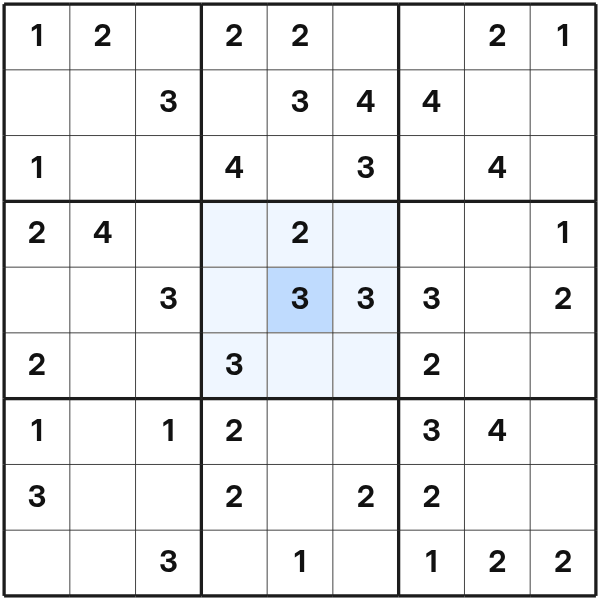
The number field itself is safe. Other number fields in the marked environment can also not be mines. Among the remaining empty neighbors, there must be exactly three mines in total.
2. Recognizing three possible fields in a row
In row 1, only (1,3), (1,6), and (1,7) are empty. All other fields in this row contain number clues and are thus safe.
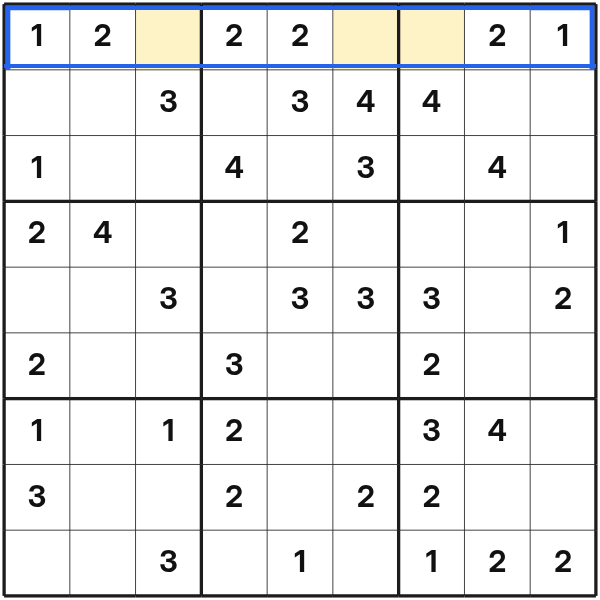
Each row contains exactly three mines. Therefore, the three yellow marked, still empty fields must be mines. The number clues do not need to be used for this conclusion.
3. Enter the three mines of the row
The previous step clearly identified all three empty fields in the first row. Now, mark the mines symbols there.
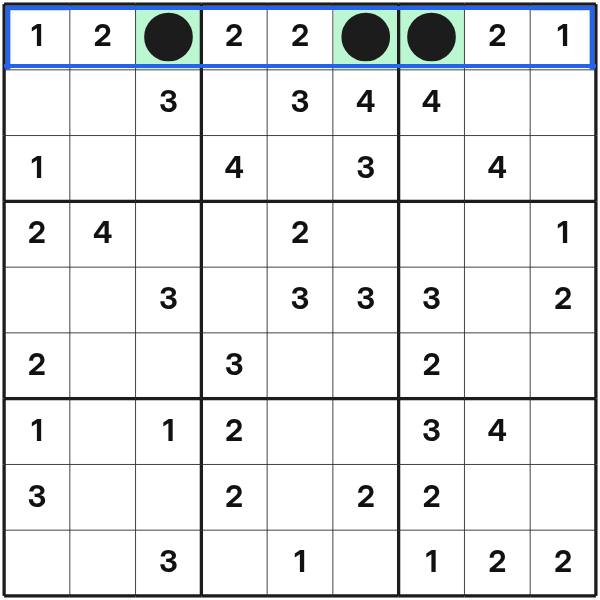
Row 1 now contains exactly three mines. The new mines immediately influence the number clues in the first two rows and the two top 3×3 blocks.
4. Find the missing mine for a clue
The 2 at (1,4) already sees the mine at (1,3). Of its other neighbors, only (2,4) is an empty field; the other neighbors are number fields and therefore safe.
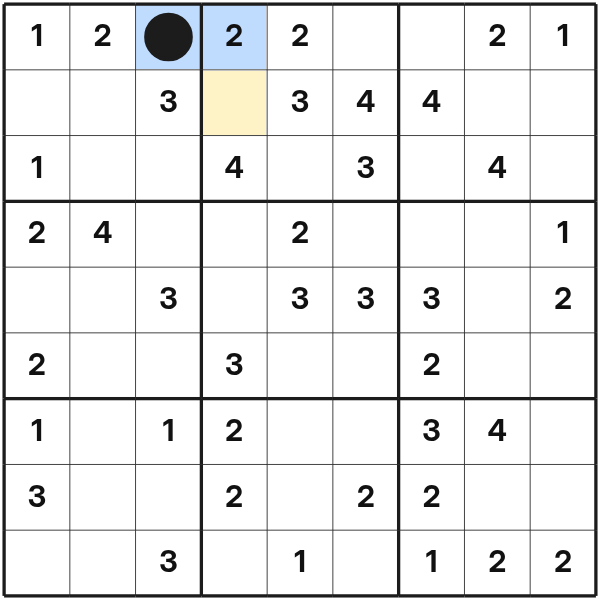
The value 2 requires exactly one more mine. Therefore, the yellow marked, still empty field (2,4) must be a mine.
5. Confirm the second mine for the clue
The mine at (2,4) is now entered. Together with the already known mine at (1,3), it fulfills the clue 2.
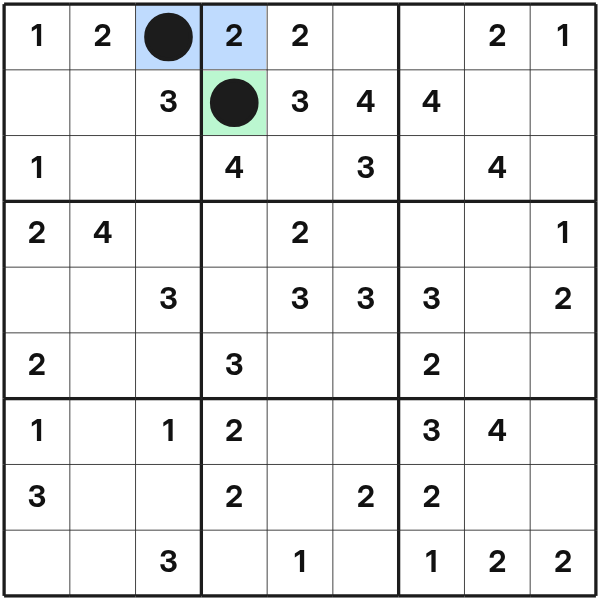
Now, exactly two mines are near the 2. All other neighbors of this clue stay safe.
6. Recognize all remaining neighbor fields as mines
The 4 at (2,6) has four possible neighboring mines. Two of them, (1,6) and (1,7), are already known as mines. Only (3,5) and (3,7) remain open.
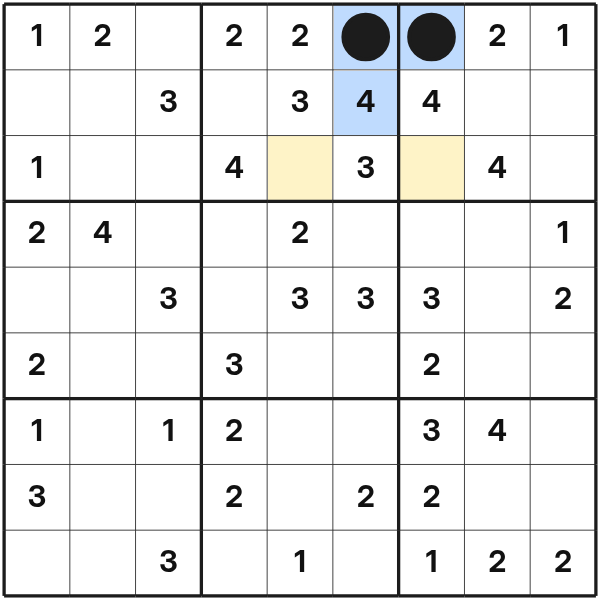
The clue still needs two mines, and there are exactly two possible fields. Therefore, both yellow marked fields are mines; they are still empty before marking in the image.
7. Enter the two forced mines
The two previously identified fields (3,5) and (3,7) are marked as mines.
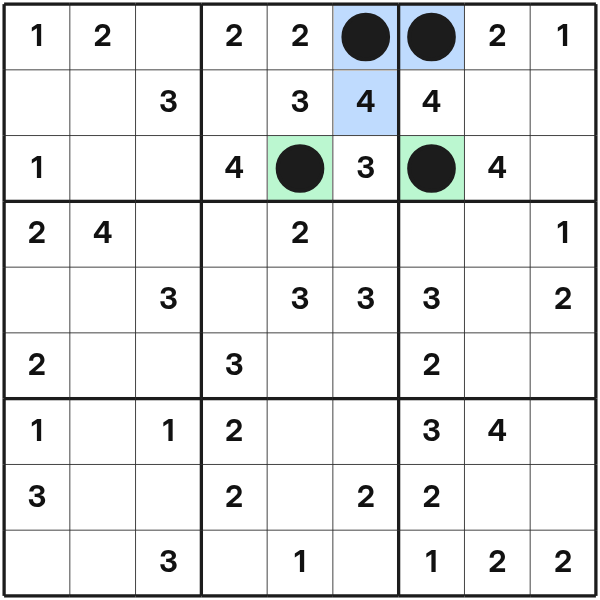
The 4 in (2,6) now shows exactly four mines. This step also provides new information for row 3, columns 5 and 7, and the adjacent blocks.
8. Secure a field after fulfilling a hint
The 1 at (1,1) already sees the mine at (2,1). Its required mine count is thus fully met.
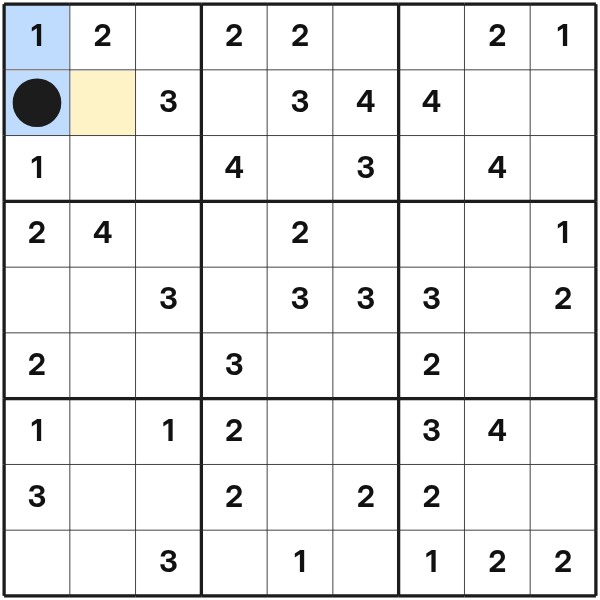
The other potential neighboring field (2,2) cannot be a mine. It is marked yellow and still empty in the image before marking the safety cross.
9. Mark the safe field with a cross
A cross is now placed at (2,2). The cross indicates that this empty field definitely does not contain a mine.
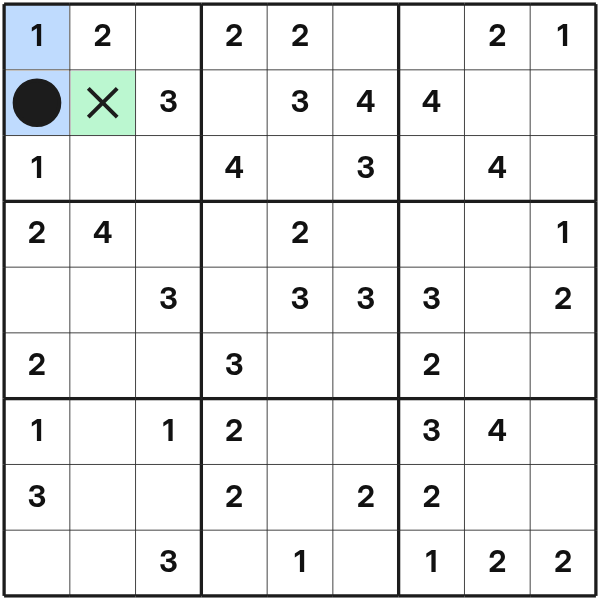
Safety markings are important: they reduce the remaining neighbors of other clues without themselves being counted as mines.
10. After three block mines, secure the remaining fields
The top right 3×3 block already has three mines marked. The required number for this block is thus reached.
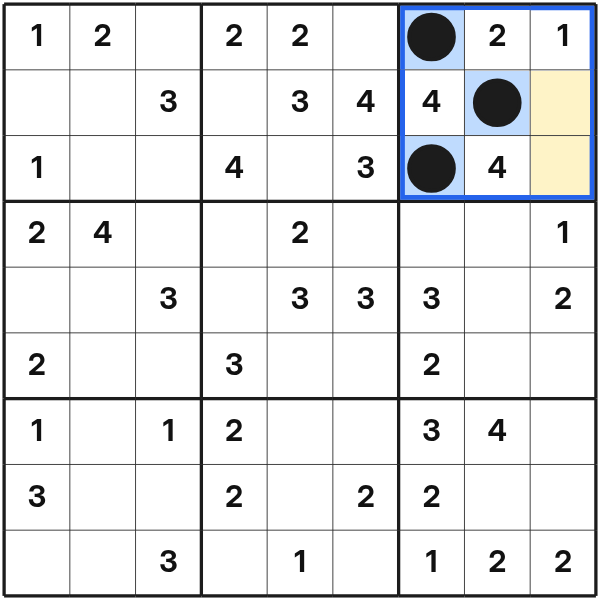
The two yellow marked, still empty fields (2,9) and (3,9) cannot be mines anymore. The clue 1 at (1,9) confirms the same for (2,9).
11. Enter the safe block fields
Safety crosses are now set in (2,9) and (3,9). The three mines of the block remain unchanged.
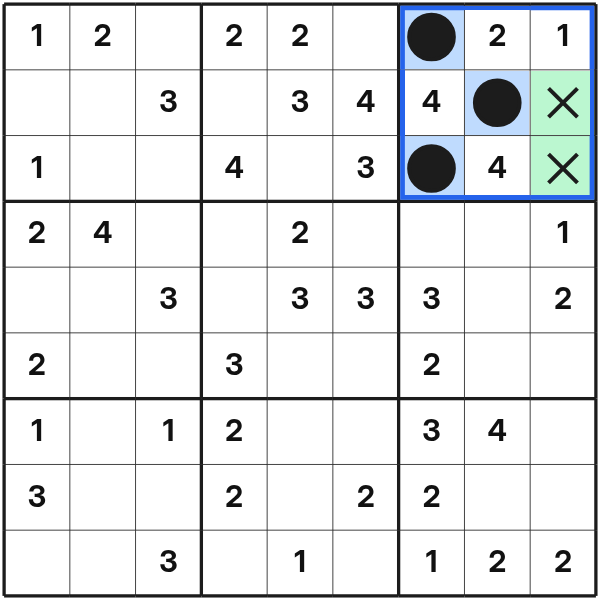
The block is now fully evaluated: three mines and two explicitly safe non-clue fields. The crosses help in column 9 and neighboring number clues afterward.
12. Overlapping clues comparison
The 1 at (1,1) requires exactly one mine in the two jointly marked fields (2,1) and (2,2). The 2 at (1,2) sees the same two fields plus (1,3).
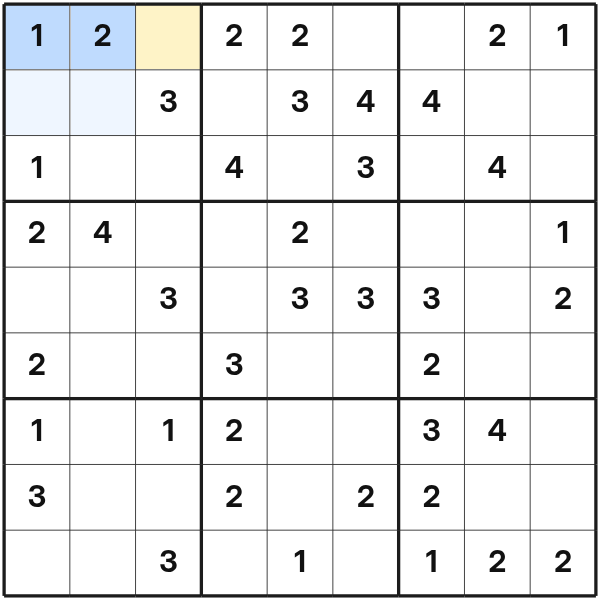
The second clue needs exactly one more mine than the first. This additional mine can only be in the yellow marked, still empty field (1,3).
13. Enter the additional mine for the larger clue
The comparison result is implemented: (1,3) gets a mine symbol. The exact position of the single mine in (2,1) and (2,2) does not need to be known for this.
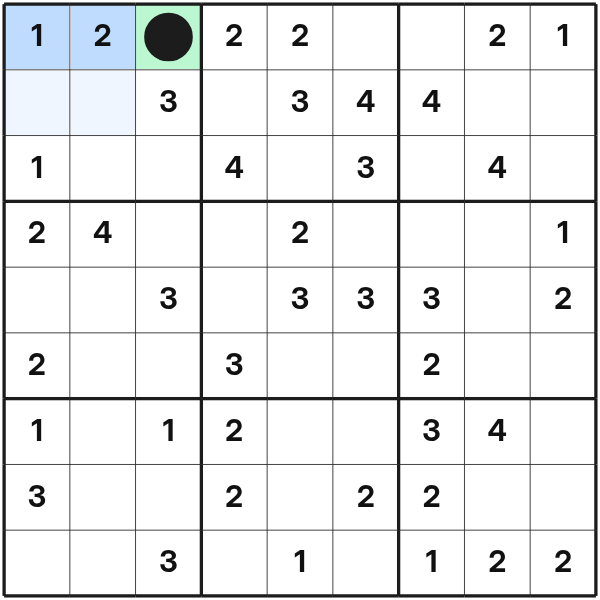
Both clues can now be satisfied simultaneously: one mine in the shared pair group, the other exclusively in the additional field of 2.
14. Use similar clues for a safe field
The 1 at (1,1) and the 1 at (3,1) both see the shared pair (2,1) and (2,2). The lower clue also sees the field (3,2).
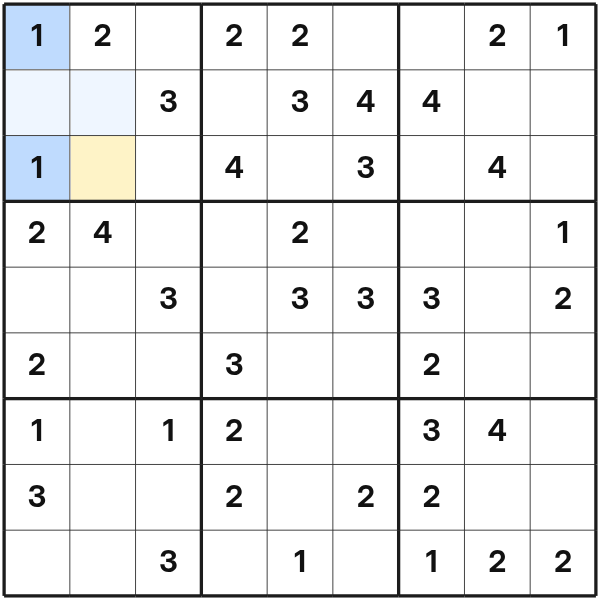
Both clues require the same number of mines. Therefore, no mine can be in the additional, yellow marked field (3,2); it is still empty before marking the cross.
15. Mark the safe difference field
The comparison result is maintained with a cross at (3,2). The one mine both clues require remains in the shared pair group.
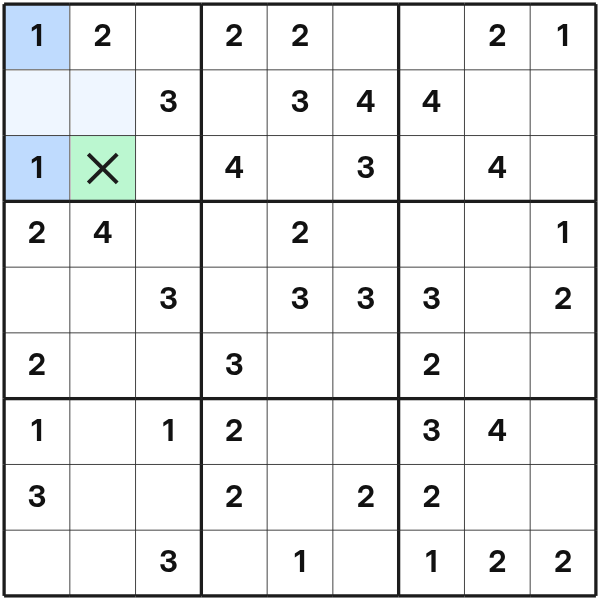 Even without knowing the mine in the pair group exactly, (3,2) is sure. Such quantity comparisons are especially useful when individual clues alone do not determine a mine.
Typical solving process
- Count potential mine fields in each row, column, and 3×3 block.
- Check number clues with already confirmed mines.
- The achieved mine counts make all remaining neighbors safe.
- If three mines are reached in a row, column, or block, the rest there is safe.
- Immediately transfer each new mine and each safe field to all affected clues.
Common mistakes
- Treat number fields as potential mines: Only empty fields can contain mines.
- Count only orthogonal neighbors: The number also includes diagonal neighbors.
- Read the triple rule only as a maximum: Each row, column, and block contains exactly three mines.
- Do not mark safe fields: Even a confirmed non-mine field provides important info for neighboring numbers.
- Solve number clues and the triple rule separately: The strongest deductions combine both rule types.
- Consider overlapping numbers individually: Comparing their neighbor fields often reveals mines or safe fields.
- Guess too early: When multiple numbers are possible, the field is not yet solved.
- Do not recheck after each entry: A new number can immediately solve more fields.
Tips for beginners
- Count confirmed mines and still possible mine fields in each row, column, and block separately.
- Use your own symbol consistently for safe fields.
- Start with clues that are almost fulfilled or have few unknown neighbors.
- Compare neighboring number clues when their neighbors greatly overlap.
- Check all surrounding number clues after each new mine.
- Also verify if three mines are reached or if only so many spaces are left as missing mines.
Solve Sudoku Mine in small, safe steps. Count the neighboring clues and the three mines in row, column, and block again after each marking. This way, the entire minefield can be determined without guessing.