
Sudoku Mine – Medium
Download puzzle & solution
Share puzzle
Our puzzles are completely free. Please support this website by recommending it to your friends and family. Thank you!
New puzzle
Sudoku Mine
Sudoku Mine combines Minesweeper logic with an additional Sudoku structure. Mines must be placed in empty cells. The given numbers indicate how many mines are in the directly adjacent cells. Additionally, each row, each column, and each 3x3 region must contain exactly three mines.
The supplementary rule is crucial: it’s not just "at most three," but exactly three mines per row, column, and 3x3 region.
Basic Rules
- The game board consists of 9 rows and 9 columns, divided into nine 3x3 regions.
- Exactly three mines are in each row.
- Exactly three mines are in each column.
- Exactly three mines are in each 3x3 region.
- A number indicates how many mines are in the adjacent cells.
- Adjacent includes cells horizontally, vertically, and diagonally neighboring.
- The puzzle is solved when all numerical clues are satisfied and each row, each column, and each 3x3 region contains exactly three mines.
Strategies for Solving
1. Three possible cells mean three mines
In the first row of the following example puzzle, only three cells are empty. Since each row must contain exactly three mines and number cells cannot be mines, all three empty cells must be mines.
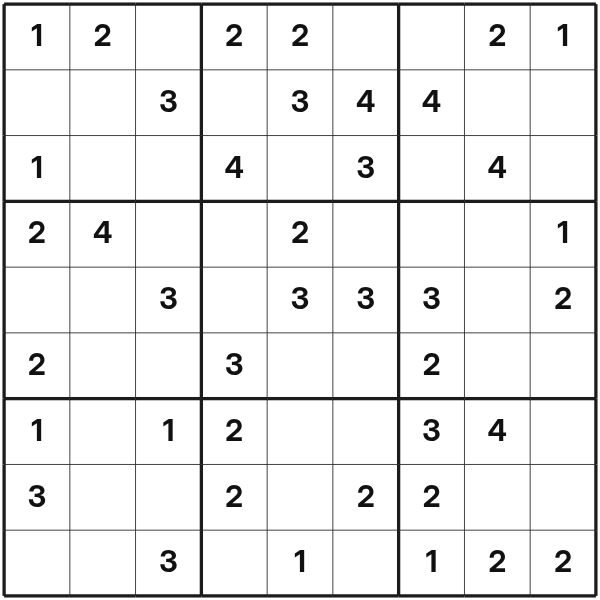
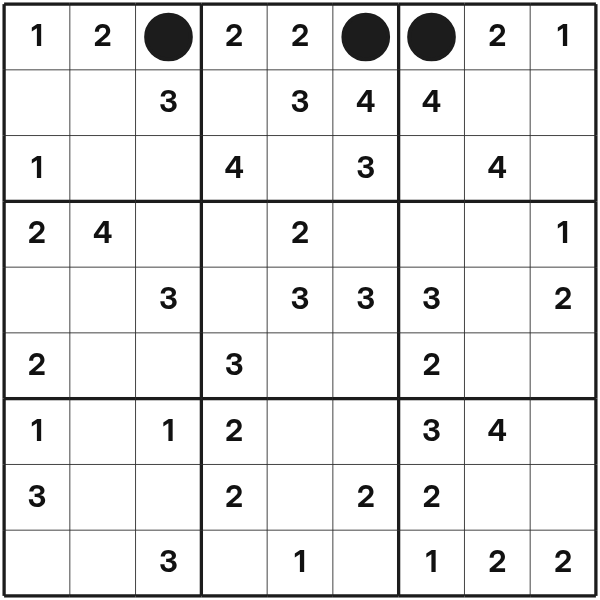
This step only uses the rule "exactly three mines per row." The number clues do not need to be evaluated yet.
2. A number clue enforces another mine
Now consider the 2 in the fourth cell of the first row. Among its adjacent cells, the mine to the left is already known. The other adjacent number cells cannot be mines. This leaves only the cell directly below as the second mine.
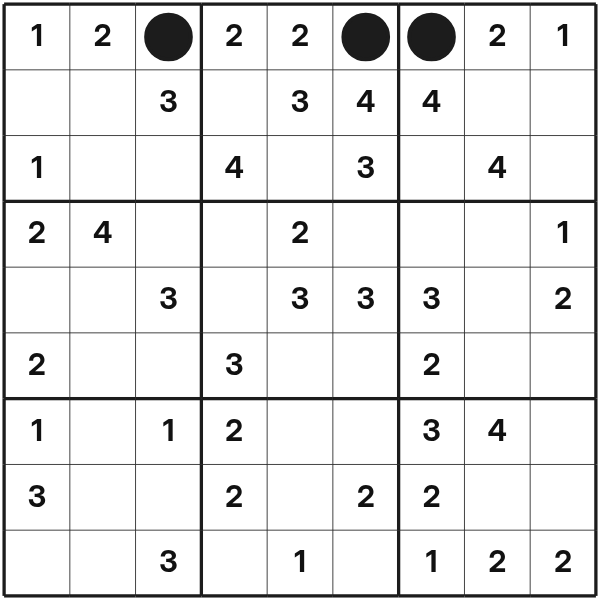
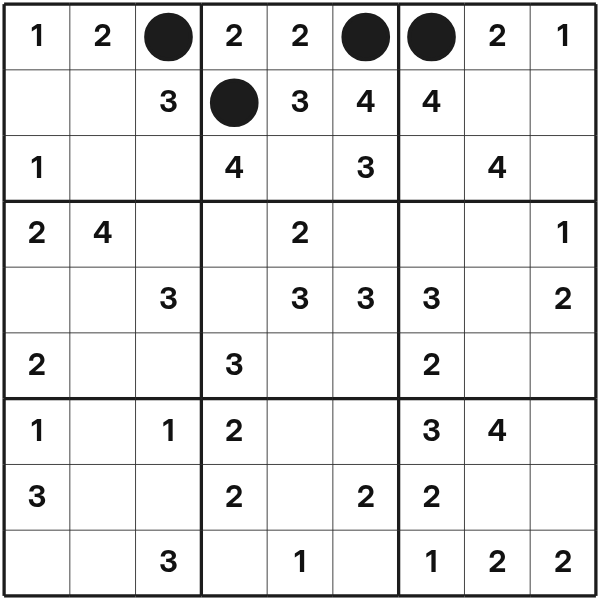
The 2 now precisely indicates two mines: the mine to the left and the new mine directly below. The entry is unambiguous.
3. When all possible neighbors are needed
Next, consider the 4 in the seventh cell of the second row. Its neighbors already contain two mines in the first row. All other neighboring cells are number cells, except for the cell to the right and the diagonally left below.
The 4 needs a total of four neighboring mines. Two are already known, and exactly two possible mine cells remain. Therefore, both cells must be mines.
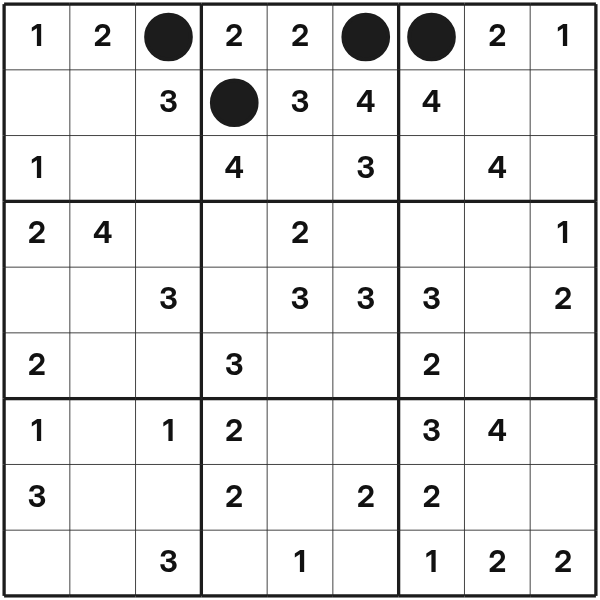
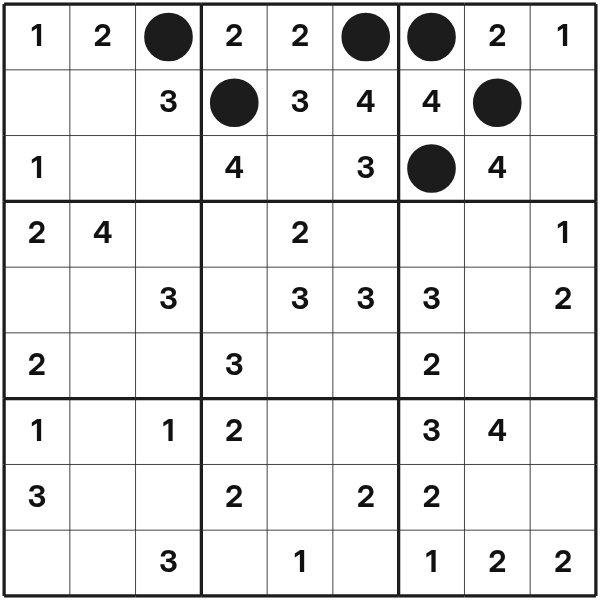
Again, no guesswork: the clue still requires two more mines, and there are exactly two potential fields.
4. Three mines in a region make all other cells safe
In the upper right 3x3 region, there are now three mines: one in the first row, and one each in the second and third rows. Since each region must contain exactly three mines, the remaining empty cells in this region cannot be mines.
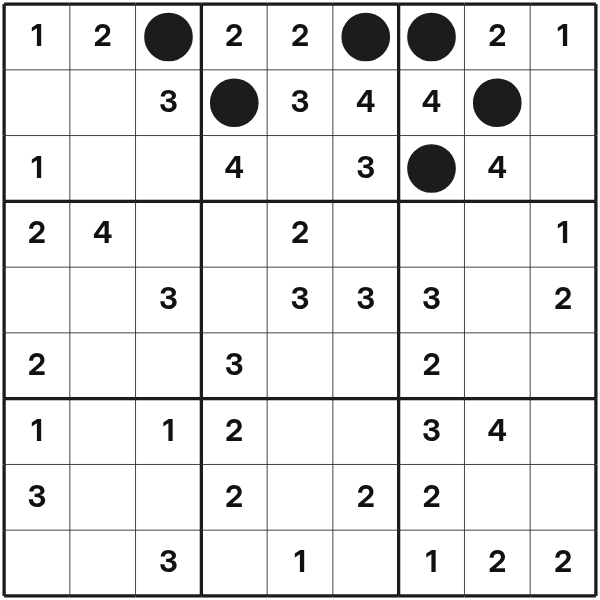
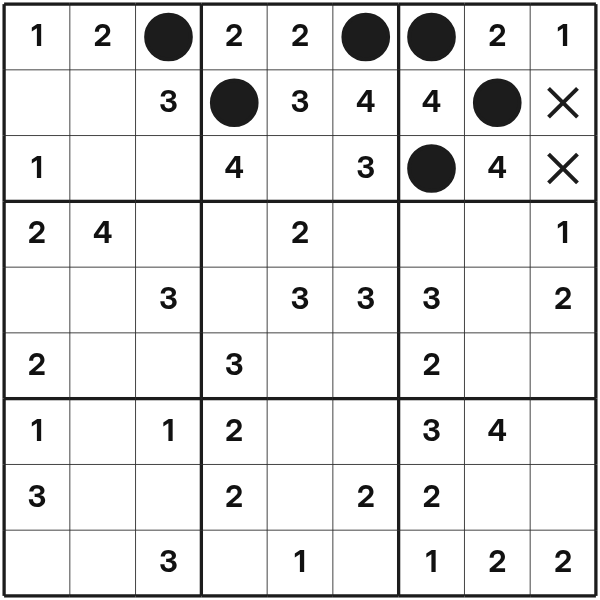
The 1 in the upper right confirms the same conclusion: next to it, exactly one mine is already present, so the other empty neighboring cell is safe.
5. Using local and global rules together
The strongest steps often arise from combining both rule types:
- A number clue specifies how many mines are directly adjacent.
- The row rule limits the total number of mines in the entire row to exactly three.
- The column rule does the same for the column.
- The region rule limits mines in the corresponding 3x3 area.
A cell may locally seem possible as a mine but be excluded by a complete row, column, or region. Conversely, the three-mine rule can enforce a mine even if no single number clue alone determines it.
Typical Solution Process
- Count in each row, column, and 3x3 region how many empty, potential-mine cells are there.
- If a region has exactly three possible cells, mark all three as mines.
- If three mines are already known in a region, mark all other empty cells in that region as safe.
- Check number clues where mines are already known.
- If the specified number of mines is reached, all remaining neighbors are safe.
- If the number of unknown neighbors equals the remaining mines needed, all these neighbors are mines.
- Immediately transfer each new entry to the affected row, column, region, and all adjacent number clues.
Common Mistakes
- Overlooking the three-mine rule altogether or thinking it means "at most three." In fact, each row, column, and region must have exactly three mines.
- Not counting the 3x3 regions.
- Forgetting diagonal neighbors in a number clue.
- Only marking mines and not labeling safe cells.
- Checking local number clues but ignoring the total of three mines per region.
Tips for Beginners
- Start with rows, columns, or regions that contain only three empty cells.
- Mentally track "mines known / mines missing" for each area.
- Mark safe cells as consistently as mines.
- After each entry, always check four things: neighboring numbers, row, column, and region.
- If a step is not clearly justified by a number or the three-mine rule, do not mark anything yet.
Sudoku Mine is more than Minesweeper in a 9x9 grid. The local number clues and the requirement of exactly three mines per row, column, and region continually interact. Those who combine both levels consistently can solve the puzzle step by step without guessing.