
Download puzzle & solution
Share puzzle
Our puzzles are completely free. Please support this website by recommending it to your friends and family. Thank you!
New puzzle
Solve Sudoku XV: Rules and Strategies
Sudoku XV is a Sudoku variation. Roman numeral symbols between neighboring cells specify paired sums.
An X indicates a sum of 10, a V indicates a sum of 5. In this fully marked version, unmarked neighboring cells cannot sum to 5 or 10.
The goal is a fully and correctly filled puzzle. Each entry must be deduced from the visible clues and the already placed numbers.
Rules
- Each cell contains exactly one number from 1 to 9.
- Each row contains numbers 1 to 9 without repetition.
- Each column contains numbers 1 to 9 without repetition.
- Each normal 3×3 block contains numbers 1 to 9 exactly once.
- An X indicates a sum of 10, a V indicates a sum of 5. In this fully marked version, unmarked neighboring cells cannot sum to 5 or 10.
- Given numbers are not changed.
- Each entry must satisfy all the rules.
Grid Orientation
Rows are counted from top to bottom, columns from left to right. At (4,7), 4 is the row and 7 is the column.
The images show specific intermediate states. Blue-marked cells are used for the step, red means excluded, and green indicates a confirmed result. Yellow highlights the currently considered cell. Small numbers in an empty cell are candidates; a circle marks the logically determined value.
Basic Solving Idea
Memorize the possible V and X pairs. For each symbol, sum both cells and use in this fully marked version missing symbols as exclusions for sums 5 and 10.
After each confirmed entry, check the affected row, column, block, and all additional clues again. Often, this already yields the next step.
1. Know the possible V pairs
A V requires a sum of 5. Since neighboring cells must not be the same, only 1+4 and 2+3 are possible.
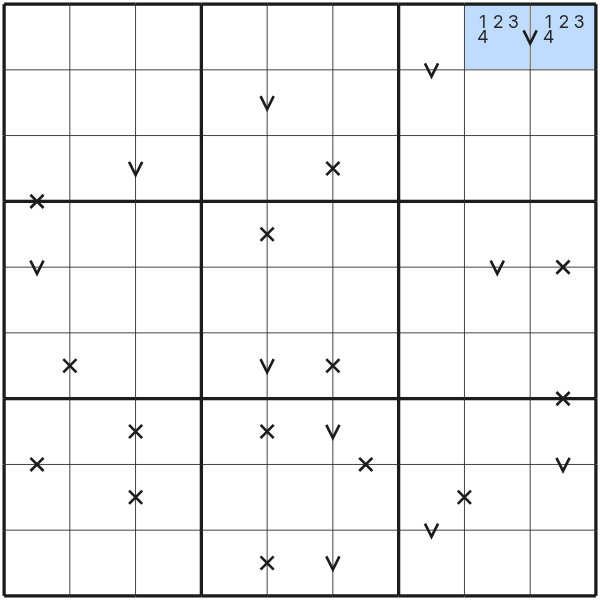
Both marked cells are still empty. The small notes initially show 1, 2, 3, and 4. Further numbers in the row, column, or block will determine which pair and order apply.
2. Calculate the partner directly for a V
At (1,8), the value is 4. The V for the empty cell (1,9) requires a total of 5 together.
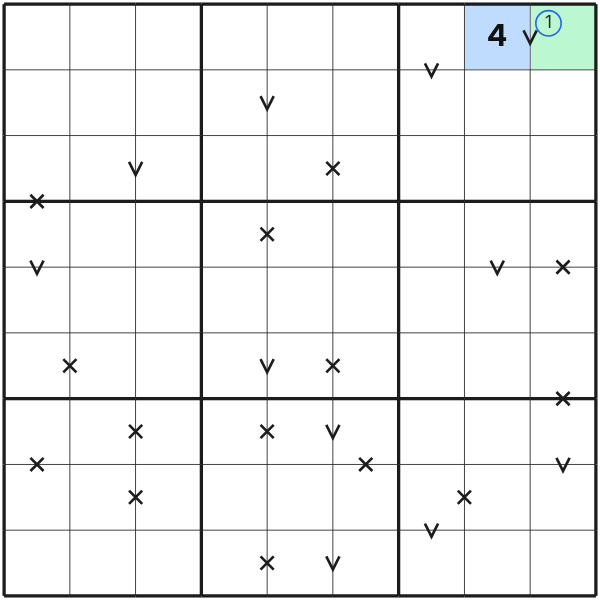
5 − 4 = 1. Therefore, 1 belongs at (1,9). The image leaves the cell blank and shows 1 as a circled candidate.
3. Calculate the partner directly for an X
The X between (4,4) and (4,5) requires a sum of 10. The cell on the right already shows 9.
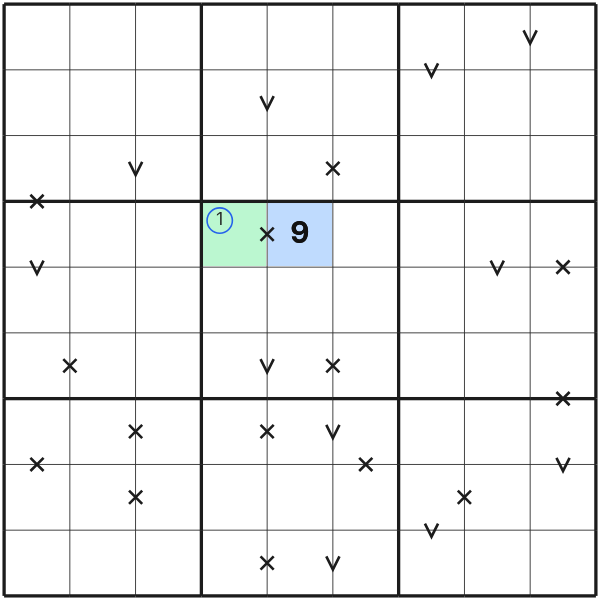
10 − 9 = 1. Therefore, 1 goes into the still empty cell (4,4). Generally, pairs 1+9, 2+8, 3+7, and 4+6 are possible at an X.
4. Remove the 5 from a marked cell
The empty cell (4,4) touches an X. A 5 there would only sum to 10 with another 5.
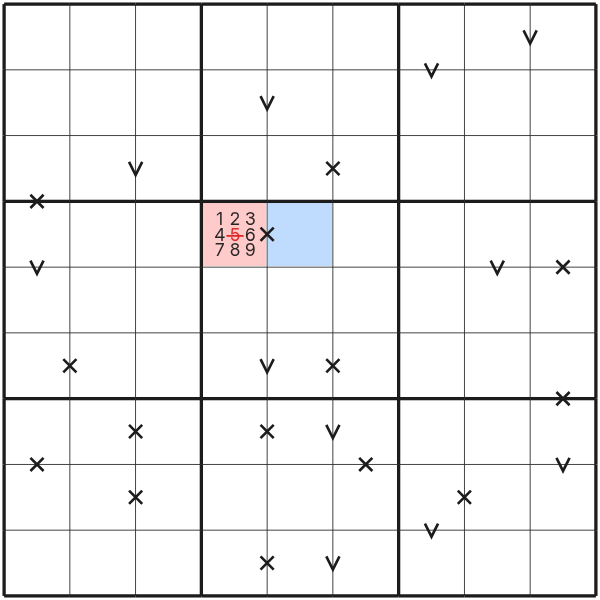
Two identical numbers cannot be side by side in the same row or column. At a V, 5 would even need the forbidden partner 0. Thus, 5 is excluded from every cell touching an X or V.
5. Use missing symbols as exclusions
At (5,2), 1 is present. The three red-marked neighboring cells have neither an V nor an X.
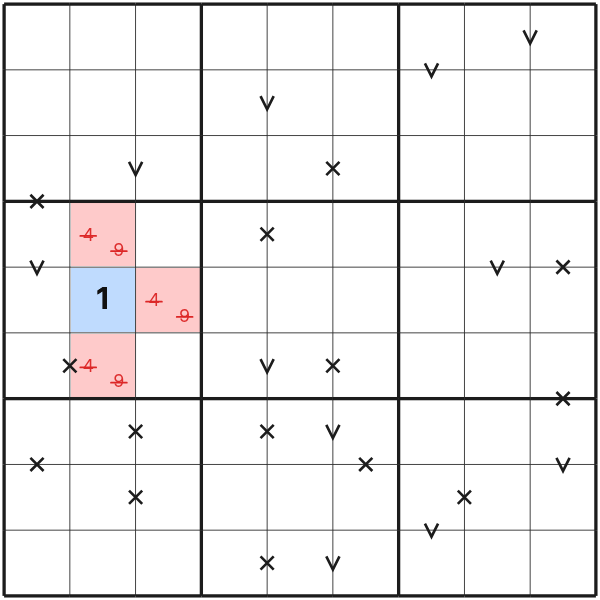
This XV puzzle is fully marked. Therefore, neighbors cannot contain 4 or 9: 1+4 would demand a V, 1+9 an X. This step eliminates candidates without placing a number immediately.
6. Find the last candidate with a missing symbol
Row, column, and block in (3,4) still allow 3, 4, and 9. To the left is 1, but between the cells, no XV symbol is present.
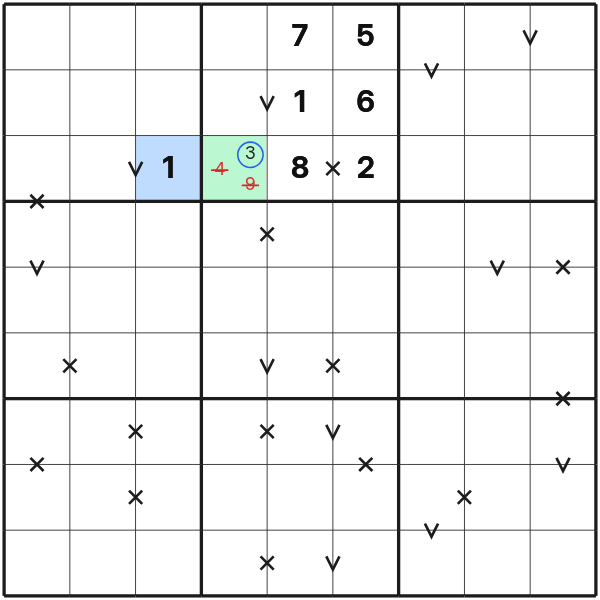
4 and 9 both require marking because 4 with 1 makes 5, and 9 makes 10. Both options would be marked and thus invalid. Only 3 remains for (3,4).
7. Calculate a short V-X chain
At (6,4), the value is 2. The V first determines the middle cell (6,5); its value is then used for the X to the right.
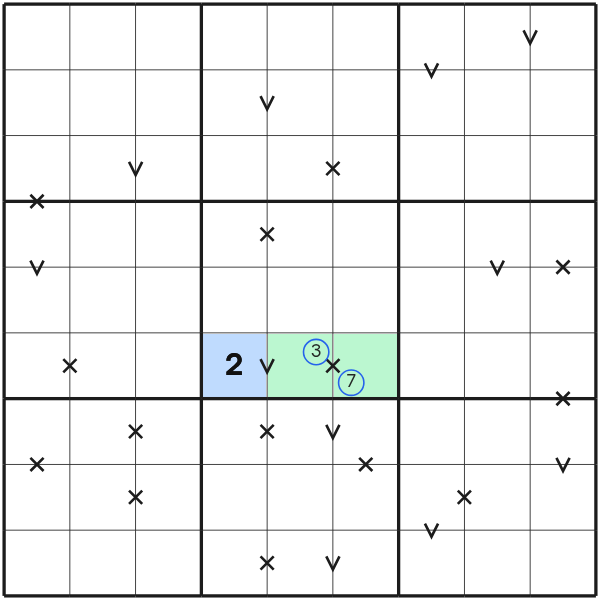
From 5 − 2, the value 3 is in the middle. Then, 10 − 3 gives the value 7 for (6,6). Both cells remain empty in the image; the circled candidates show the order of the two confirmed steps.
8. Combine two V pairs in one block
In the 3×3 block 3, two separate V pairs exist. Each pair is either 1+4 or 2+3.
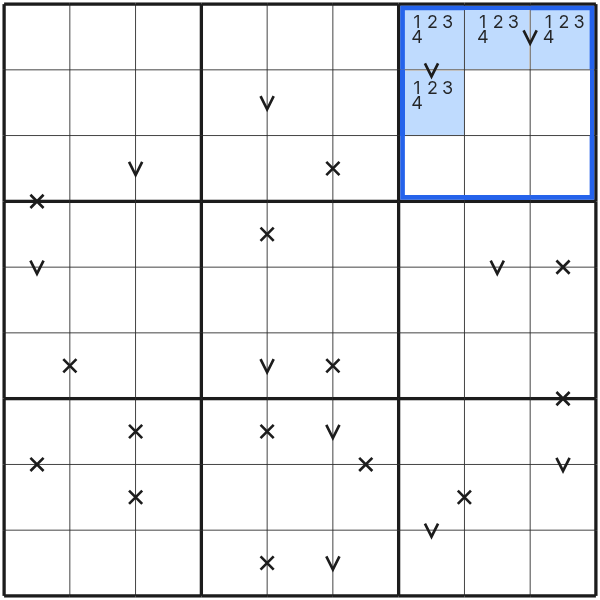
Since duplicate numbers are not allowed in the block, the four marked cells together contain exactly 1, 2, 3, and 4. These four numbers can be eliminated from the other five cells of the block, even if the order within pairs is still open.
Typical Solving Process
- Note the pairs 1+4 and 2+3 for V, and 1+9, 2+8, 3+7, and 4+6 for X.
- Remove 5 from all cells touching an X or V.
- Immediately calculate the second value when a partner is known.
- Check two symbols sharing a cell together.
- Use multiple V pairs in the same row, column, or block as a set of numbers.
- Verify every possible order with normal Sudoku rules.
- Also consider missing symbols: unmarked neighboring cells must not sum to 5 or 10 in this version.
Common Mistakes
- Reading X and V as multiplication or letters: They represent sums 10 and 5.
- Placing a suitable pair without Sudoku check: Row, column, and block still apply.
- Allowing 5+5 as an X pair: Same neighboring numbers violate row or column rules.
- Guess the order of a number pair: The symbol only indicates the sum; position depends on other clues.
- Ignoring missing symbols: The puzzle is fully marked; without symbols, sum cannot be 5 or 10.
- Guess too early: If multiple numbers are possible, the cell is not yet solved.
- Not rechecking after an entry: A new number can immediately resolve more cells.
Tips for Beginners
- Write down the six possible XV pairs beside the puzzle once.
- Remove 5 immediately from every cell touching an X or V.
- Look for known numbers directly next to a symbol; their partners are then easier to determine.
- Check unmarked neighbors for forbidden sums 5 and 10 when known numbers appear.
- Pay attention to cells where two symbols meet.
- Two V pairs in the same Sudoku unit often cover 1, 2, 3, and 4.
- Set the order of a pair only when the row, column, or block confirms it.
Solve Sudoku XV in small, secure steps. After each entry, check the affected row, column, block, and clues again. This way, you often reach the solution without guessing.