
Sujiken – Hard
Download puzzle & solution
Share puzzle
Our puzzles are completely free. Please support this website by recommending it to your friends and family. Thank you!
New puzzle
Sujiken Solving: Rules and Strategies
Sujiken is a Sudoku variant. Sujiken uses 45 fields in a right-angled triangular shape instead of a full square.
Numbers may not repeat in any horizontal, vertical, or diagonal line, nor in any of the six bordered subregions.
The goal is a completely and correctly filled puzzle. Each entry must be deducible from the visible clues and already placed numbers.
Rules
- Numbers 1 to 9 are used.
- No number may repeat in any horizontal, vertical, or diagonal line.
- No number may repeat in any of the three square and three triangular regions.
- A short line or a six-field triangular region does not need to contain all numbers 1 to 9.
- Given numbers remain unchanged.
- The puzzle is solved when all 45 fields are filled, and each line and region are free of repetitions.
Grid Orientation
Rows are counted from top to bottom, columns from left to right. For (4,7), 4 is the row, and 7 is the column.
The images show concrete intermediate states. Blue-marked fields are used for the step, red means excluded, and green indicates a certain result. Yellow highlights the currently considered spot.
Basic Approach to Solving
Check each field horizontally, vertically, diagonally, and within the bordered region. Pay attention to which lines have nine fields and which only prohibit repetitions.
After each certain entry, re-examine the affected row, column, block, and all additional hints. Often, this already leads to the next step.
1. Recognize the three line directions in the triangle
A Sujiken field is checked horizontally, vertically, and diagonally. The three differently marked nine-line paths meet in the triangular grid, even if their directions seem unusual at first.
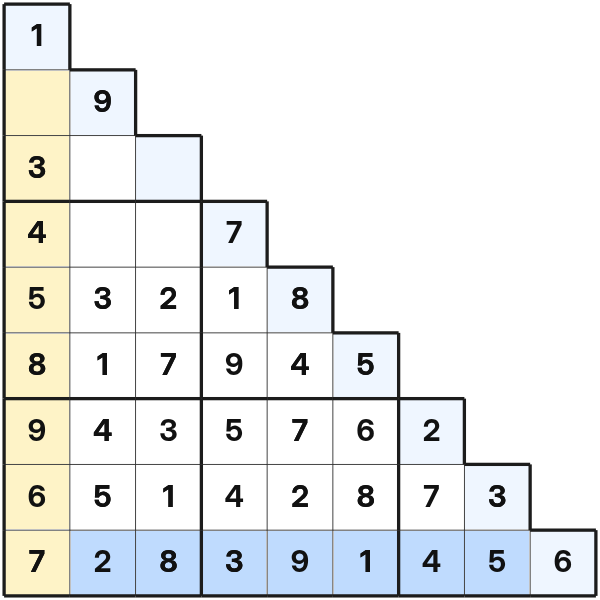
Each of these lines can only have one occurrence of a number. Shorter lines follow the same repetition rule but do not need to contain all numbers 1 to 9.
2. Complete a square nine-region
The marked Sujiken region 1 has nine fields. The present numbers are 1, 2, 3, 4, 5, 7, 8, 9; only 6 is missing.
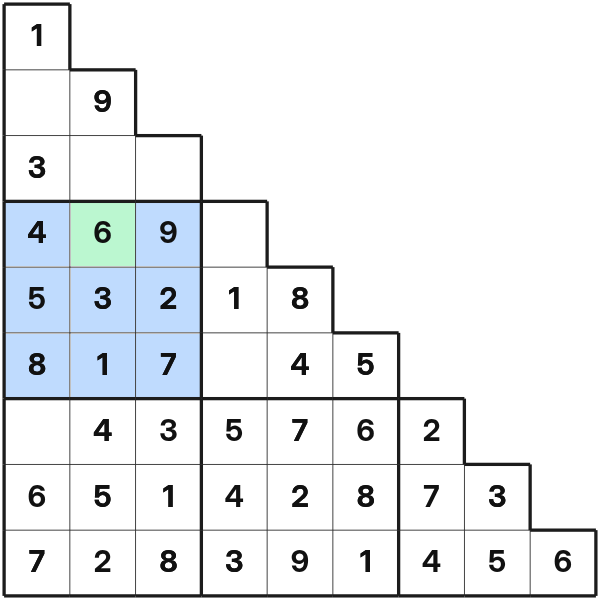
Therefore, 6 is at (4,2). The three square nine-regions work like full Sudoku regions, even though the whole grid is triangular.
3. Properly read a six-field triangular region
Sujiken region 4 contains only six fields. The visible values are 1, 2, 9, 3, 8, 4.
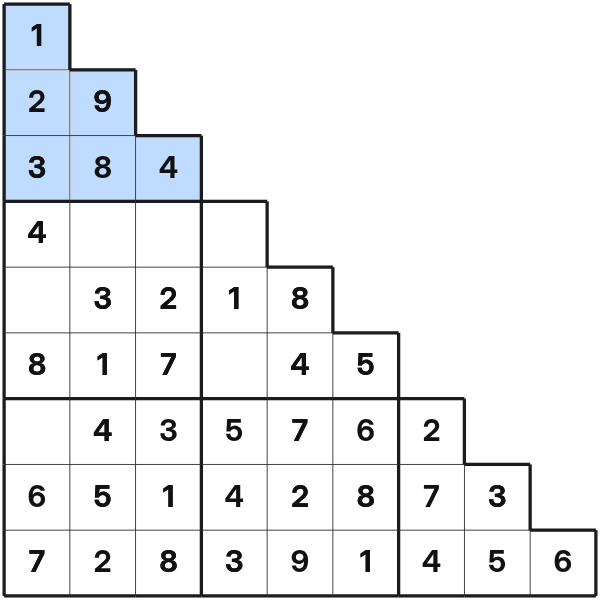
It is not necessary for numbers 1 to 9 to fully appear here. The requirement is only that no number repeats. Therefore, a missing number cannot be deduced solely from the triangle region.
4. Exclude a number horizontally
(3,1) and (3,2) lie on the same horizontal line. (3,1) already has the 3.
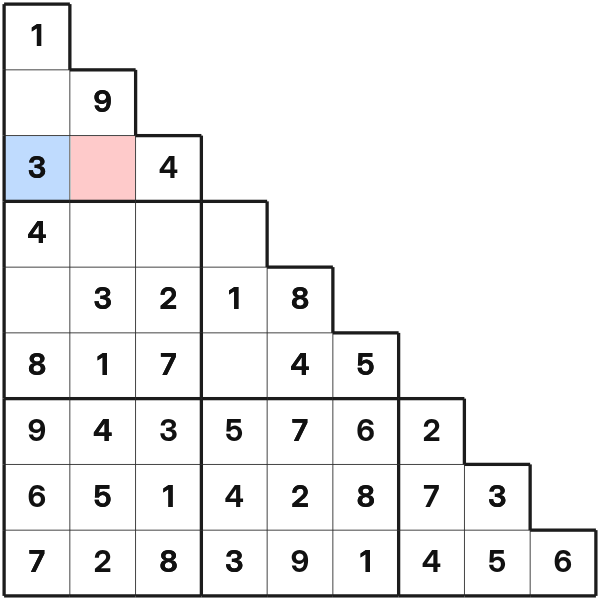
Thus, the 3 cannot appear again in the red field. Even a short line is fully free of repetitions, even if it does not contain a complete sequence 1 to 9.
5. Exclude a number vertically
(2,2) and (3,2) lie on the same vertical line. (2,2) already has a 9.
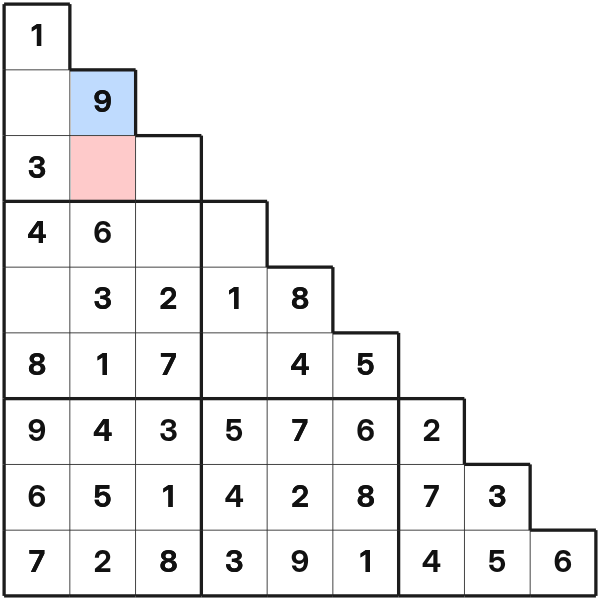
Therefore, the 9 cannot occur again in the red field. Even a short line is fully free of repetitions, even if it does not contain a complete sequence 1 to 9.
6. Exclude a number on the diagonal line
(3,2) and (2,1) lie on the same diagonal. (3,2) already has the 8.
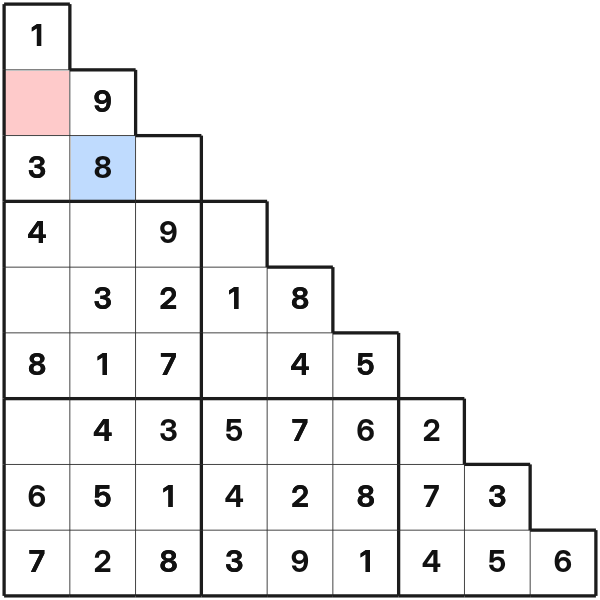
Thus, the 8 cannot occur again in the red field. Even a short line is fully free of repetitions, even if it does not contain a complete sequence 1 to 9.
7. Combining all four regions around a field
The field (2,1) belongs to a horizontal, vertical, diagonal line, and an outlined region. Any existing number in these four regions excludes the same value at the target.
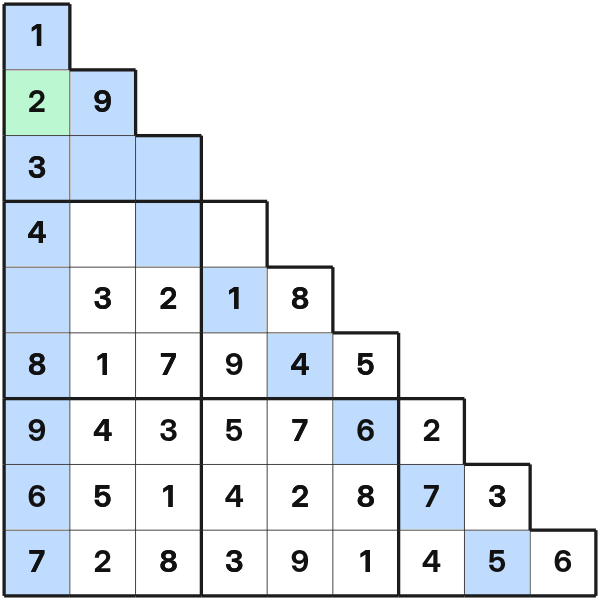
After all four checks, only 2 remains in the intermediate state. The number is entered in green. Considering only the row and region often misses the crucial exclusion in Sujiken.
8. Use the longest main diagonal as a nine-line
The longest diagonal has nine fields. Besides 4, the numbers 1, 2, 3, 5, 6, 7, 8, 9 are already present.
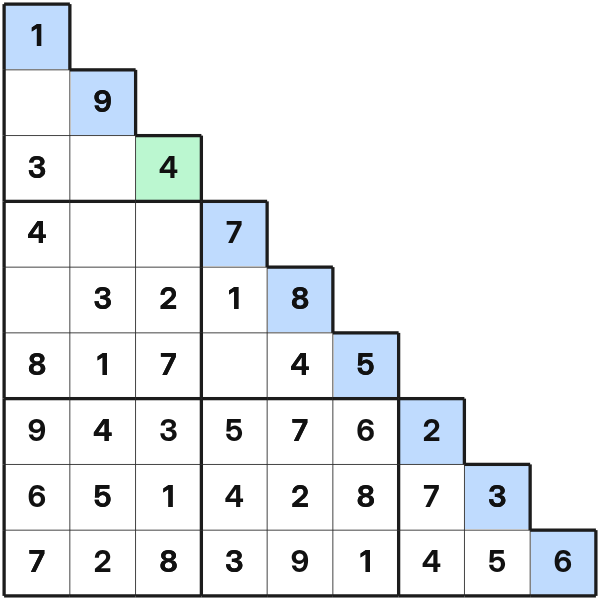
Just like a complete Sudoku unit, only 4 is missing. It is entered at (3,3). Only the nine-line paths allow this direct conclusion of completeness.
9. Check the bottom nine-row for completion
The bottom row is the only horizontal line with nine fields. It must therefore contain all numbers 1 to 9.
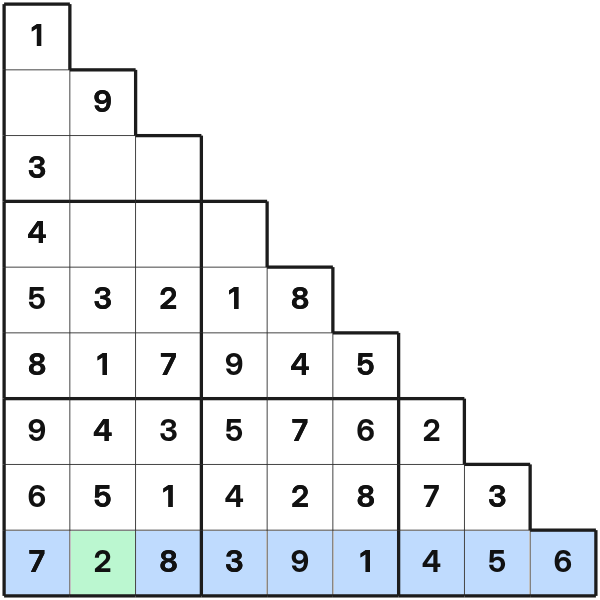
In the displayed state, only 2 is missing at (9,2). After the entry, re-examine the vertical line, the diagonal, and the associated region of this field.
10. Evaluate triangle region and line together
The yellow-marked fields are part of Sujiken region 5 and horizontal line 5. A candidate must fit in both areas without repetition.
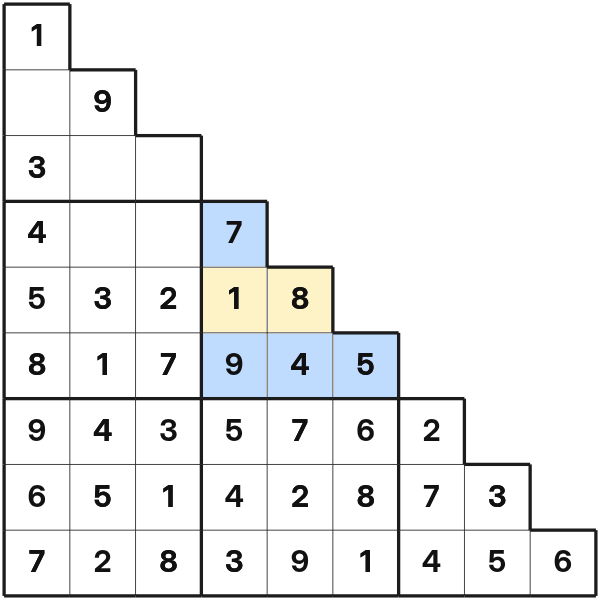
Such overlaps are especially useful: an exclusion from the line can determine the last possible spot in the triangle region, and vice versa. After each certain entry, both areas are re-examined.
Typical solving process
- First, look for missing numbers in the three square nine-regions.
- Check each open field horizontally, vertically, and diagonally.
- Differentiate between nine-line paths and shorter lines that only prohibit repetitions.
- Treat the three six-field triangular regions as groups without repetition.
- Utilize overlaps between a line and a region.
- Re-examine all three lines and the region of the field after each entry.
Common mistakes
- Trying to fill short lines with 1 to 9: They only require non-repetition.
- Overlooking a diagonal line: Each field lies in horizontal, vertical, and diagonal lines.
- Reading a triangular region as a nine-region: The six-field regions only contain six different numbers.
- Focusing only on the square regions: The three outlined triangles are also distinct groups.
- Treating the triangular shape like a cut-off Sudoku: The actual drawn lines and regions are decisive.
- Guessing too early: If multiple numbers are possible, the field is not yet solved.
- Not rechecking after an entry: A new number can immediately solve other fields.
Tips for Beginners
- Trace the diagonal lines with your finger or a pen until their direction is familiar.
- Start with the three square nine-regions and the long nine-lines.
- Note only prohibited repetitions in short lines; do not look for a complete sequence there.
- Always check a field in all three line directions.
- Pay attention to fields that lie in both a triangular region and a heavily filled line.
- After an entry, a quick tour of all four affected regions is worthwhile.
Solve Sujiken in small, secure steps. After each entry, re-check the affected row, column, block, and additional hints. This way, you often reach the goal without guessing.