
Download puzzle & solution
Share puzzle
Our puzzles are completely free. Please support this website by recommending it to your friends and family. Thank you!
New puzzle
Tents
Tents is a logic puzzle also known as Trees and Tents, Tents and Trees, or Campsite. The grid contains several trees. Exactly one tent must be placed in an adjacent cell horizontally or vertically for each tree.
The numbers on the edges indicate how many tents are in each row or column. Tents must not touch each other, not even diagonally. Many cells can be eliminated before it is clear which tent belongs to which tree.
Basic Rules
- Each tree has exactly one tent.
- Each tent must be adjacent (horizontally or vertically) to a tree.
- Each tree and each tent form a unique one-to-one correspondence.
- A tent must not be diagonally adjacent to a tree.
- A tent is never placed on a tree cell.
- Tents must not touch each other horizontally, vertically, or diagonally.
- The numbers on the edges specify exactly how many tents are in each row or column.
- A tent can geographically border multiple trees; what matters is that a unique assignment of all tents and trees remains possible.
- The puzzle is solved when each tree has exactly one tent, all tents are assigned to a tree, all edge numbers are correct, and no tents touch each other.
Solving Strategies
1. Exclude rows and columns with 0 completely
A border number 0 means no tents are allowed in that entire row or column.
In the example below, the fourth and seventh rows have the hint 0. Additionally, the first and fifth columns have the hint 0. All free cells in these areas are marked with x.
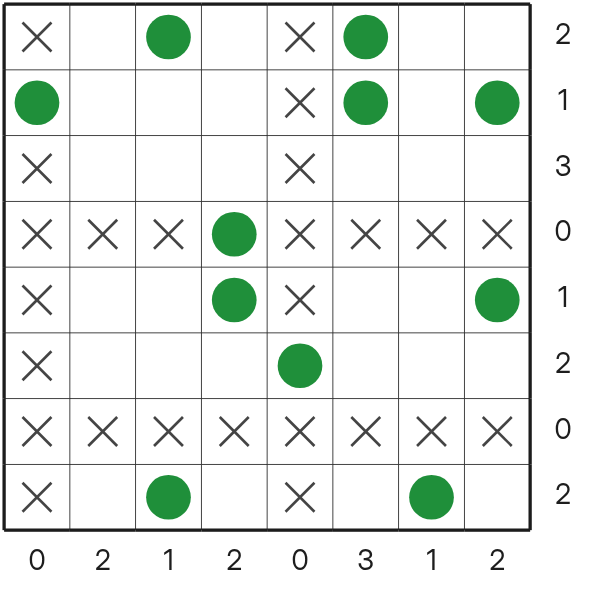
Of course, trees remain, but they cannot have their tent in an excluded cell.
2. A tree with only one possible neighboring cell forces a tent
The tree in the fourth row is in a row with the hint 0. No tents are allowed to its left or right. Directly below it is another tree.
This leaves only the cell directly above the tree as a possible tent location.
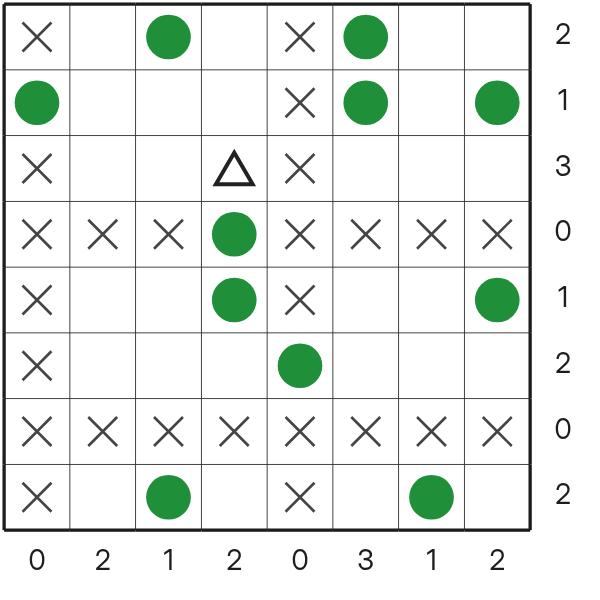
The tent in the third row is clearly identified: all three orthogonally adjacent cells are excluded or already occupied by a tree.
3. A column with 0 can force a tree to the side
The tree at the left edge of the second row has three possible neighboring cells: above, right, and below. The cells above and below are in the first column, which has the hint 0.
Therefore, the tent must be to the right of the tree.
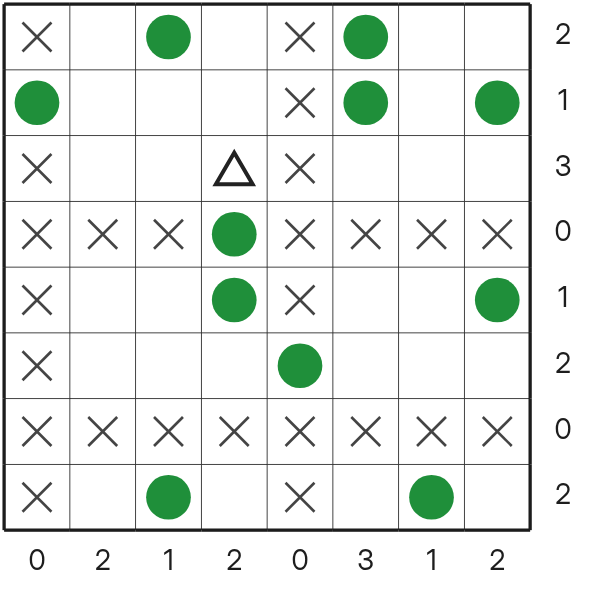
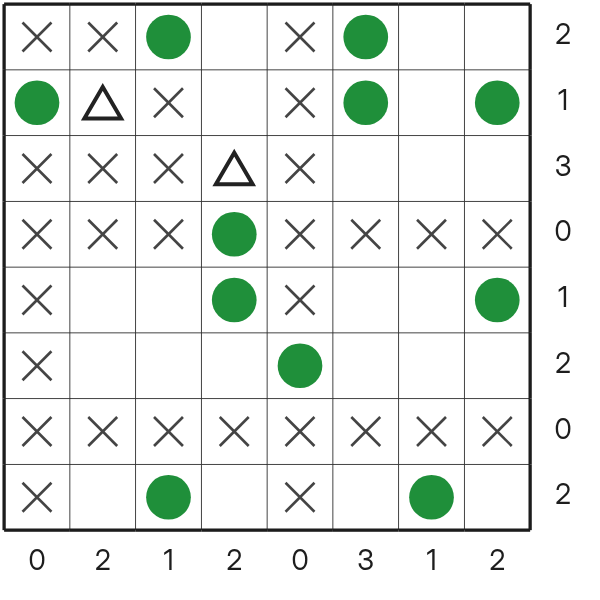
Once a tent is placed, all eight surrounding cells are no longer available for tents. Trees can remain in this area but are not tents.
4. The touching rule can uniquely identify the next tree
The tree in the first row, third column, needs a tent. The cell to the left is excluded due to the already placed tent in the second row. The cell directly below it also neighbors this tent.
Therefore, only the cell to the right of the tree remains.
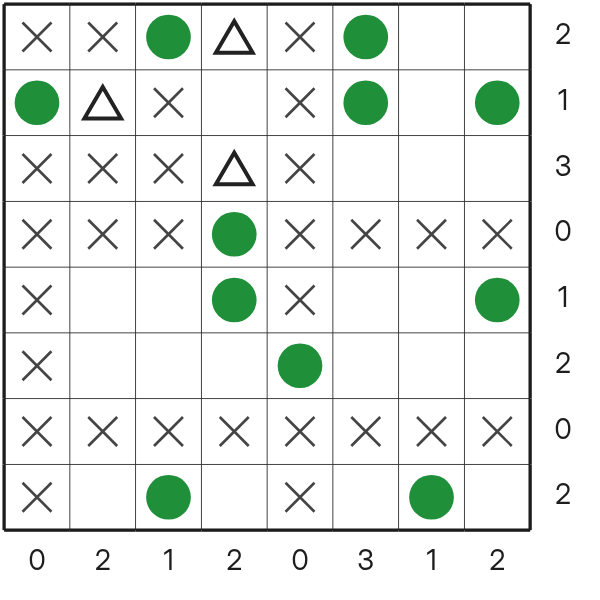
The uniqueness here is not only due to the tree rule but also because tents cannot touch even diagonally.
5. A tree between a 0-column and a tree cell
The second tree in the first row is in the sixth column. To its left is the fifth column with hint 0. Directly below the tree is another tree.
The only remaining neighboring cell is to the right, where a tent must be placed.
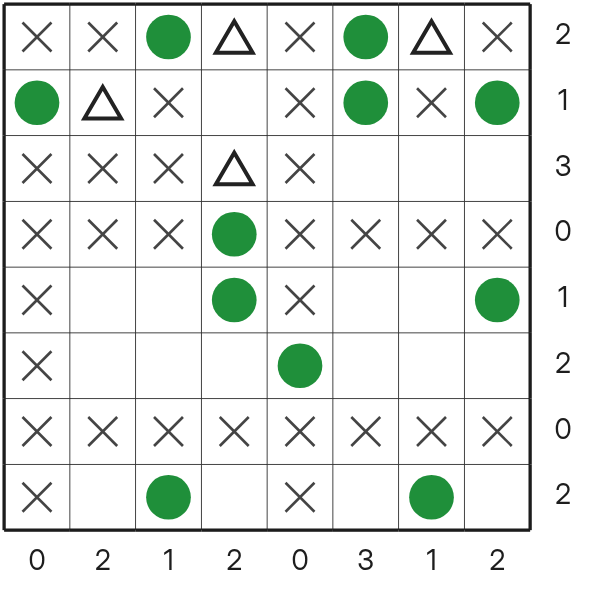
The first row now contains exactly two tents, meeting its edge hint. All other free cells in this row stay tent-free.
6. A completed column creates new exclusions
The fourth column already contains the two required tents: one in the first and one in the third row. The column hint of 2 is thus fulfilled.
All other free cells in this column are excluded.
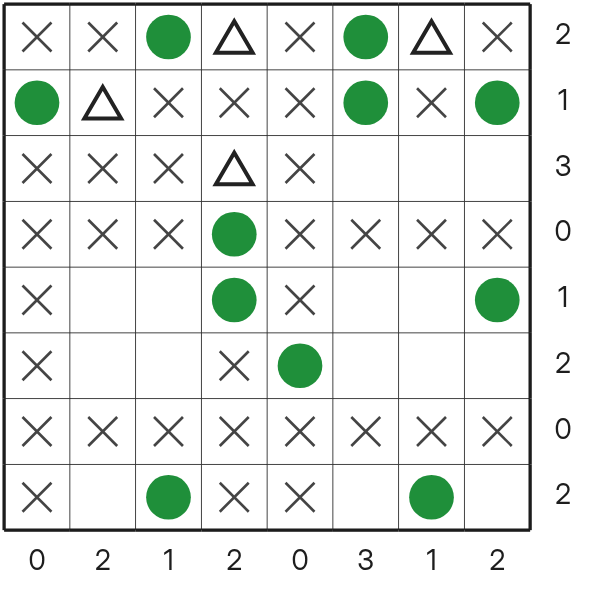
The tree in the fifth row, fourth column, cannot have its tent to the right or below. A tree is above it. The tent must be to the left of the tree.
The tree in the sixth row, fifth column, also only has one possible neighboring cell: right.
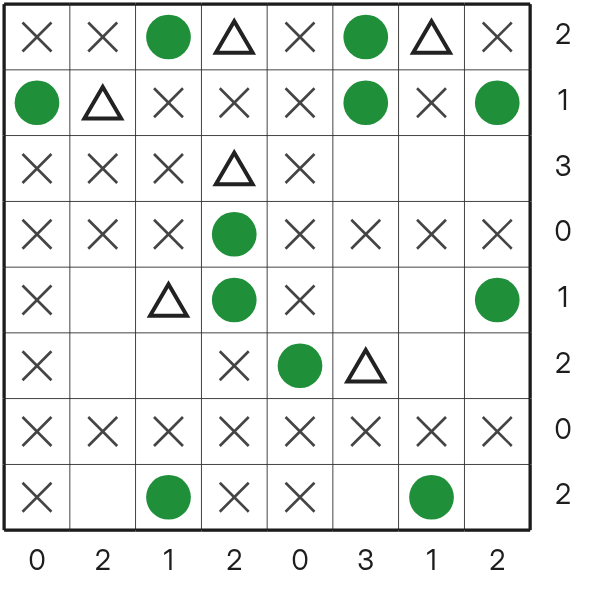
7. A placed tent blocks diagonal candidates
The tree at the right edge of the fifth row still needs a tent. The entire fourth row above it is excluded. The cell to the left of the tree is diagonal to a tent in the sixth row and cannot contain a tent either.
Therefore, only the cell directly below the tree remains.
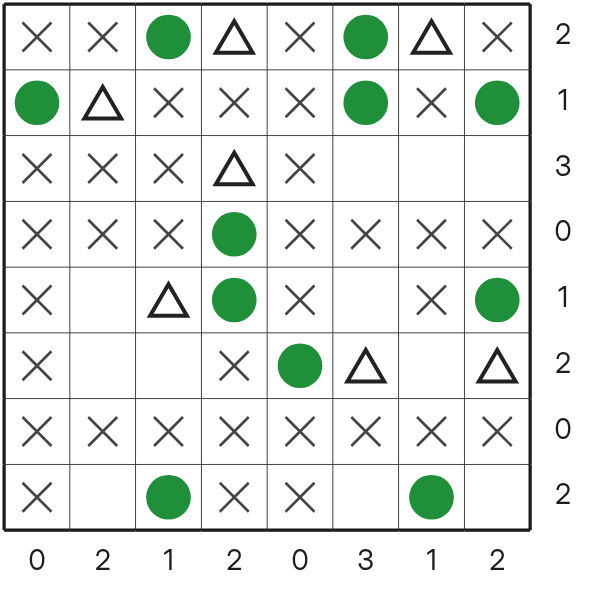
Afterward, the sixth row has exactly two tents and is fully fulfilled.
8. Trees at the edges can be evaluated by already set tents
The tree on the right in the second row cannot have its tent above or to the left because both cells would touch the tent already set in the first row. The tent must go directly below the tree.
In the same row, the tree in the sixth column has the cell to the left blocked by the 0-column, the cell to the right blocked by the touch rule, and the cell above by a tree. Its tent goes directly below.
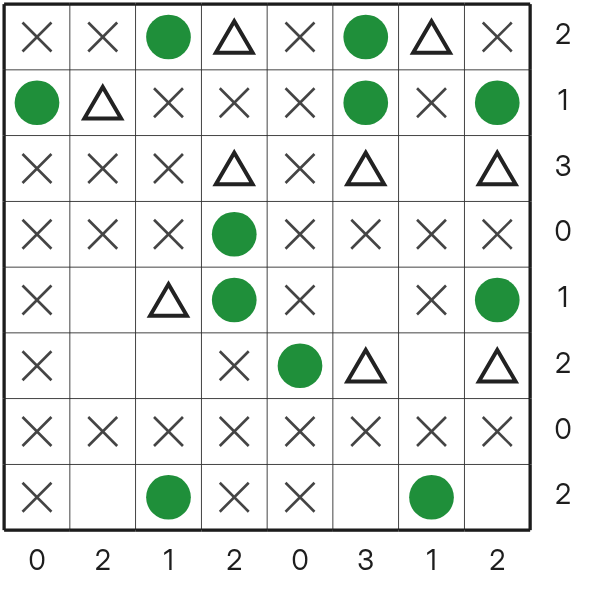
The third row thus contains exactly three tents fulfilling its hint.
9. Complete columns solve the remaining edge trees
The eighth column already contains the two requested tents. The free cell at the bottom right is therefore excluded.
The tree in the last row, seventh column, can only have its tent to the left. The other tree in the last row has the fourth column fully occupied and the seventh row tent-free. Its tent must also be to the left.
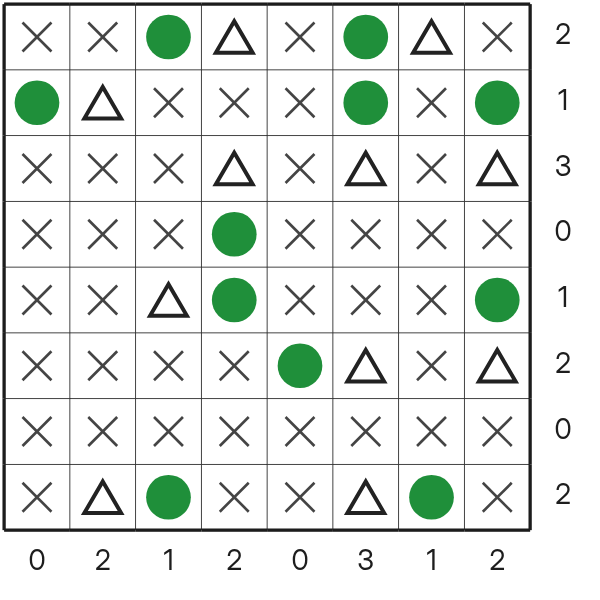
Now, all row and column numbers match, each tent has an orthogonally adjacent tree, and no tents touch each other.
10. Consider tent placement and tree assignment separately
Sometimes it is certain that a particular cell must contain a tent, even if it is not yet clear which of two adjacent trees it will be assigned to later. This is allowed as long as a unique one-to-one assignment is possible in the end.
Conversely, a tree must not be prematurely linked to a tent if that tent might be needed for another tree. For more complex puzzles, it helps to initially mark possible pairs mentally or with small lines.
Typical solving procedure
- Mark all cells in rows and columns with hint 0 as tent-free.
- Find trees with only one possible orthogonal neighboring cell.
- After placing each tent, mark all eight surrounding cells as tent-free.
- Check rows and columns where the tent count is already reached.
- If in a row or column, the remaining possible cells equal missing tents, place tents in all these cells.
- Immediately apply new exclusions to neighboring trees.
- Regularly check whether each tree still has at least one possible tent spot and each tent a possible tree.
- Finally, verify the unique one-to-one assignment.
Common mistakes
- Assigning a tent diagonally rather than orthogonally to a tree.
- Allowing tents to touch diagonally.
- Checking only the tree assignment and forgetting row or column counts.
- Not completely excluding a fulfilled row or column.
- Automatically assigning a tent to each neighboring tree. Each tent belongs only to one tree.
- Rushing with multiple possible pairs.
Tips for Beginners
- Always start with 0 hints.
- Select safe empty cells and mark them with a cross.
- Mentally draw a 3x3 exclusion zone around each tent after placing it.
- Pay particular attention to trees on edges and near 0-hints early.
- Keep count of "tents placed / tents remaining" for each row and column.
- Before placing each tent, ask: which tree can it belong to? Can all other trees still be served?
Tents connects local tree-tent pairs with global row and column counts. The strongest solutions arise when a tent immediately blocks surrounding cells, constrains an adjacent tree, and completes a row or column at the same time.