
Tripledoku – Hard
Download puzzle & solution
Share puzzle
Our puzzles are completely free. Please support this website by recommending it to your friends and family. Thank you!
New puzzle
Solved Tripledoku: Rules, Overlaps, and Strategies
Tripledoku is a multi-doku consisting of 3 classic 9×9 Sudoku puzzles. Three 9×9 Sudokus are diagonally Overlaid from top left to bottom right.
In total, the visible figure includes 171 active cells within a framework of 15 rows and 15 columns. Adjacent subgrids share broad areas; at the center, all three Sudokus meet.
The goal remains familiar: in each individual 9×9 subgrid, the numbers 1 through 9 must occur exactly once in each row, column, and 3×3 block. A shared cell has the same entry in all related subgrids.
Rules
- Each active cell contains exactly one number from 1 to 9.
- Each contained 9×9 Sudoku independently satisfies normal row, column, and 3×3 block rules.
- Overlapping cells belong simultaneously to all subgrids they intersect.
- Given numbers are not modified.
- Areas without grid cells are not part of the puzzle and are not filled in.
- The puzzle is only solved when each subgrid is complete and free of contradictions.
Orientation in the diagram
For examples, we count the rows of the entire diagram from top to bottom and columns from left to right. Row 4, Column 7 refers to the cell at the intersection of these two gridlines.
These global coordinates do not yet indicate which Sudoku units apply. It must always be checked in which 9×9 subgrid the cell lies. An overlap cell can thus belong to multiple relevant rows, columns, and blocks.
Basic idea for solving
Initially work with known Sudoku techniques: complete houses, individual cell candidates, and hidden single candidates. After each definite entry in a shared cell, move to the neighboring subgrid and update candidates immediately.
When progress stalls, overlaps are not an obstacle but additional information. A candidate is only allowed if it fits every affected row, column, and 3×3 block.
1. Recognizing subgrids and their overlaps
Start not with individual numbers, but with the shape. The blue frame shows the subgrid in the top left. The yellow area is also used with the middle subgrid.
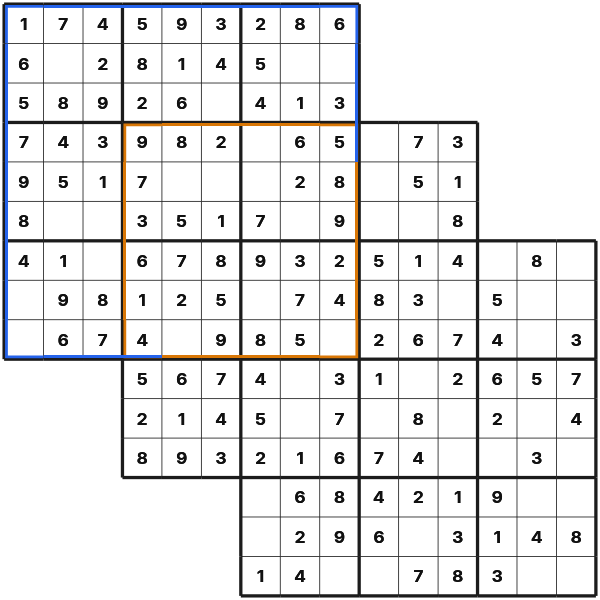
The shared area here lies in overall rows 4 to 9 and overall columns 4 to 9. Each of its 36 cells has only one value but belongs to the units of both subgrids.
The thick lines help identify the 3×3 blocks. For rows and columns, always consider the complete 9×9 subgrid, not the entire visible width or height.
2. Approaching a nearly complete unit
In the shown progress, we look at row 3 in overall row 3 of the top-left subgrid. Only row 3, column 6 is open there.
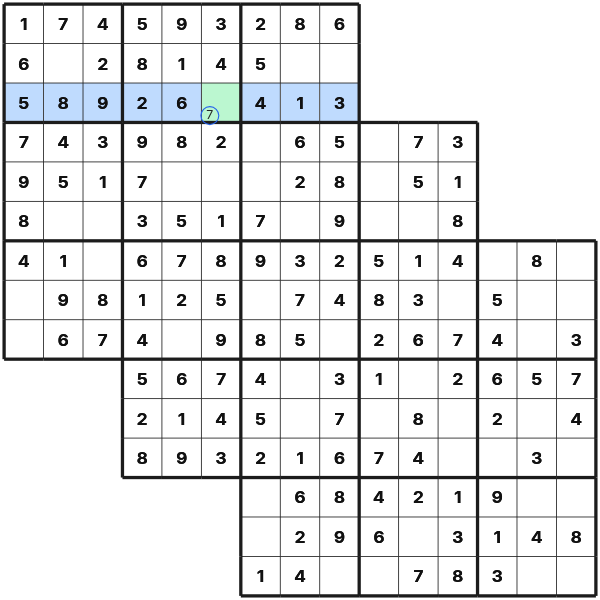
The eight visible entries contain all numbers 1 to 9 except 7. Therefore, 7 must be in row 3, column 6. The other subgrids are not needed for this first step.
Such complete houses are the fastest entry points. Check them separately in each subgrid, as a long visible line can belong to several different Sudoku rows.
3. Finding a single cell candidate
Now consider row 2, column 8. The cell is not just the last gap of a single unit; its row, column, and block neighbors must be checked together.
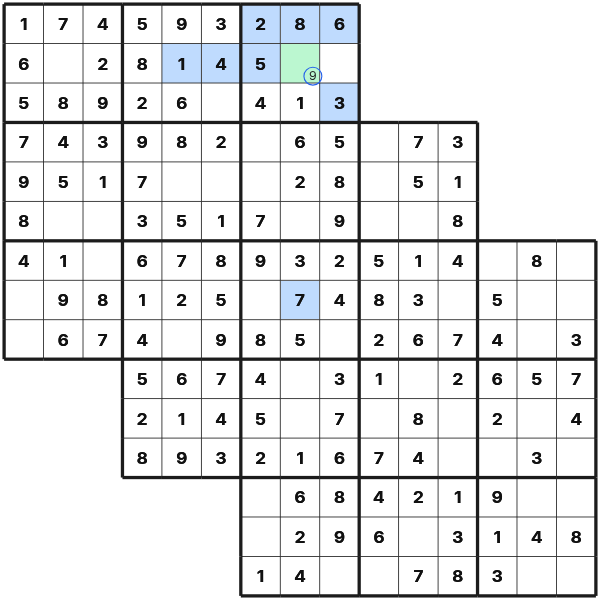
The numbers 1, 2, 3, 4, 5, 6, 7, and 8 are already visible in at least one related unit. They are eliminated. The only remaining candidate is 9; it can be confidently entered.
Blue cells indicate matching elimination clues. You do not need to mark them when solving; it’s crucial to eliminate candidates from all units of the cell.
4. Using a hidden single candidate
Next, check the 3×3 block in the middle of overall rows 10 to 12 and overall columns 10 to 12 for the number 3. Several cells in this unit are still empty.
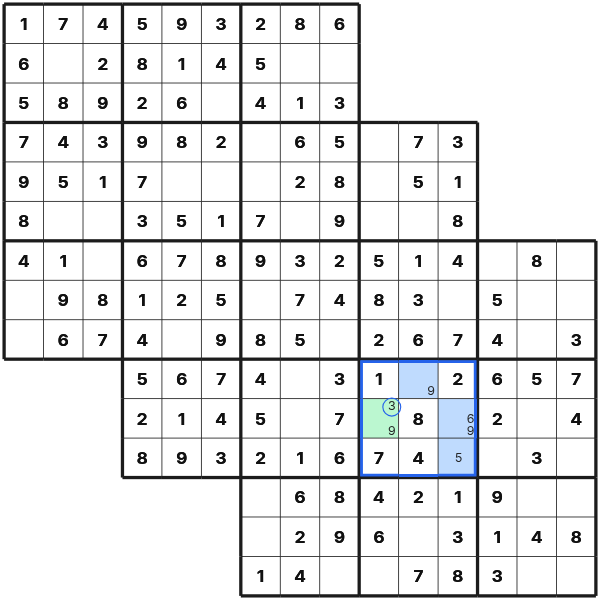
The 3 appears only in row 11, column 10 among the notes displayed. The cell also has 9 as a candidate, but within the considered unit, 3 has no other place.
Thus, 3 belongs to row 11, column 10. The other open cells have notes: row 10, column 11: 9; row 11, column 12: 6 and 9; row 12, column 12: 5.
5. Intersecting candidates in the overlap cell
Row 11, column 10 belongs to multiple subgrids. It is not enough to take candidates from only one direction.
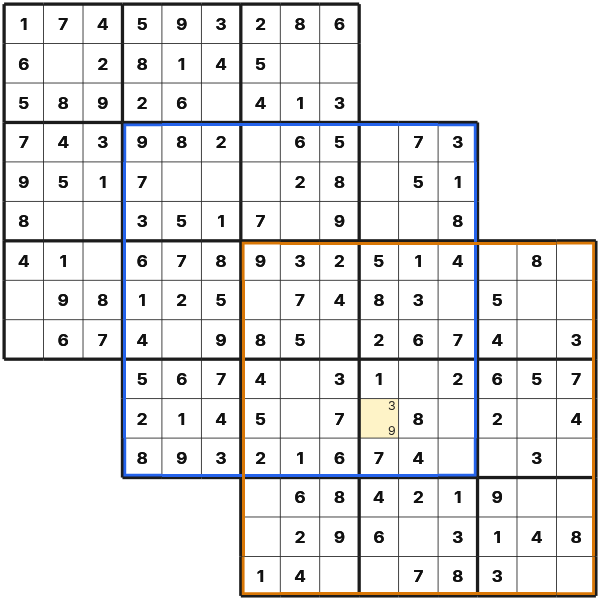
The individual checks give candidates 3, 6, and 9 for the middle subgrid; candidates 3 and 9 for the bottom-right subgrid. Only the intersection 3 and 9 satisfies all row, column, and block conditions simultaneously.
This smaller candidate list is already a significant progress, even if no value is yet set. Always update shared fields whenever something changes in one of the involved subgrids.
6. Solving a shared cell confidently
Now, the typical multi-doku step follows. Row 6, column 8 lies in the top-left and middle subgrids at once.
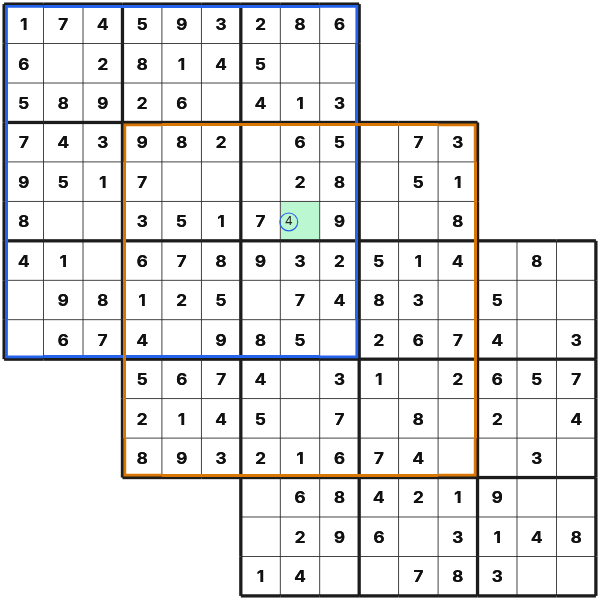
After eliminating all options, only 4 remains. It is entered there. For the final, all involved subgrids are considered. The completed entry affects all of them equally.
After such an entry, do not only check the unit where you found it. Its greatest impact often lies on the other side of the overlap.
7. Tracking the effect into the neighboring grid
Now, 4 is visible in row 6, column 8. Next, look at row 6, column 10. This cell shares an entity with the new entry in the adjacent subgrid.
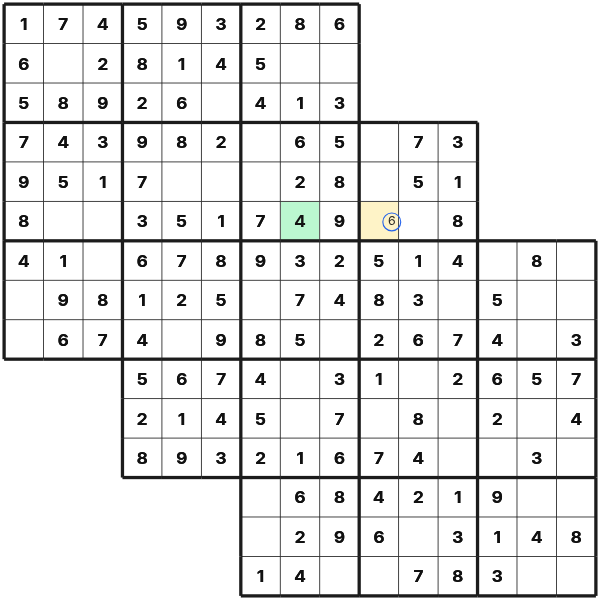
Before the entry, 4 and 6 were possible there. 4 is now eliminated. Only 6 remains; thus, row 6, column 10 is also solved.
This chain reaction makes multi-dokus highly solvable: a secure step followed by an immediate check in the connected grid. This creates a chain without guessing.
8. From block to row or column
We examine the 3×3 block in the bottom-right subgrid in overall rows 7 to 9 and overall columns 13 to 15. There, 6 can only be in row 7, column 15, or row 8, column 15.
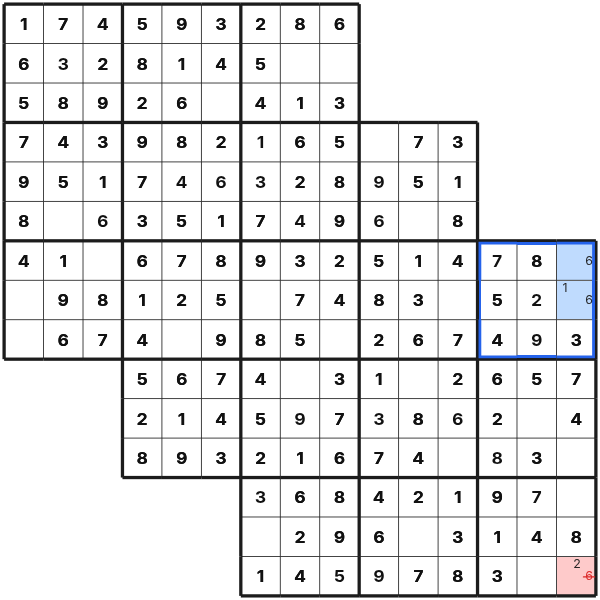
All these options are in the same overall column 15. Therefore, 6 must appear in this line within this block.
Outside the block, the 6 can be eliminated from the same subgrid line at row 15, column 15. The red-marked notes show these eliminations.
9. Evaluating a naked pair
We look at the column in overall column 14 of the bottom-right subgrid. There, row 9, column 14, and row 11, column 14, have exactly the same two candidates: 1 and 9.
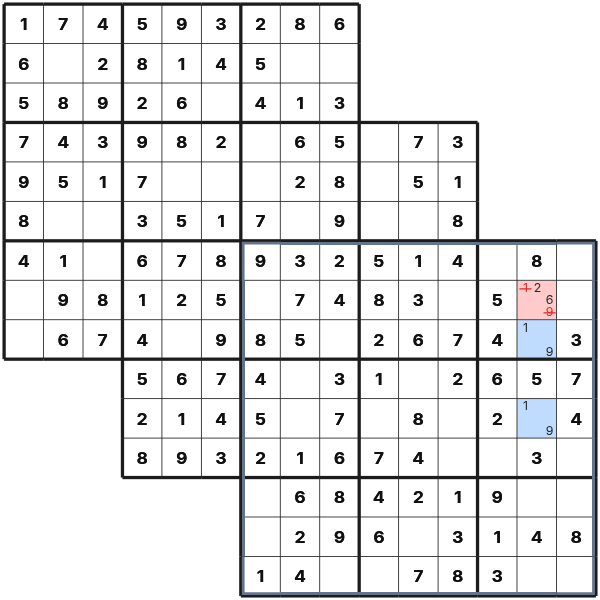
These two numbers must split the two blue cells below. Therefore, 1 and 9 can no longer appear in any other cell in this unit.
In row 8, column 14, the red notes are removed. A pair does not yet set either number but can prepare new single candidates within the same unit.
Typical solving process
- Mentally mark the boundaries of all 9×9 subgrids.
- Look for nearly complete rows, columns, and blocks in each subgrid.
- Note candidates when a cell is not immediately determined.
- Check shared cells from all involved subgrids' perspectives.
- Immediately follow each new overlap entry into the neighboring grids.
- Subsequently use hidden singles, block-line interactions, and pairs.
- Repeat until all subgrids are complete.
Common mistakes
- Handling the entire visible row as one Sudoku row. Always consider only the nine cells of a specific subgrid.
- Checking a shared cell only in the subgrid where it was immediately found.
- Incorrectly treating blank areas outside the drawn figure as fillable cells.
- Forcing a subgrid in isolation. Some puzzles are only clarified through overlap information.
- Continuing after a secure overlap entry without updating candidates in the connected subgrid.
- Guessing when unsure, even though switching to another subgrid may reveal new hints.
Tips for newcomers
- Use differently colored edge markings for subgrids if the shape initially seems confusing.
- Begin where many givens are present, then follow the shared cells.
- Only note candidates allowed in all units of the cell.
- After each entry, first check row, column, block, then the overlap.
- If a area gets stuck, consciously switch to another subgrid instead of guessing.
Conclusion
Tripledoku does not require new rules. The main task is to carefully apply familiar Sudoku logic to multiple overlapping 9×9 grids. By consciously tracking boundaries and shared cells, the complex figure becomes a sequence of smaller, verifiable steps.