
Download puzzle & solution
Share puzzle
Our puzzles are completely free. Please support this website by recommending it to your friends and family. Thank you!
New puzzle
Vudoku
Vudoku is a Sudoku variant with V-shaped additional hints. The basic grid is a standard 9x9 Sudoku. Additionally, V-markings are drawn at certain positions. Each such marking has a V tip with a number related specifically to the two numbers at the ends of the V arms.
The rule states: The number at the V tip must be either the sum or the difference of the two other numbers at the arms of the V. Since only numbers 1 through 9 are allowed, many combinations can be immediately excluded.
Basic rules
- Every row must contain the numbers 1 to 9 exactly once.
- Every column must contain the numbers 1 to 9 exactly once.
- Every 3x3 block must contain the numbers 1 to 9 exactly once.
- Each marked V has a tip and two arm cells.
- The number at the tip must be either the sum of the two arm numbers or their difference.
- For the difference, the order of the arm numbers does not matter. The positive difference is always used.
- All numbers must remain between 1 and 9.
- The V rule applies only where a V is explicitly marked.
- The given numbers may not be changed.
- A Vudoku is solved when all normal Sudoku rules and all drawn V relationships are satisfied.
Strategies for solving
Vudoku hints are especially strong when two of the three involved numbers are known. Then, for the third number, often only one or two possibilities remain. Normal Sudoku rules then determine which is valid.
1. Check sum and difference
In the following example, a V is located at the top left. Its tip is in the upper-left corner cell. The two arm cells are directly to the right and directly below.
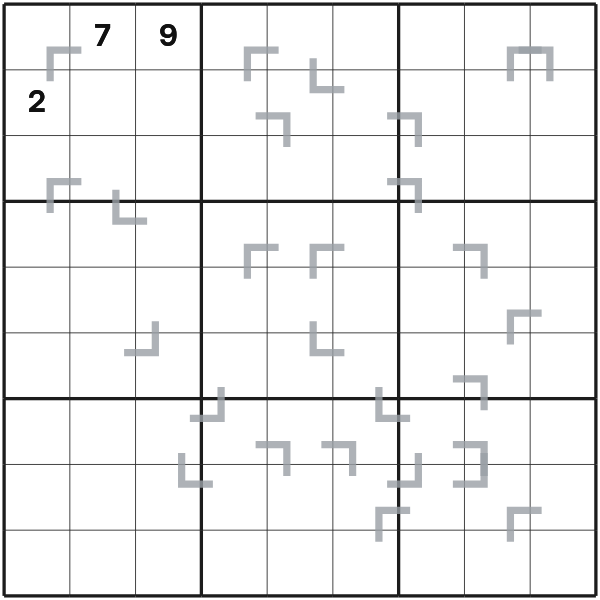
The two arm numbers are 7 and 2. Therefore, there are two possible values for the tip:
Sum:
7 + 2 = 9

Difference:
7 - 2 = 5
In the first row, there is already a 9. The tip cannot also be 9. Remaining is only 5.
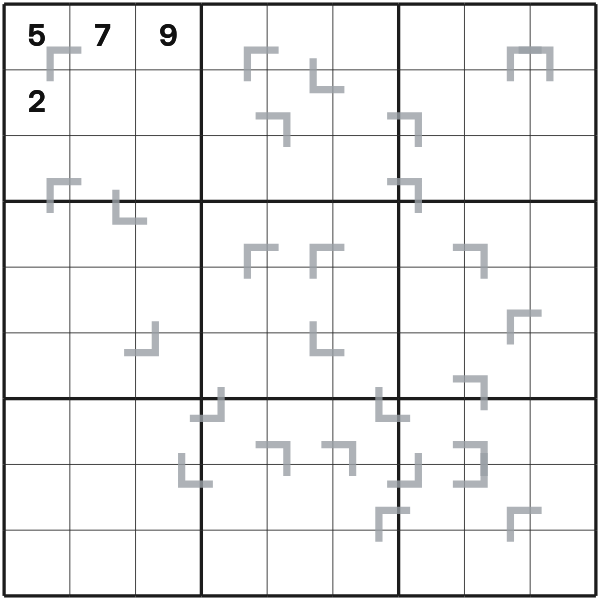
The V rule initially gives two possibilities. The normal Sudoku rule of the row clearly distinguishes between them.
2. Exclude a too large sum
Another V in the example puzzle is in the upper middle 3x3 block. Its tip is in the fifth cell of the second row. The arm cells are immediately to the left of the tip and directly below.
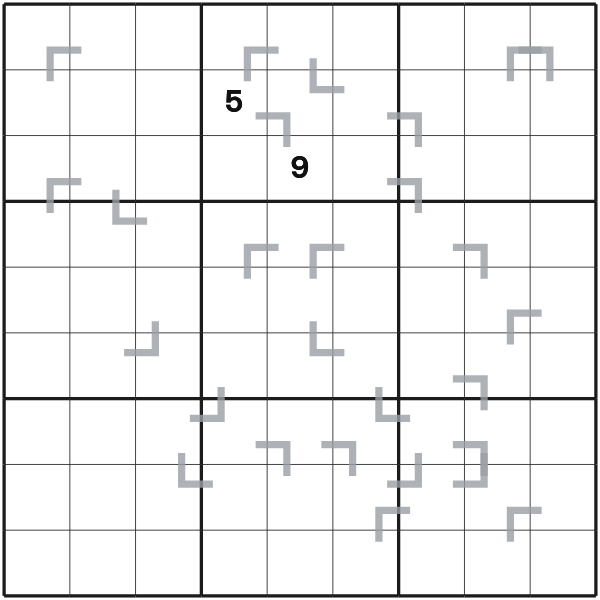
The two arm numbers are 5 and 9. Their sum is 14 and cannot be a Sudoku number. Only the positive difference remains:
9 - 5 = 4Therefore, the tip of the V must be 4.
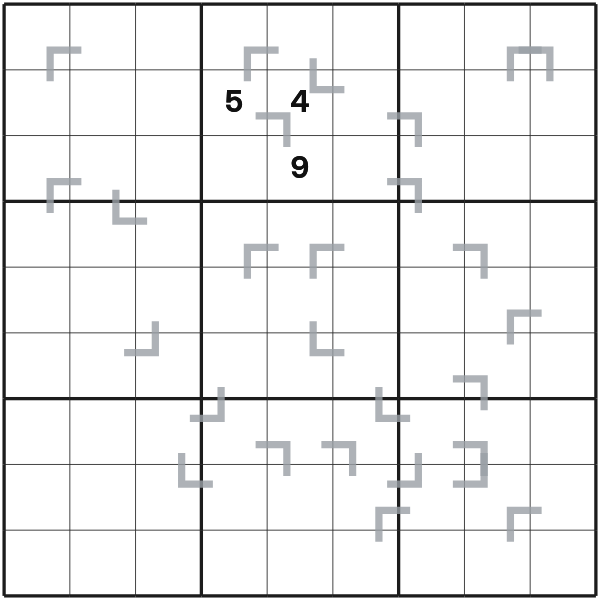
This conclusion is immediately clear: the sum exceeds the allowed range of 1 to 9, while the difference yields a valid value.
3. Tip and one arm determine the second arm
In the middle area of the example puzzle, there is a V with its tip in the fourth cell of the fourth row. The arm cells are directly to the right and below.
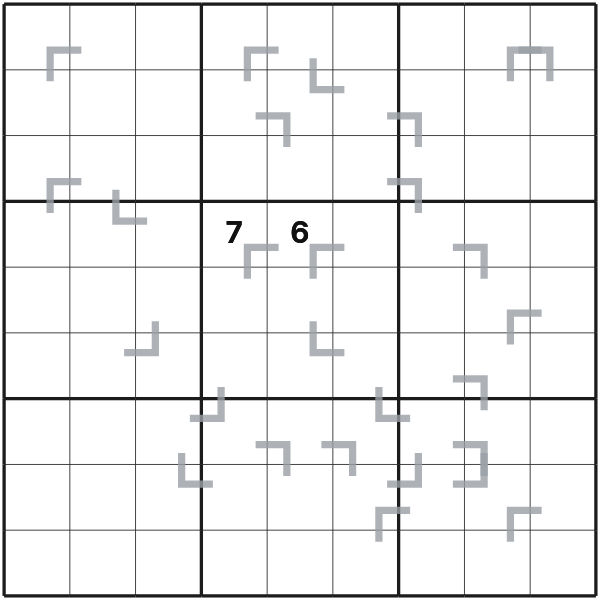
The tip is 7, and the right arm is 6. For the lower arm, a number is sought that satisfies the V rule.
The possible sum is:
6 + 1 = 7A positive difference of 7 with known 6 and a number from 1 to 9 is impossible. Therefore, the lower arm must be 1.
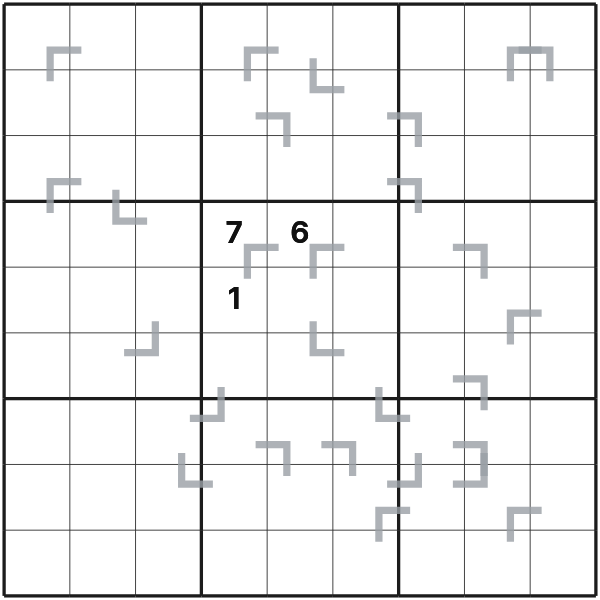
Again, only one valid value remains for the third cell based on the known tip and arm.
4. Two calculable options distinguished by Sudoku rules
If both sum and difference produce valid numbers between 1 and 9, neither should be entered immediately. Both must first be checked against the corresponding row, column, and 3x3 block.
The first example shows this case: from arm numbers 7 and 2, possible tip values are 9 and 5. The existing 9 in the row rules out 9 as the tip.
If both options remain valid after verification, no definite entry can yet be made. Both values are then noted as candidates until further hints help decide.
5. Deduce possible arm pairs from a known tip
If only the tip is known, possible arm pairs can be collected. For a tip value of 5, for example, the following pairs are conceivable:
Sum:
1 + 4 = 5
2 + 3 = 5

Difference:
6 - 1 = 5
7 - 2 = 5
8 - 3 = 5
9 - 4 = 5
Which pairs are actually possible depends on the candidates for the two arm cells. Numbers already present in the row, column, or 3x3 block are excluded.
Typical solving process
- First check V markings where two of the three involved numbers are known.
- Calculate the sum and the positive difference of the two arm numbers.
- Exclude results less than 1 or greater than 9.
- Verify remaining values against row, column, and 3x3 block.
- When the tip and one arm are known, determine all possible values for the second arm.
- If multiple possibilities remain, record them as candidates and do not guess.
- After each confirmed entry, update the affected row, column, block, and all other V hints.
Common mistakes
- Mistaking the tip of the V for an arm cell.
- Only checking the sum and forgetting the difference.
- Treating a sum greater than 9 as a possible Sudoku number.
- Entering a numerically fitting number without checking row, column, and block.
- Guessing between two still possible results.
Tips for beginners
- First determine clearly which cell is the tip and which are the arms for each V.
- If both arms are known, always compute the sum and positive difference.
- Immediately exclude any results outside 1 to 9.
- Use V hints also to reduce candidates, even if not yet definitive.
- After each V step, recheck the affected row, column, and 3x3 block.
- If two valid values remain, wait for further certainty.
Vudoku extends Sudoku with small arithmetic relationships but remains a logic puzzle. The V markings connect exactly three specific cells. Sum and difference suggest potential values, while normal Sudoku rules decide which of these can actually be entered.