
Vudoku – Hard
Download puzzle & solution
Share puzzle
Our puzzles are completely free. Please support this website by recommending it to your friends and family. Thank you!
New puzzle
Solve Vudoku: Rules and Strategies
Vudoku is a Sudoku variant. Small V-shaped markings connect a vertex with two arm cells.
The value at the vertex is either the sum or the positive difference of the two arm values.
The goal is a fully and correctly filled puzzle. Each entry must be derived from the visible clues and the already placed numbers.
Rules
- Each cell contains exactly one number from 1 to 9.
- Each row contains the numbers 1 to 9 without repetition.
- Each column contains the numbers 1 to 9 without repetition.
- Each standard 3×3 block contains the numbers 1 to 9 exactly once.
- The value at the vertex is either the sum or the positive difference of the two arm values.
- Given numbers are not changed.
- Each entry must satisfy all rules.
Grid Orientation
Rows are counted from top to bottom, columns from left to right. In (4,7), 4 is the row and 7 is the column.
The images show specific intermediate states. Blue marked cells are used for the step, red means excluded, and green indicates a certain result. Yellow highlights the currently considered cell.
Basic Idea in Solving
Calculate at each V the sum and the positive difference of the arms. Cross out results outside 1 to 9 and check the remaining values against Sudoku rules.
After each certain entry, recheck the affected row, column, block, and all additional hints. Often, this already leads to the next step.
1. Distinguishing the Vertex and Arms of a V Marking
The corner of the marking is in cell (6,3); this is the vertex. The two adjacent cells (6,2) and (5,3) are the arms.
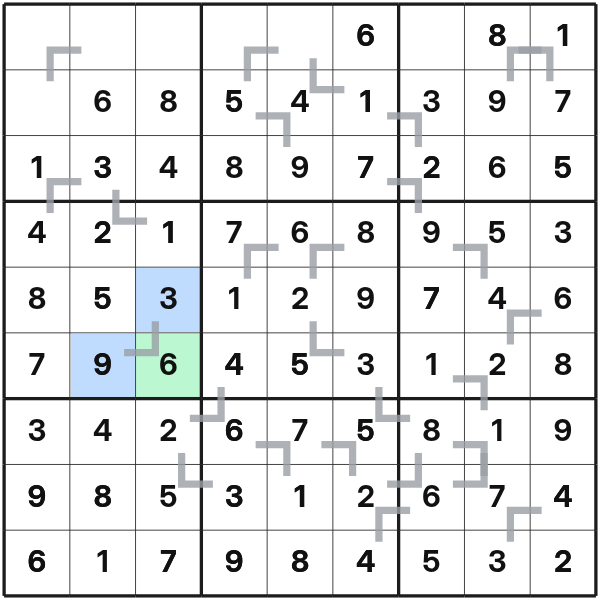
In the example, the arms carry 9 and 3, the vertex 6. The calculation is always read from the two arms to the vertex, regardless of which way the V points.
2. Using the Sum of the Two Arms
The blue arm cells contain 2 and 4. Their sum is 2+4=6; this value is between 1 and 9 and is thus generally possible as a vertex.
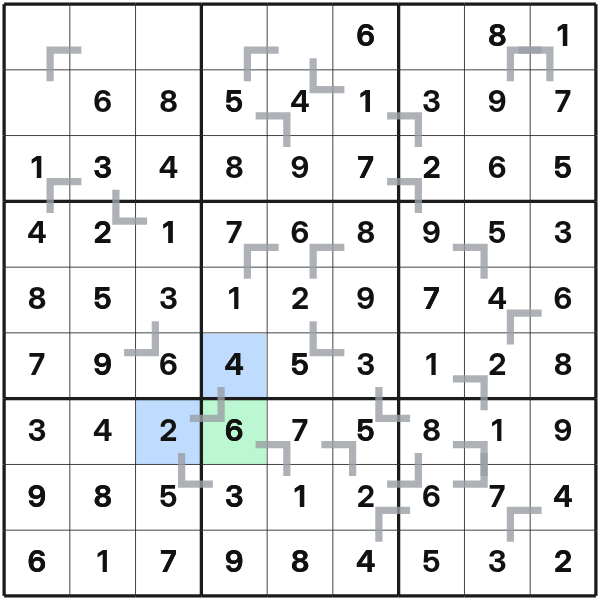
The alternative 2 already appears at (7,3) in the same row, column, or block as the vertex. It is excluded; therefore, 6 is entered at (7,4).
3. Discard a Sum Out of Range Immediately
In this V, 9 and 3 are in the arms. The sum 12 is outside the allowed range 1 to 9.
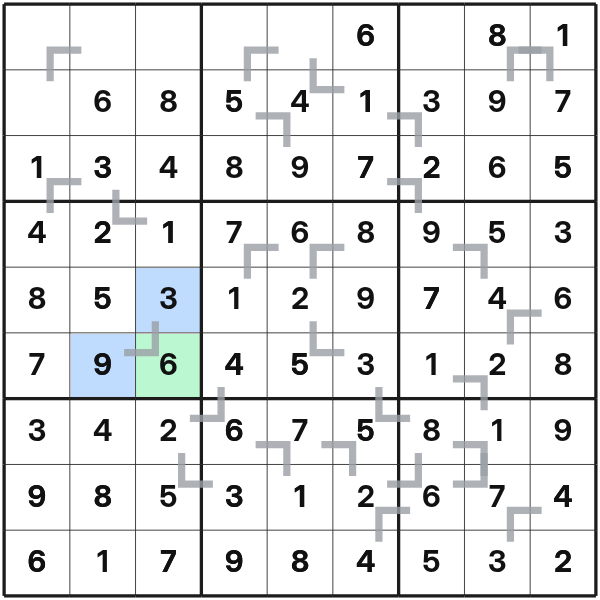
Thus, only the positive difference |9−3|=6 remains. The vertex (6,3) definitely gets the 6.
4. Excluding Zero Difference When Arms Are Equal
Both arm cells contain 1. The difference would be 0, but Vudoku only uses numbers 1 to 9.
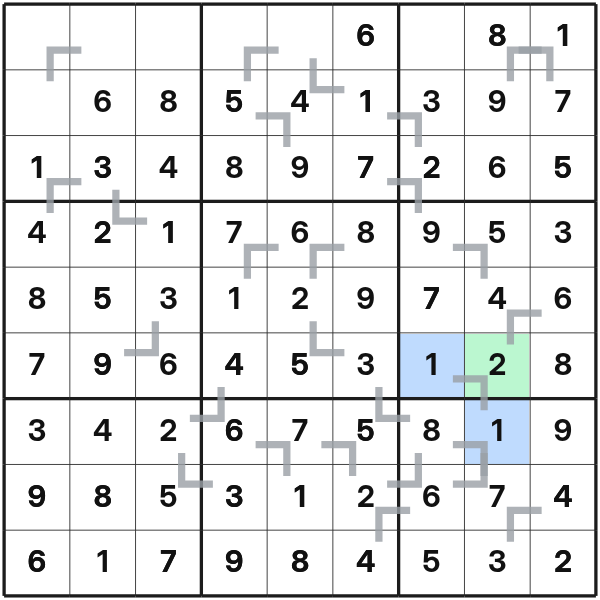
Therefore, the sum remains 1+1=2. In the vertex cell (6,8), the 2 is placed.
5. Deciding Between Two Calculation Results with Sudoku
From the arms 2 and 4, two valid vertex values arise: the sum 6 and the difference 2. Both are within 1 to 9.
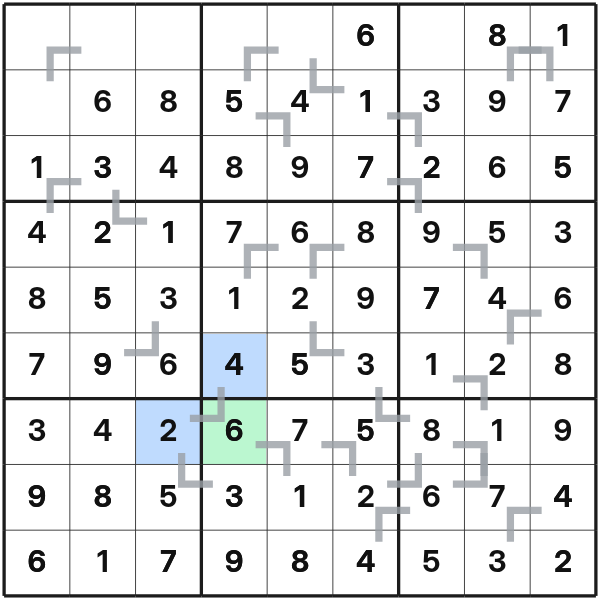
The V rule alone does not decide here. However, the alternative 2 already appears at (7,3) in a normal Sudoku unit of the vertex. It is struck out; leaving 6.
6. Evaluating Two V Markings with the Same Vertex Together
At cell (8,8), two different V markings end. For each V, a set is formed from its own arms, either the sum or the positive difference.
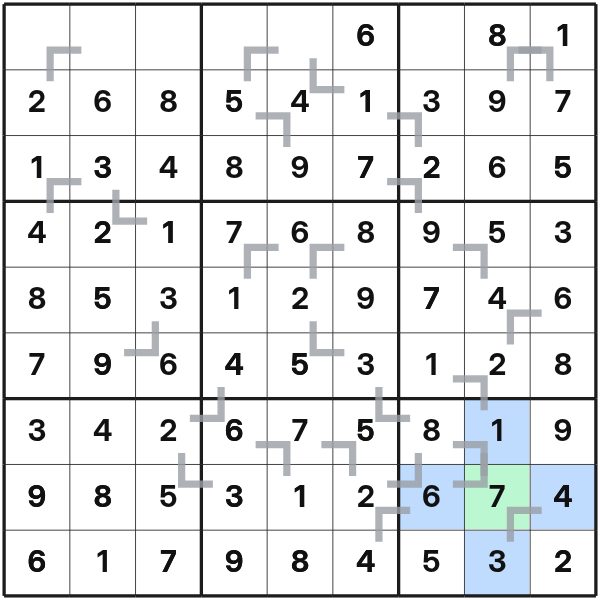
The vertex must be in both sets. In the images, only 7 remains in both calculations. The overlap is stronger than any individual V marking.
7. Checking a Shared Cell in Two V Calculations
The cell (7,4) belongs to two V hints. It can be the vertex of one V and an arm of another, or serve as an arm in both.
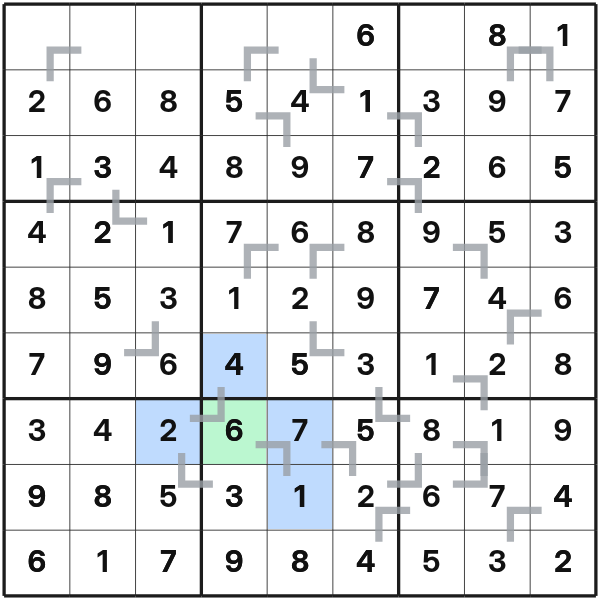
The value 6 must satisfy both relations. After entering it, not only a V is updated, but all related markings are recalculated.
8. Calculating Backwards from the Vertex to an Arm
The vertex is 6, one arm is 9. The second arm is sought. Both a sum calculation and the equation for the positive difference are checked.
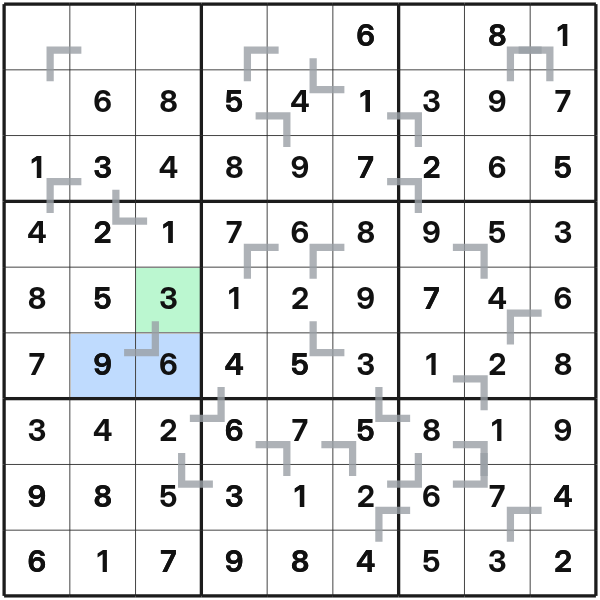
Within 1 to 9, only 3 fits here. With 9, this gives the difference 6; the alternative calculation would not be permitted.
9. Rechecking Sudoku Units After a V Result
The green result 6 at the vertex (6,3) comes from the arms 9 and 3. This completes not only the V calculation.
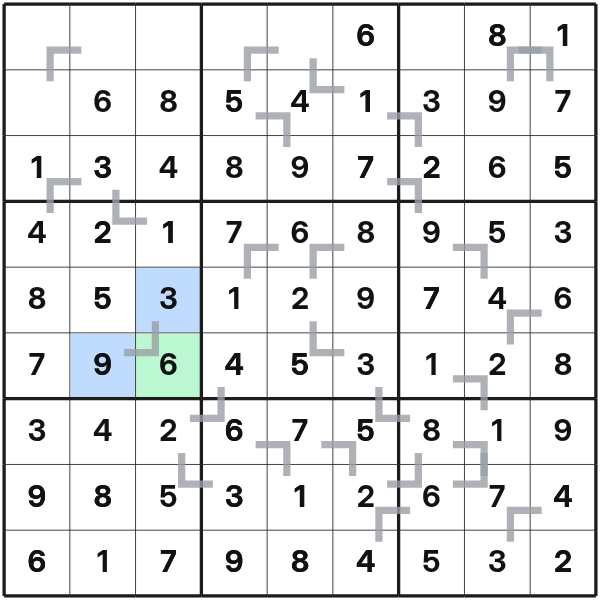
The new value is immediately crossed out from all other cells in the same row, column, and 3×3 block. Then, other V markings touching these cells are checked.
Typical Solution Process
- Determine the vertex and both arms for each marking.
- Calculate both the sum and the positive difference from the arms.
- Cross out 0 and results greater than 9.
- Check the remaining vertex values against row, column, and 3×3 block.
- Eliminate possibilities when two V markings share a cell.
- Calculate backwards from known vertex and arm if available.
- Immediately transfer each new value to other touched V markings.
Common Mistakes
- Calculating only the sum: The positive difference can also determine the vertex.
- Swapping vertex and arm: The corner of the marking indicates the vertex.
- Entering 0 as a difference: Only numbers 1 to 9 are allowed.
- Leaving a result over 9: Such sums are invalid field values.
- Solving overlapping V markings separately: A shared cell must meet all calculations at once.
- Rushing to guess: When multiple numbers are possible, the cell is not yet solved.
- Not rechecking after each entry: A new number can immediately solve more cells.
Tips for Beginners
- First mark the corner of each V unambiguously; it is the vertex.
- Write sum and difference side by side if both are in 1 to 9.
- Discard sums over 9 or a difference of 0 immediately.
- Look for V markings sharing a vertex or an arm.
- Calculate backwards when vertex and an arm are already known.
- Recheck each calculation in row, column, and 3×3 block.
Solve Vudoku in small, secure steps. Check the affected row, column, block, and hints after each entry. This way, you often achieve the goal without guessing.