
Download puzzle & solution
Share puzzle
Our puzzles are completely free. Please support this website by recommending it to your friends and family. Thank you!
New puzzle
Yajikabe
Yajikabe is a Japanese logic puzzle that combines elements of Yajilin and Nurikabe. Some cells contain a number with an arrow. The remaining cells must either be colored black or left white.
The arrows count black cells in a straight line. At the same time, all black cells must form a single connected area, and no fully black 2x2 block is allowed. Therefore, it is not enough to just satisfy the individual number clues: each mark must also conform to the shape of the entire black area.
Basic Rules
- Some empty cells must be painted black.
- Cells with a number and an arrow always remain white.
- The number indicates how many black cells lie in the arrow direction up to the grid edge.
- All black cells along this line are counted. White cells and other clues do not interrupt the count.
- All black cells must be connected via shared sides to form a single area.
- Diagonally adjacent black cells are not considered connected.
- A completely black 2x2 area is forbidden.
- Black cells may touch horizontally or vertically; only a fully black 2x2 square is prohibited.
- The puzzle is solved when all arrow clues are satisfied, all black cells are connected, and no 2x2 black square exists.
Strategies for Solving
1. Zero clues make the entire arrow line white
A hint with the number 0 means no black cell may lie in its arrow direction.
In the example below, the 0 hint in the first row points to the right. Therefore, the three cells to the right must stay white. The 0 hint in the fourth row points upward, keeping the cells above it white. The 0 hint in the sixth row points downward.
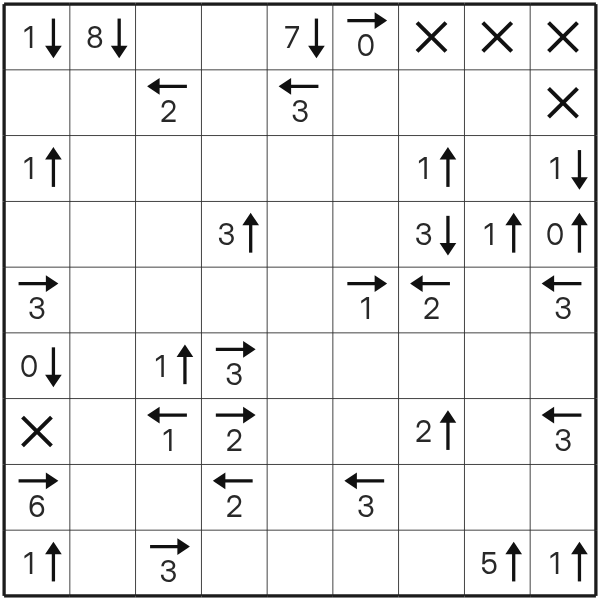
These cells can still be seen from other arrows later, but do not count as black cells there.
2. If the clue matches all possible cells, they are black
The 8 clue in the first row points precisely to eight cells below. Since it requests eight black cells, all eight must be black.
The 7 clue in the same row also sees eight cells. However, one of them is a number clue itself and must remain white. This leaves exactly seven possible black cells; all seven are then black.
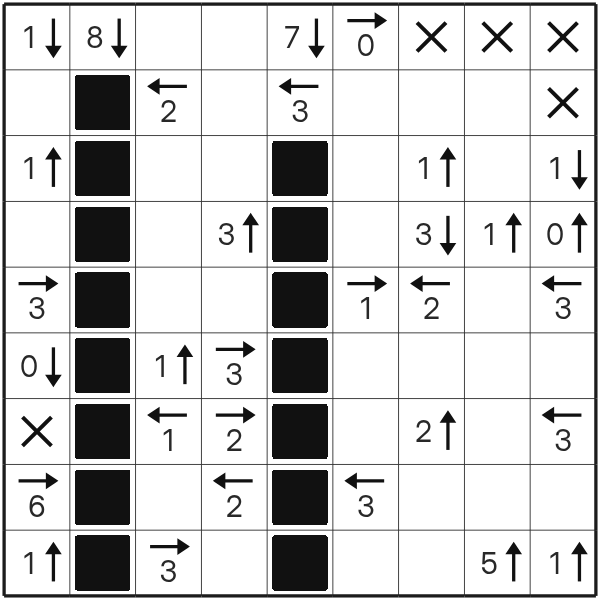
This second insight shows an important way of thinking: not only the line length matters, but also which cells are already safely white due to other rules.
3. A partially fulfilled arrow determines the remaining cells
The 2 clue in the second row only sees the two cells to its left. The second cell in this row is already black due to the 8v clue. Therefore, the first cell must also be black.
The 3 clue in the same row sees four cells. The first two are black; the third is a clue and therefore white. To reach a total of three black cells, the fourth cell must be black.
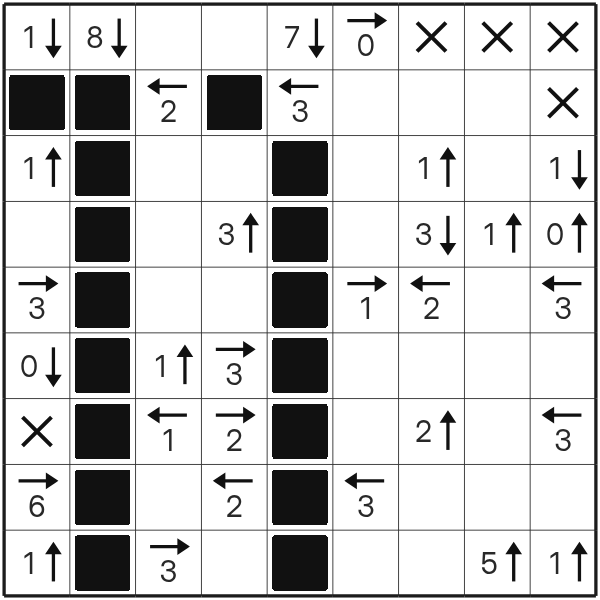
Both entries are unambiguous: the still missing number of black cells exactly matches the number of the remaining possibilities.
4. An arrow can fill a whole short line at once
The 3 hint in the fourth row points directly to three cells above. All three must be black.
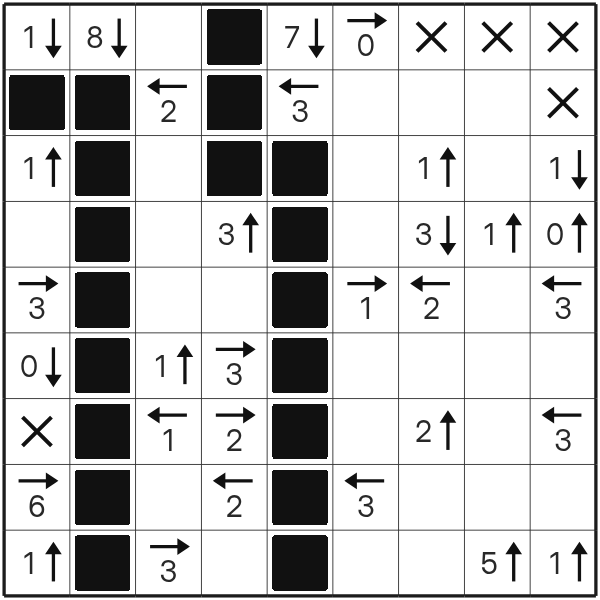
The clue extends to the edge. It does not matter if there are other black or white lines between the counted cells; only the number of black cells in this column above the clue counts.
5. Once the required number is reached, all other cells remain white
The 1 hint in the fifth row sees two more clue cells to its right and exactly one normal cell. Since exactly one black cell is required, this normal cell must be black.
The 3 hint on the right edge of the same row already shows exactly three black cells: in the second, fifth, and eighth cells. All other normal cells to the left of the hint must therefore be white.
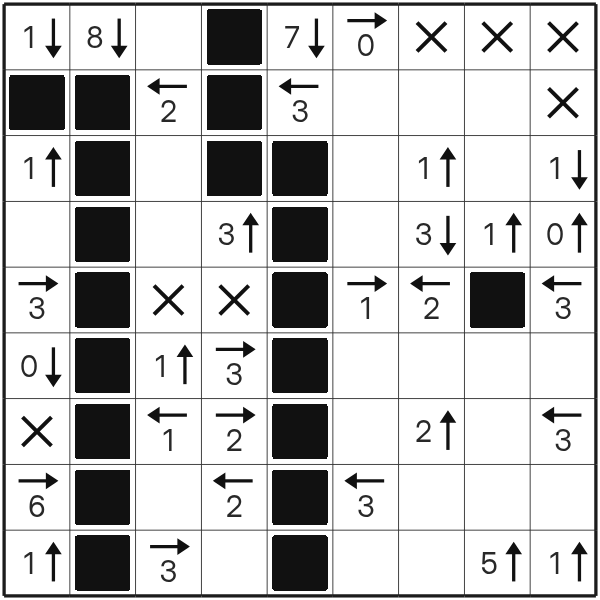
This technique is just as important as placing black cells. A fulfilled clue often creates several safe white cells.
6. Three black cells in a 2x2 block force a white cell
In the example below, three cells in a 2x2 area are already confirmed black.
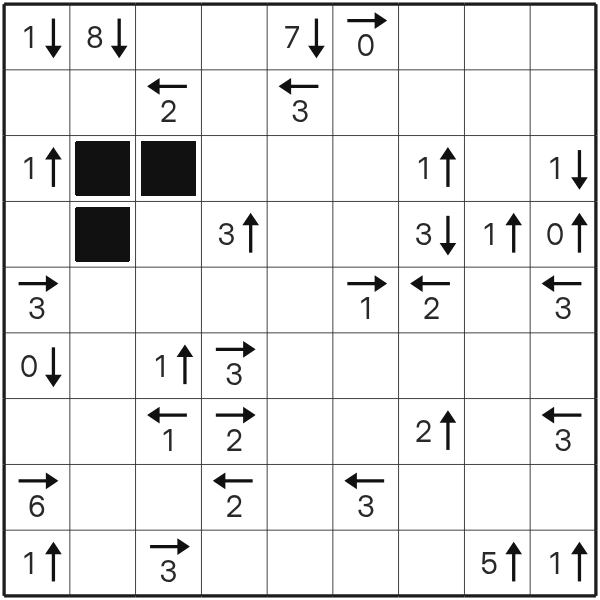
If the fourth cell were also black, it would create a fully black 2x2 square. The remaining cell must remain white.
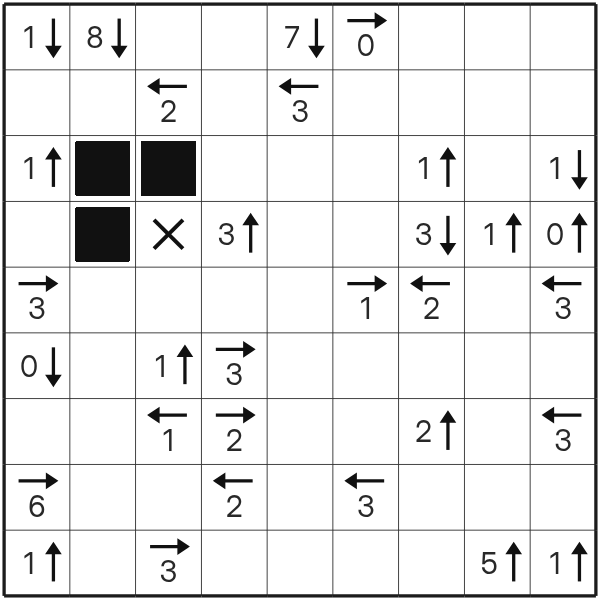
This conclusion does not require an arrow clue. It follows directly from Yajikabe’s area rule.
7. The black area must not form an isolated part
In the example below, the fourth cell of the first row is already black. The cell to the left is safely white, to the right is a clue cell, and above, the grid ends.
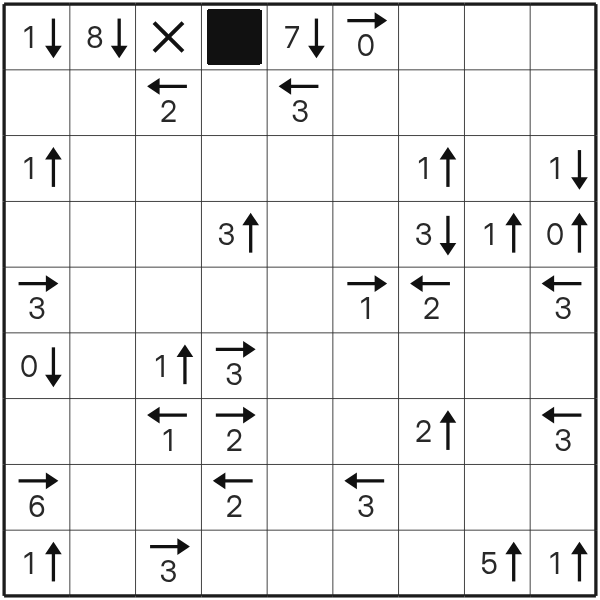
This leaves the only possible connection for this black cell to the rest of the black area: the cell directly below. This cell must also become black, regardless of arrows and numbers.
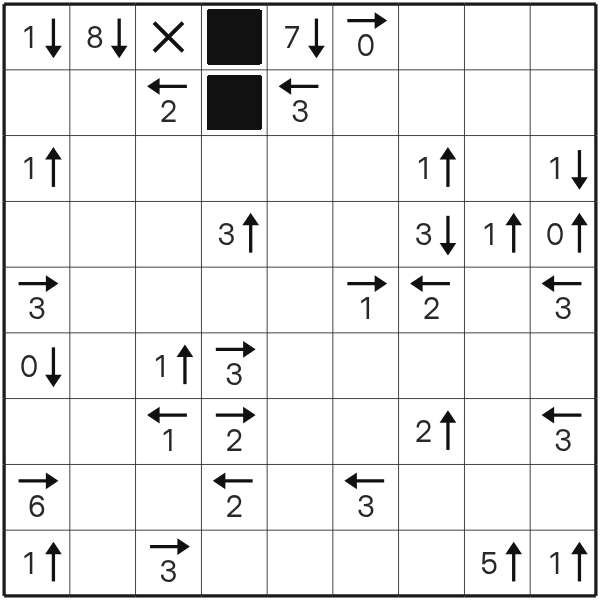
If it remained white, the black cell at the top edge would be permanently isolated. This would contradict the requirement for a connected black area.
8. A high clue can fully determine the remaining cells
The 6 hint in the eighth row points to eight cells to its right. Three are already black. Two are clue cells and must remain white.
That leaves exactly three normal cells, which are needed to reach a total of six black cells.
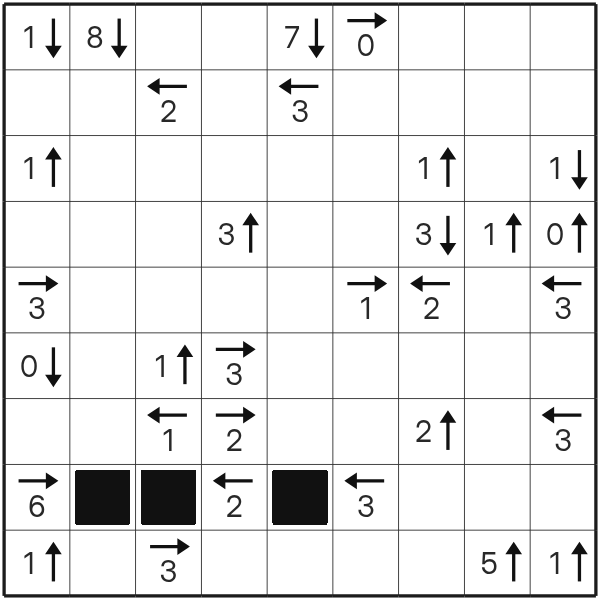
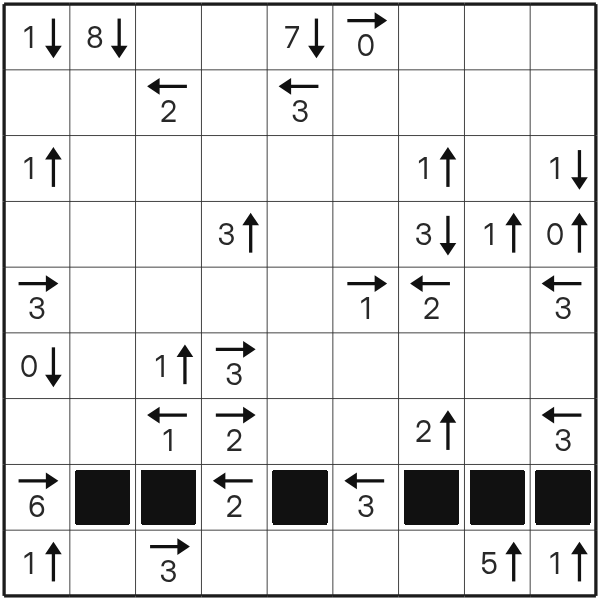
The conclusion is clear: three black cells are missing, and exactly three possible cells remain.
9. Always check arrows, 2x2 rule, and connectivity together
A cell can be numerically possible for an arrow yet still be excluded by another rule. Before marking, three questions should be checked:
- Does the mark fit all the arrows that see this cell?
- Does this create a black 2x2 area?
- Can the black area still form a single connected region?
Only if all three conditions are met and alternatives are excluded is the step safe.
Typical Solution Process
- Mark all number and arrow cells as safe white.
- Process all 0 clues and mark their full lines as white.
- Look for clues where the number exactly matches the count of remaining possible black cells.
- Check clues where the desired count is already reached and mark the other cells as white.
- After each black cell, verify all adjacent 2x2 areas.
- Regularly check whether black partial areas can only be connected through a specific cell.
- Repeat arrow counting, 2x2 checks, and connectivity testing after each confirmed step.
Common Mistakes
- Stopping the count at a white cell or another clue. The arrow counts up to the edge.
- Coloring a number cell black.
- Separating black cells as in Yajilin. In Yajikabe, they must be connected.
- Prohibiting horizontally or vertically adjacent black cells; only a full black 2x2 block is forbidden.
- Focusing only on arrow numbers and forgetting the connected black area.
- Noticing a black 2x2 square until the end.
- Guessing among multiple possible arrangements.
Tips for Beginners
- Start with 0 clues and very high clues.
- Maintain two counters for each arrow: confirmed black cells and remaining possible black cells.
- Mark all safe white cells as diligently as black cells.
- Immediately verify any new black cell against the four nearby 2x2 areas.
- Keep narrow connections between black partial areas in mind as potential bridges.
- If a step is not clearly justified by an arrow, 2x2 rule, or connection, hold off on marking it.
Yajikabe combines precise line counting with area logic. The arrows specify how many black cells lie in one direction, while the 2x2 rule and connection constraints limit their arrangement. Good progress often results from evaluating these three conditions simultaneously.