
Download puzzle & solution
Share puzzle
Our puzzles are completely free. Please support this website by recommending it to your friends and family. Thank you!
New puzzle
Calcudoku
Calcudoku is a number puzzle that combines the structure of a Latin square with calculation cages. Similar puzzles are also known under names like MathDoku. Depending on the provider, some details may vary slightly.
In each row and column, the numbers 1 to 6 are entered exactly once. The grid is additionally divided into cages. Each cage has a target number with an arithmetic operation. The numbers within a cage must produce the specified result with this operation.
Unlike Sudoku, there are no additional 2x3 or 3x3 blocks. Numbers may be repeated within a cage if they are not in the same row or column.
Basic Rules
- The example grid consists of 6 rows and 6 columns.
- In each row, the numbers 1 to 6 are entered exactly once.
- In each column, the numbers 1 to 6 are entered exactly once.
- The thick lines divide the grid into calculation cages.
- The numbers of a cage must sum, multiply, subtract, or divide to the target number.
- For addition and multiplication, all numbers in the cage are summed or multiplied.
- For subtraction and division, the order is not fixed. The positive difference or the larger number divided by the smaller is used.
- A number can be repeated within a cage if it does not occur twice in the same row or column.
- There are no additional Sudoku blocks.
- The puzzle is solved when all rows, columns, and cage targets are satisfied.
Strategies for Solving
1. Reduce a division cage to its only pair of numbers
In the following example, a cell already has a 6. Additionally, there is a vertical two-cell cage with the target 6÷ in the first column.
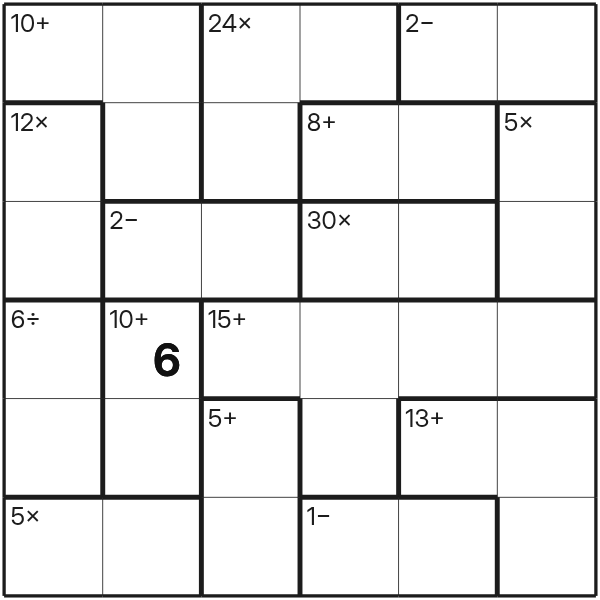
With numbers from 1 to 6, only the pair 1 and 6 can produce this result. But a 6 is already in the second cell of the fourth row, so the top cage cell cannot also be 6.
The top cell must be 1, and the bottom cell 6.
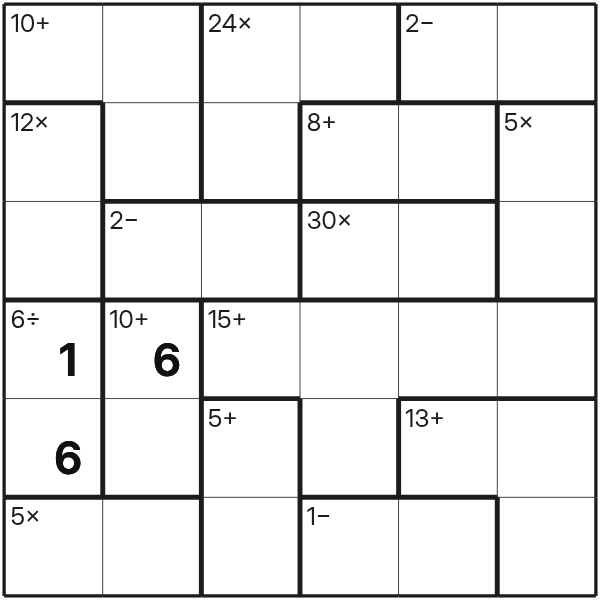
The cage rule yields the pair 1 and 6. The row rule clearly determines the order.
2. Combine a subtraction with the row rule
In the following example, the rightmost cells of the first row have the target 2−. The right cell already contains 3.
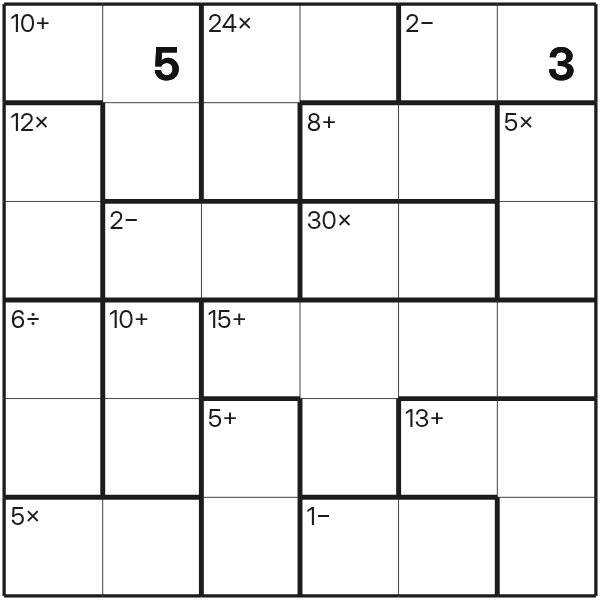
A number with a difference of 2 from 3 can be 1 or 5:
|3 - 1| = 2
|5 - 3| = 2
However, 5 is already in the same row. Therefore, the left cell of the cage cannot be 5 and must be 1.
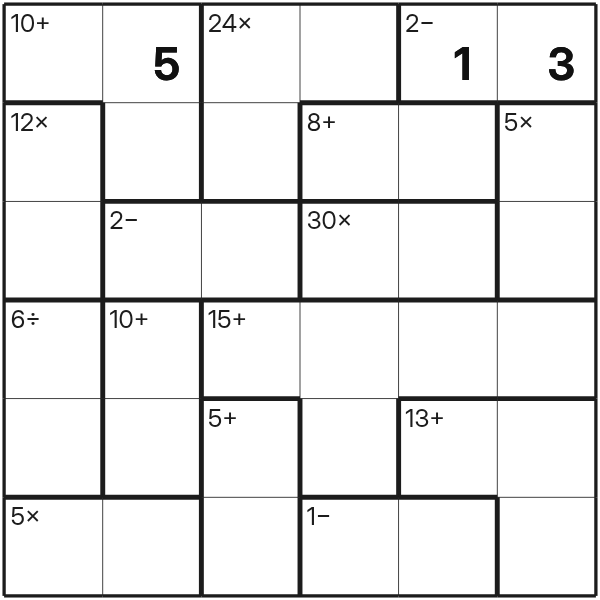
The subtraction alone gives two candidates. Only the row rule makes the entry definitive.
3. Complete a product with two known factors
In the following example, a cage consists of three cells with the target 24×. Two of its values are already known.
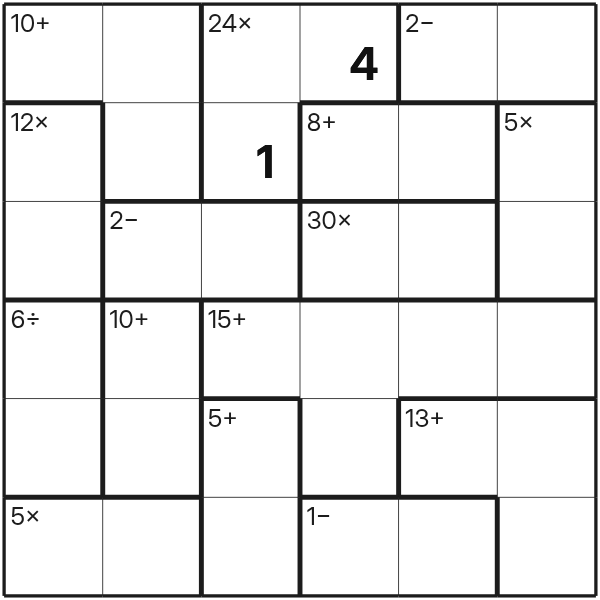
The missing factor is directly derived:
24 ÷ 4 ÷ 1 = 6Therefore, the third cell of the cage must be 6.
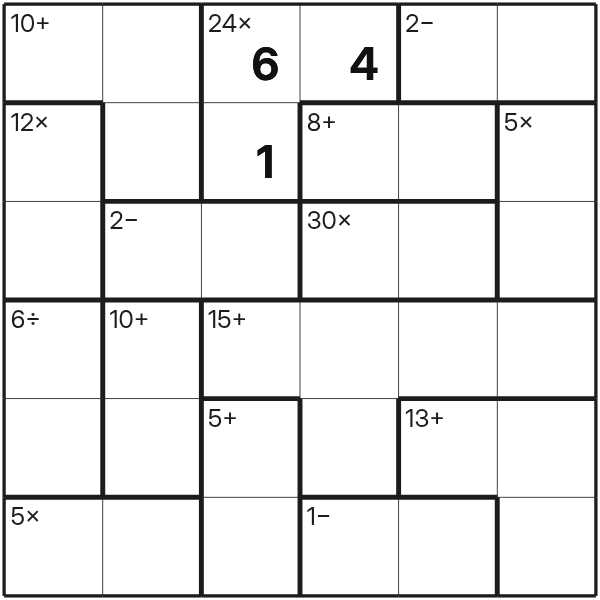
6 is within the allowed range and does not violate the row or column rules.
4. Evaluate an irregular sum cage
In the following example, a cage covers four filled cells in the fourth row and additionally a empty cell directly beneath it. The target sum is 15+.
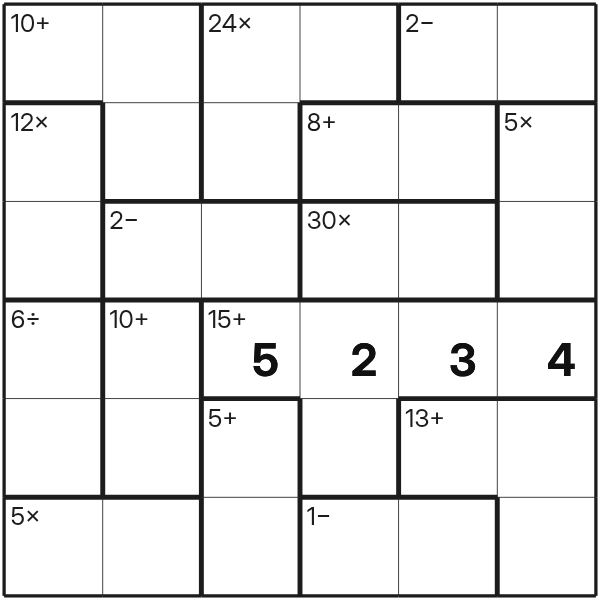
The four known values sum to 14. The fifth cell of the cage must therefore be exactly 1.
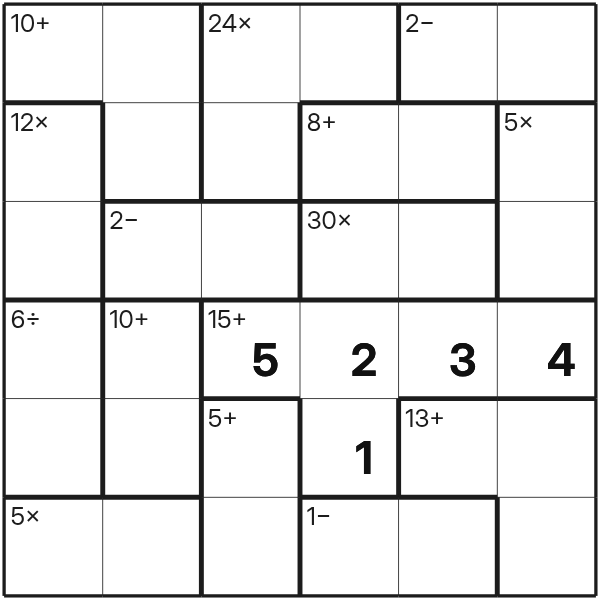
15 - 14 = 1The unusual shape of the cage does not affect the calculation. It is crucial to consider all cells with the same cage label completely.
5. Arrange a product pair with a previously used number
In the following example, there is a vertical two-cell cage with the target 5× in the sixth column. Only the pair 1 and 5 are possible with numbers from 1 to 6.
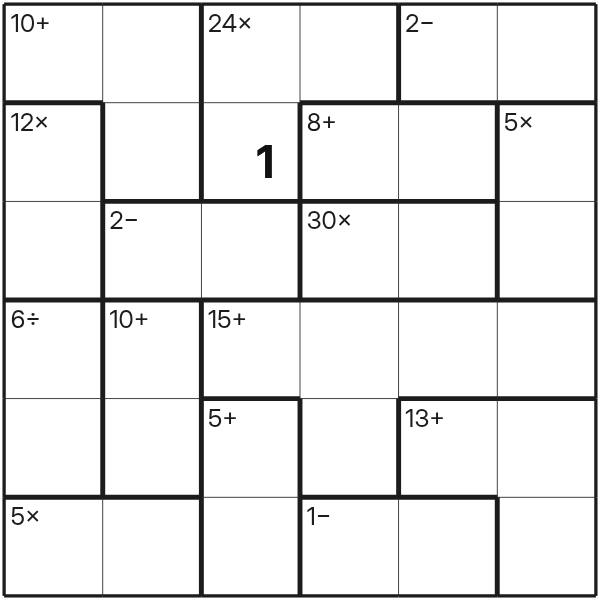
The top cell of the cage is in the second row. A 1 already exists in the third cell of this row, so the top cage cell cannot be 1.
It must contain 5; the lower cell then becomes 1.
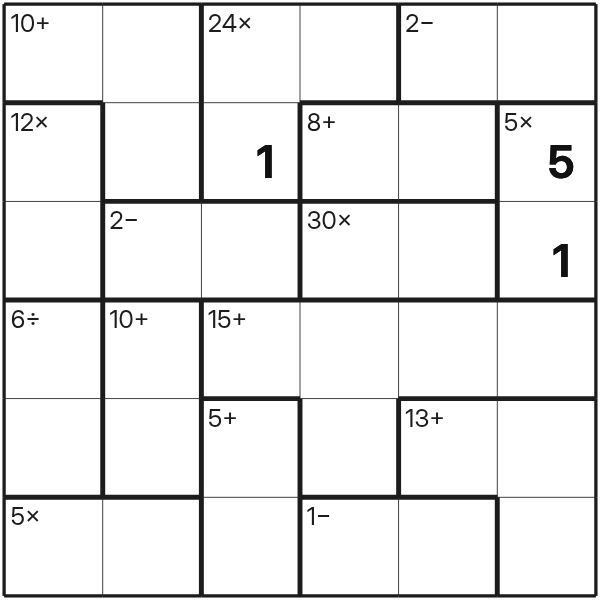
Again, the cage initially provides an unordered pair. The row rule determines the exact placement.
6. Systematically note cage combinations
A cage does not necessarily determine a single number immediately. For a two-cell cage with 8+ in a 6x6 puzzle, for example, pairs like 2 and 6 or 3 and 5 are possible. The two numbers can be in any order.
Such combinations are compared with the already used numbers in the affected rows and columns. As soon as a number or order is eliminated, the cage can be further restricted.
7. Properly evaluate repetitions within a cage
A cage can theoretically contain the same number multiple times if the cells are in different rows and columns. The cage boundaries do not override the row and column rules.
Therefore, if two cage cells are in the same row or column, they must never contain the same value.
Typical solving process
- Start with cages containing only two cells and with strongly limited results.
- Determine possible number pairs for subtraction, division, and small products.
- Use already used numbers in affected rows and columns to establish the order.
- Calculate missing values in cages where all other numbers are known.
- Carefully check irregular cage shapes and identify each related cell.
- Note potential combinations for larger cages without prematurely fixing their order.
- Immediately transfer each confirmed entry to its row, column, and all affected cages.
Common errors
- Using additional Sudoku blocks when Calcudoku only involves rows, columns, and cages.
- Assuming a fixed reading direction for subtraction or division.
- Overlooking a cell within an irregular cage.
- Entering a numerically suitable number that already appears in the row or column.
- Strictly prohibiting or allowing repetitions in a cage without checking rows and columns.
- Confusing a cage combination with a fixed sequence already determined.
- Calculating with numbers outside the range 1 to 6.
Tips for beginners
- Start with division and subtraction cages of two cells.
- Write possible number pairs next to cages before entering values.
- Immediately check each potential combination against both rows and columns.
- Use the factors of the target number for multiplication; the remaining sum for addition.
- Fully understand the shape of a cage visually before calculating.
- If multiple combinations remain possible, note candidates rather than guessing.
Calcudoku combines calculation with logical elimination. The cages determine possible number combinations, while the row and column rules decide where each number can go. Steady progress almost always results from combining both levels.