
Download puzzle & solution
Share puzzle
Our puzzles are completely free. Please support this website by recommending it to your friends and family. Thank you!
New puzzle
Easy as ABC
Easy as ABC is a letter puzzle on a square grid. The puzzle type is also known under the names "ABC End View" or "Last Man Standing." The grid consists of 6 rows and 6 columns and uses the letters A to E.
In each row and column, each letter A, B, C, D, and E must occur exactly once. Since the grid is 6 fields wide, exactly one field per row and column remains empty. The outside of the grid indicates which letter must be visible first from that direction. Empty fields are skipped in this consideration.
Basic Rules
- A grid consists of 6 rows and 6 columns.
- Letters A, B, C, D, and E are used.
- Each letter must appear exactly once in each row.
- Each letter must appear exactly once in each column.
- Each row has exactly one empty field.
- Each column has exactly one empty field.
- An edge clue indicates the first letter seen from that direction.
- Empty fields before this letter are skipped.
- No other letter may be between the edge and the clue letter.
- The puzzle is solved when all letters, empty fields, and edge clues are uniquely satisfied.
Strategies for Solving
1. The clue letter is always in one of the first two fields
Each row and column has exactly one empty field. Therefore, the field before the edge clue can be at most this one empty field. The sought letter must therefore be either directly at the edge or in the second field.
For the first row with the left clue B, this means:
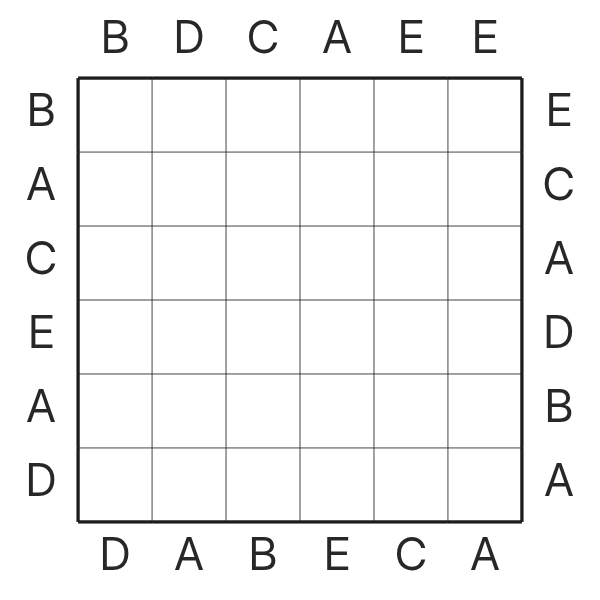
The B must be in the first or second field of the row. Based on the column clues B and D, B must be in the first field of the row here.
2. A known second letter enforces the edge letter
In the following example, the second field in the first row is D. The left clue is B.
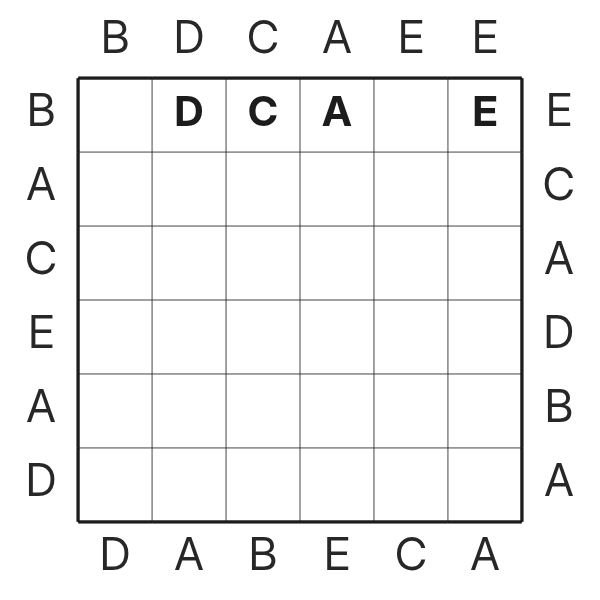
If the first field were empty, D would be the first visible letter, violating the B clue. Therefore, the first field must contain B.
After that, the row already contains B, D, C, A, and E. The only remaining open field must be the empty one.
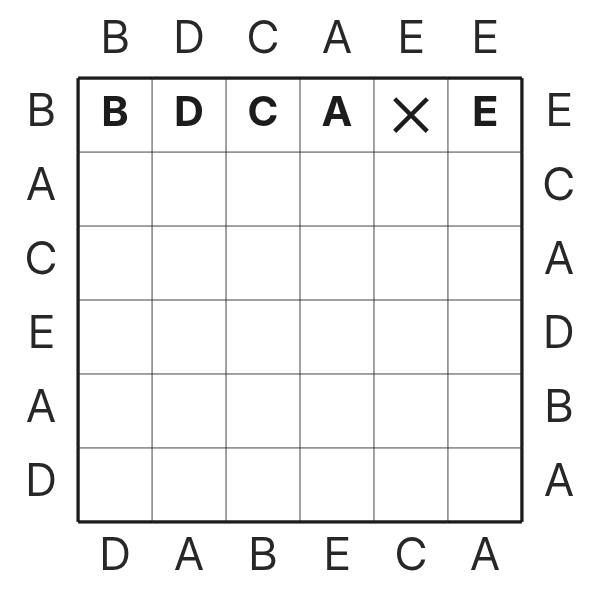
Both entries are clear: the edge clue sets B, and the row rule then determines the empty field.
3. An edge clue can designate an empty field
In the following example, the left clue in the fifth row is A. The second field already contains A.
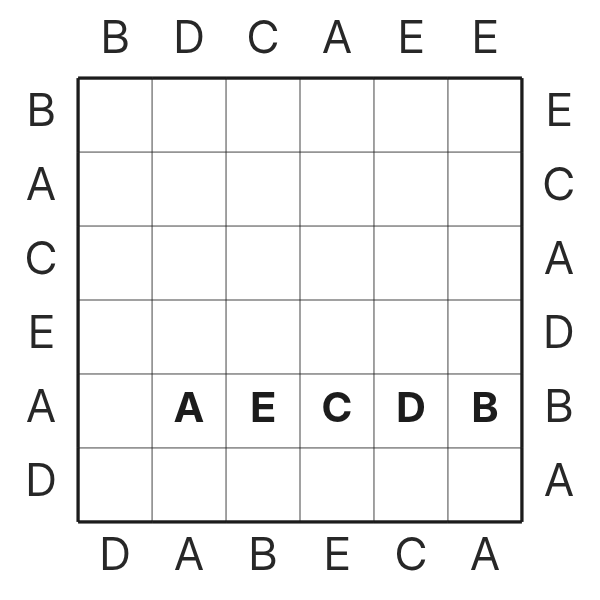
The first field cannot contain any letter. Any letter there would be visible from the left before A. Another A is also excluded because each letter can only appear once per row.
Thus, the first field must be empty.
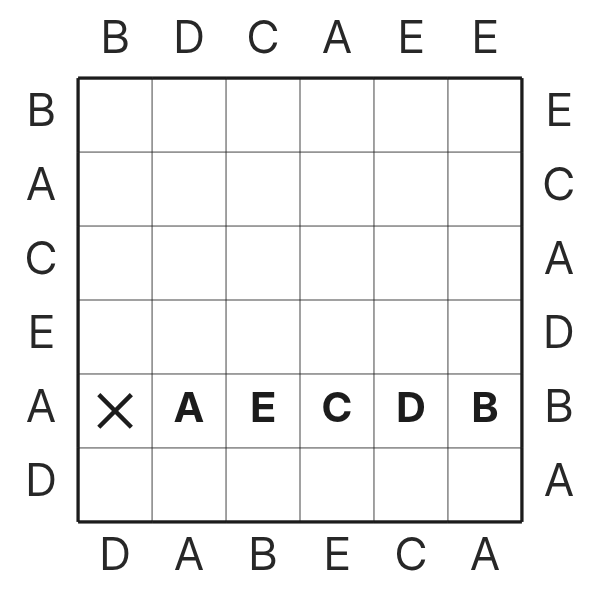
This empty field isn't just a consequence of the row filling but is directly enforced by the edge clue.
4. Combining clues from both sides of a row
In the second row of the following example, the left clue is A and the right clue is C. Several letters are already known.
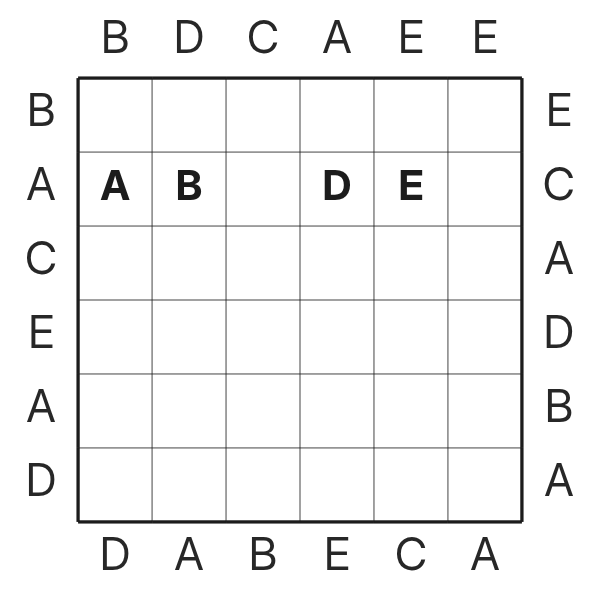
From the right, E is in the second field. Therefore, the last field cannot be empty, otherwise E would be the first visible letter and the C clue would be violated.
The last field must contain C. The row now contains A, B, C, D, and E. The only remaining empty field is the third one.
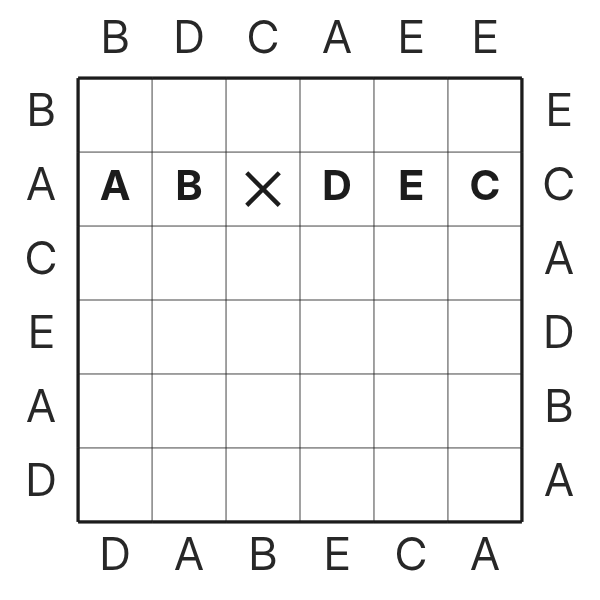
The right edge number initially sets C; then the rule of exactly one empty field determines the third field.
5. A column clue can designate a lower field as empty
Below the second column in the following example, the clue is A. The second-lowest field of this column already contains A.
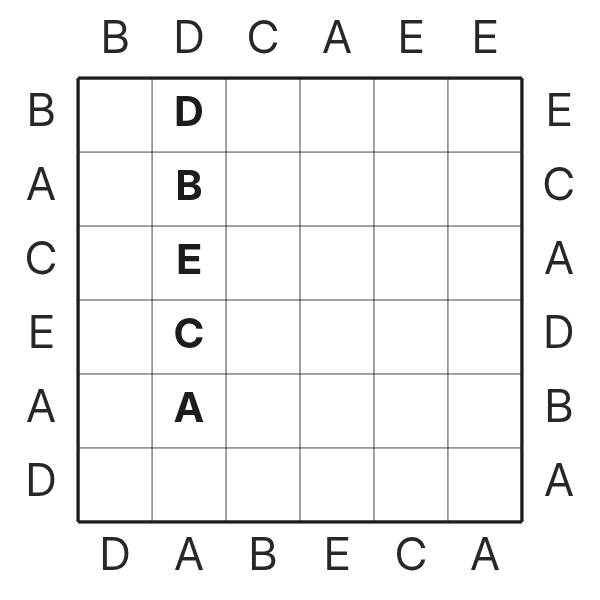
The bottommost field cannot contain any other letter because it would be visible from below before A. Another A is excluded because of the column rule.
The bottom field of the second column must be empty.
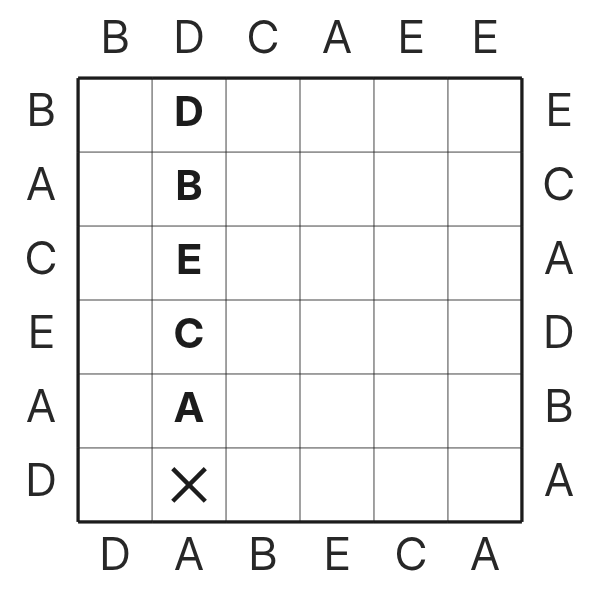
Furthermore, the column already contains all the letters D, B, E, C, A.
6. Combining letter and empty field candidates
A field can have candidates like A or C, but also the possibility of being empty. This possibility must be treated as strictly as a letter.
If an empty field is already confirmed in a row, all other fields must contain letters. Conversely, any additional empty fields are excluded. This often makes edge clues much more powerful.
Typical solving process
- Mark the first two possible fields for each edge clue.
- Check rows and columns where one of these two fields already contains another letter.
- Set edge letters if an empty field before an incorrect letter would violate the hint.
- Mark edge fields as empty if the clue letter already appears in the second field.
- Use the rule that each row and column A to E contains exactly one and one empty field.
- Combine clues from opposite sides of the same row or column.
- Update letter and empty field candidates after each definite entry.
Common mistakes
- Understanding the edge clue as a fixed position instead of the first visible letter.
- Not skipping empty fields when looking from the edge.
- Allowing more than one empty field in a row or column.
- Not treating an empty field as a real candidate.
- Using a letter twice in the same row or column.
- Ignoring the opposite hint and missing additional constraints.
- Placing a letter beyond the second field from the edge when only one empty field can be before it.
Tips for Beginners
- Start with rows or columns where the clue letter is already in the second field.
- Note empty fields clearly to avoid filling them with a letter later accidentally.
- Check only the first two fields from each edge clue. The first visible letter cannot be further back.
- Use a fully known set of letters A to E to identify remaining empty fields.
- Switch regularly between row and column clues.
- Don’t fill in anything unless a letter and an empty field are both possible.
Easy as ABC combines a Latin letter structure with line-of-sight rules from the edge. The edge clues determine which letter must appear first, while row and column rules specify where letters and empty fields can be.