
Download puzzle & solution
Share puzzle
Our puzzles are completely free. Please support this website by recommending it to your friends and family. Thank you!
New puzzle
Heyawake
Heyawake is a Japanese logic puzzle whose name roughly means "divided rooms." The game board is divided into rectangular rooms of various sizes. Some rooms contain a number. The goal is to shade certain cells and leave all other cells white.
The numbers indicate how many black cells must be in the respective room. Additionally, black cells may not border each other horizontally or vertically, all white cells must remain connected, and a straight white line cannot pass through three or more rooms.
Basic Rules
- The game board is divided into rectangular rooms.
- A number indicates exactly how many cells in the room must be black.
- A room without a number may contain any number of black cells, as long as all other rules are followed.
- Black cells may not touch each other horizontally or vertically. Diagonal contact is allowed.
- All white cells must form a single connected area, connected horizontally or vertically.
- A continuous row of white cells may cross at most two rooms.
- A straight white line connecting three or more rooms is therefore forbidden.
- The puzzle is solved when every cell is clearly black or white and all rules are simultaneously satisfied.
Strategies for Solving
1. Evaluate single-cell rooms immediately
A room consisting of only one cell and marked with 1 must be entirely black.
The fifth cell in the seventh row forms such a room and contains the hint 1 in the following example. This cell must therefore be black.
Since black cells cannot share a side, the four adjacent cells horizontally and vertically are safely white.
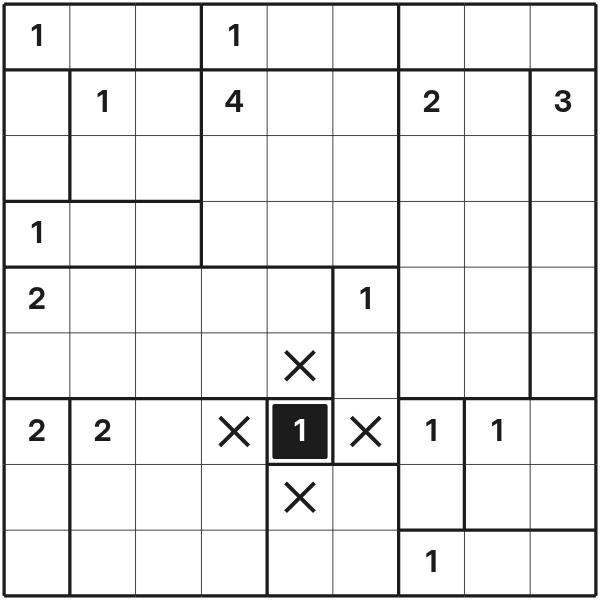
The conclusion is completely unambiguous: The room number enforces the black cell, and the neighborhood rule enforces the four white cells.
2. Black cells must not touch
The room in the following example consists of the five cells in the last column from the second to the sixth row. The room bears the hint 3.
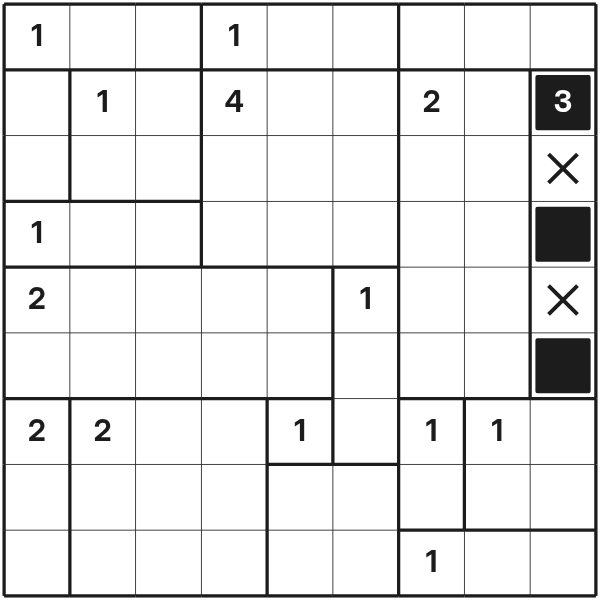
Since black cells are not allowed to touch and the room must contain exactly three black cells, the arrangement is clearly defined.
3. A 3x3 room with 4 black cells
In the following example, there is a 3x3 room with the hint 4. All white cells must be connected horizontally or vertically to a single area, and black cells may not be either horizontally or vertically adjacent. Thus, there is only one possible arrangement. This leaves exactly four remaining candidate cells for black in the room.
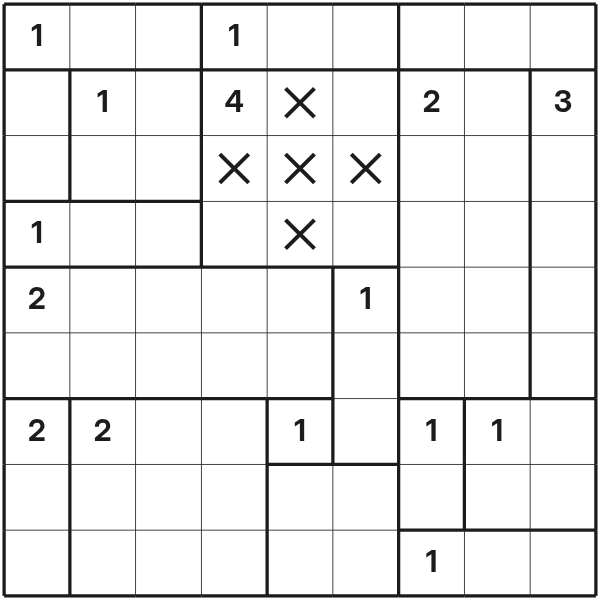
The four remaining corner cells must all be black. If the middle edge cells were marked black, there would be a separated white cell in the middle, which violates the rules.
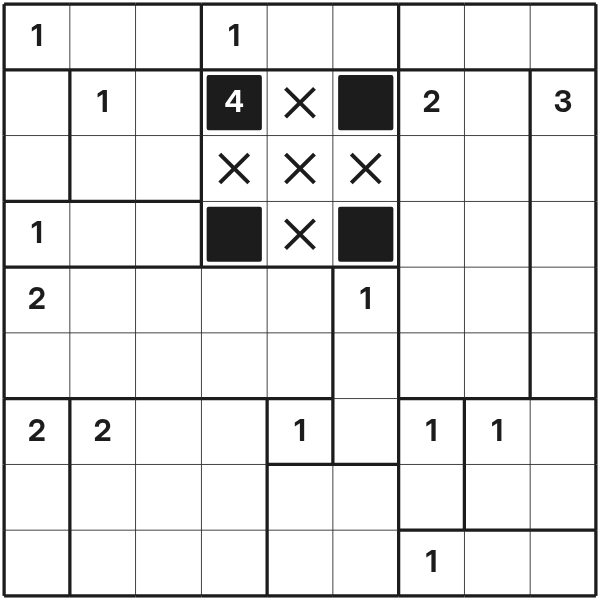
These four black cells do not touch horizontally or vertically. The hint 4 is thus exactly fulfilled and all puzzle rules are satisfied.
4. Prevent a white line crossing three rooms
The characteristic Heyawake rule concerns straight white lines. Suppose four cells are already safely white as in the example below.
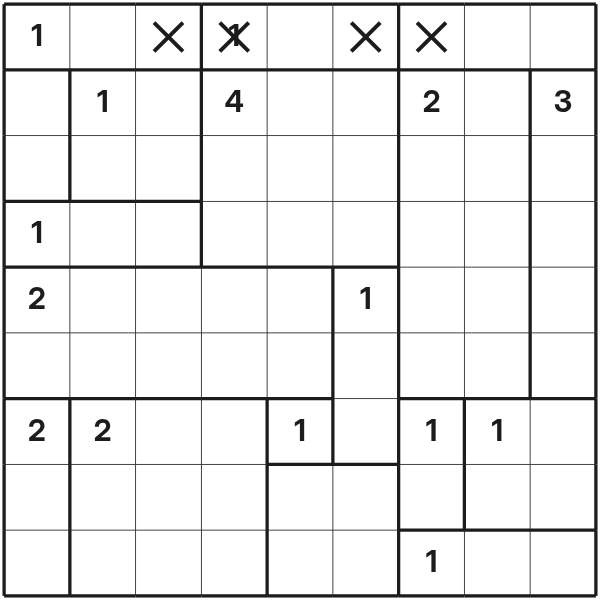
If the middle open cell were also white, a continuous white line would run from the third to the seventh position, crossing all three rooms in the first row and thus connecting three rooms.
This is not allowed. Therefore, the open cell must be black.
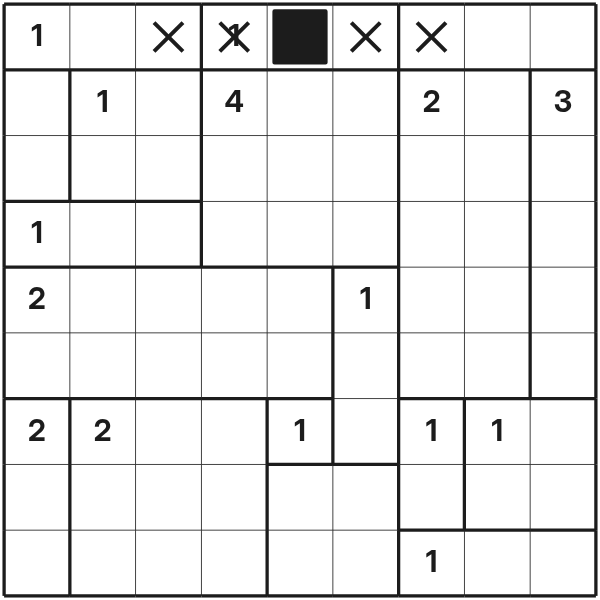
This conclusion does not rely on a room number or guesswork. It follows directly from the rule that a straight white line may pass through at most two rooms.
5. Protect the connection of all white cells
All white cells must form a single connected area. In the following intermediate state, the middle white cell is almost completely surrounded by black cells.
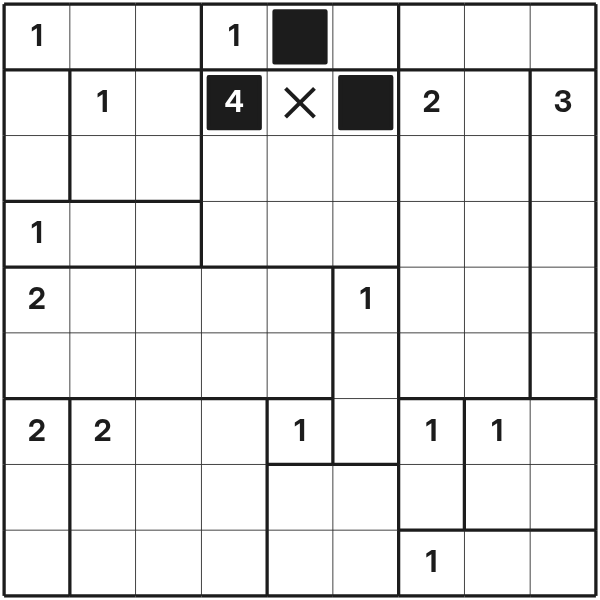
The white cell in the middle has black neighbors to the left, right, and above. The cell directly below is its only possible connection to the rest of the white area.
If this cell also became black, the white area would be completely cut off. Therefore, it must be white.
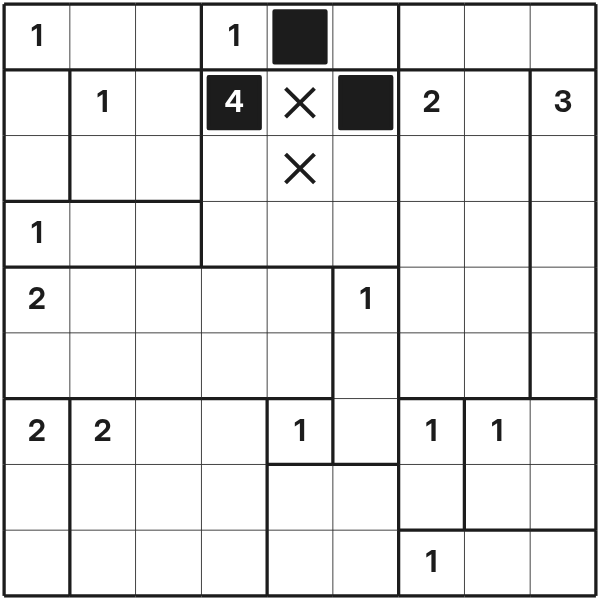
This strategy does not claim that the new white cell already shows the entire solution. It is only certain that it cannot be black, or a white island would form.
6. Check the immediate surroundings after each black cell
A new black cell immediately affects four neighboring cells. These cannot also be black.
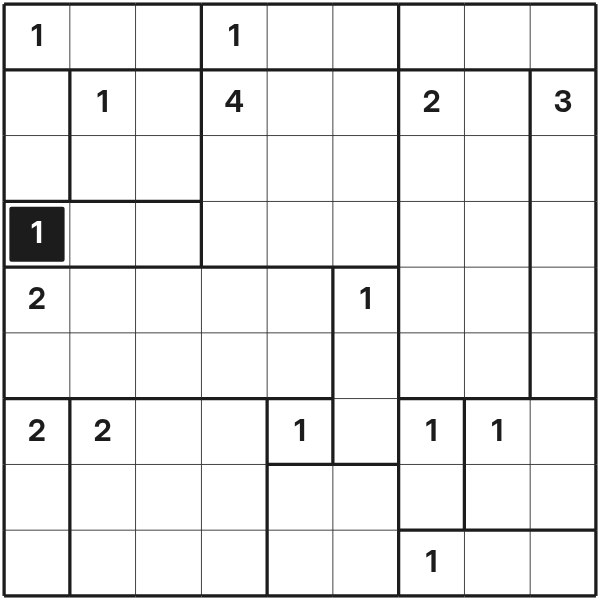
The black cell at the left edge enforces that the cell above, the cell below, and the cell to the right are white.
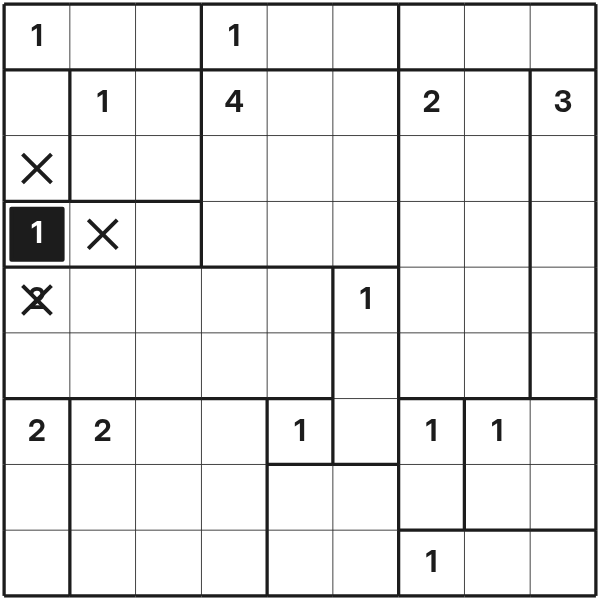
Cells outside the grid are, of course, not considered. Diagonally adjacent cells remain undetermined by this rule.
Typical solving process
- First check very small rooms and rooms with high number hints.
- After each black cell, mark all horizontally and vertically adjacent cells as white.
- When the number of a room is reached, mark all remaining cells in the room as white.
- If the number of still possible cells exactly matches the remaining number of black cells, shade all these cells black.
- Search in rows and columns for white sequences that would pass through three rooms.
- Regularly check whether a black cell would divide the white area or isolate a white cell.
- Transfer each new insight back onto room numbers, neighbors, white lines, and the connectivity of the white area.
Common mistakes
- Only consider room numbers and forget the rule of white lines.
- Place two black cells side by side horizontally or vertically.
- Incorrectly forbid diagonal contact between black cells.
- Automatically treat an unnumbered room as completely white.
- Cut off a group of white cells from the rest of the grid.
- Overlook a white line crossing three rooms because room boundaries are not tracked.
- Shade a cell when multiple options exist and none are explicitly enforced.
Tips for beginners
- Check each room boundary and remember which cells truly belong together.
- Mark safe white cells as consistently as black cells.
- Immediately check the four direct neighbors after each black cell.
- Look especially in long rows and columns for transitions between three rooms.
- Before placing a black cell, ask if the white area can remain connected afterward.
- A room hint alone does not always specify the exact position of black cells. Only enter what becomes clear through additional rules.
Heyawake combines local room numbers with global rules. The room hints determine how many cells are shaded, while neighborhood, line, and connectivity rules specify where these cells can be located. The secure solution path emerges from the consistent interplay of all four conditions.