
Download puzzle & solution
Share puzzle
Our puzzles are completely free. Please support this website by recommending it to your friends and family. Thank you!
New puzzle
Linesweeper
Linesweeper is a loop puzzle with clues based on the principle of Minesweeper. It is sometimes simply called "Loop." A single closed line must be drawn in the grid. The line runs horizontally or vertically from the center of one cell to the center of an adjacent cell.
The number cells themselves cannot be traversed by the line. A number indicates how many of the up to eight surrounding cells are visited by the line. Diagonally adjacent cells are included in the count. The number thus describes the number of neighboring cells that the solution path passes through, not the number of line segments on its edges.
Basic Rules
- A single closed loop must be created.
- The line runs through the midpoints of adjacent cells.
- The line must not cross itself or branch.
- Each cell visited by the line has exactly two connections to orthogonally adjacent line cells.
- Number cells may not be visited by the line.
- A number indicates how many of the horizontally, vertically, or diagonally adjacent cells belong to the line.
- At the edges, a number cell has fewer than eight neighbors; only existing neighboring cells are counted.
- No disconnected loops or prematurely closed small circles are allowed.
- The puzzle is solved when all numbers are satisfied and all line cells form exactly one loop.
Strategies for Solving
1. A maximum edge clue fills all neighboring cells
The 5 in the first row of the following example has exactly five neighbors due to the top edge: two in the same row and three directly below.
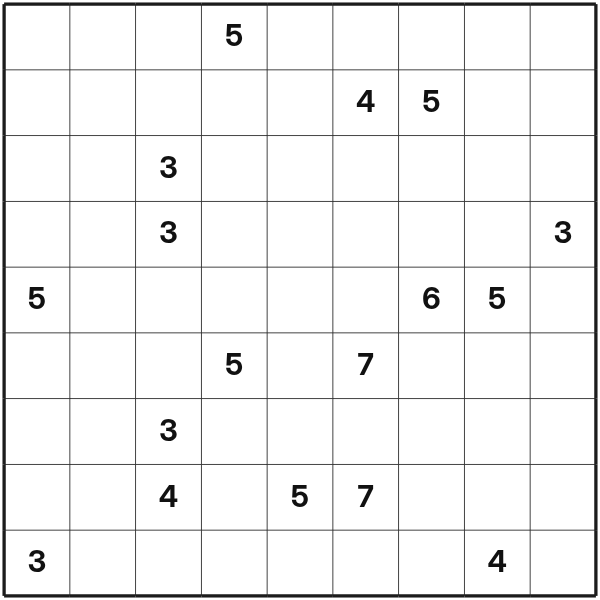
Since the clue 5 counts all five available neighboring cells, they all belong to the line.
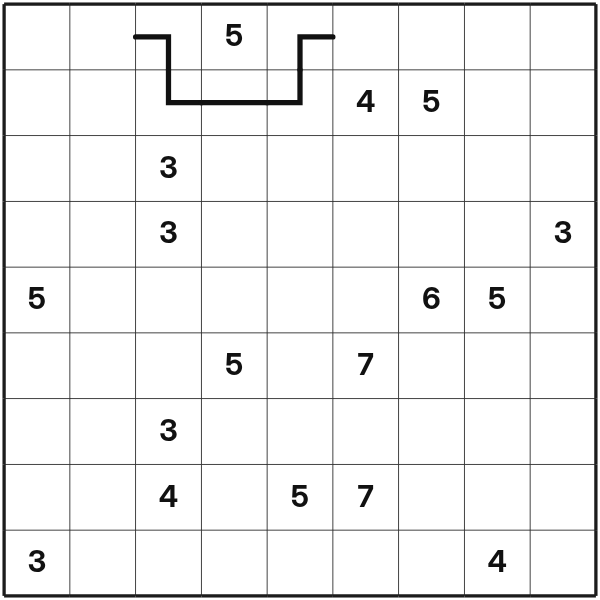
This step is clear: An edge clue 5 has exactly five neighbors and requires all five to be line cells.
2. A maximum corner clue fills its three neighbors
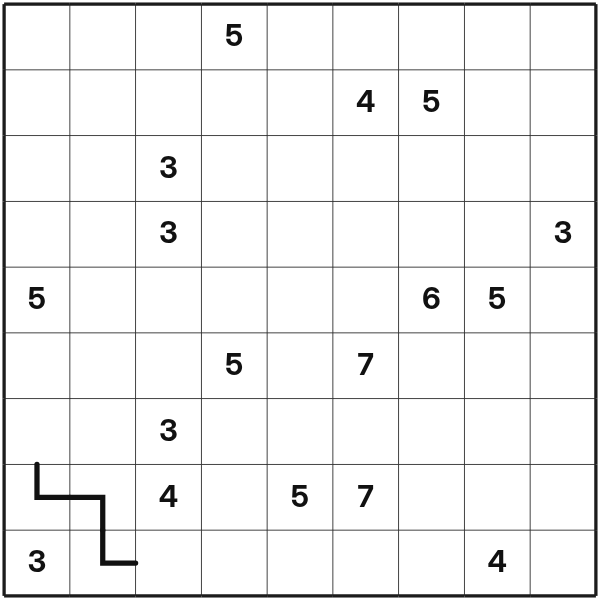
The 3 in the bottom left corner is in a corner. A corner cell has exactly three neighbors: directly above, diagonally above right, and directly right.
Since the clue 3 states, all three cells must be visited by the line.
3. A clue 7 next to a number cell forces seven line cells
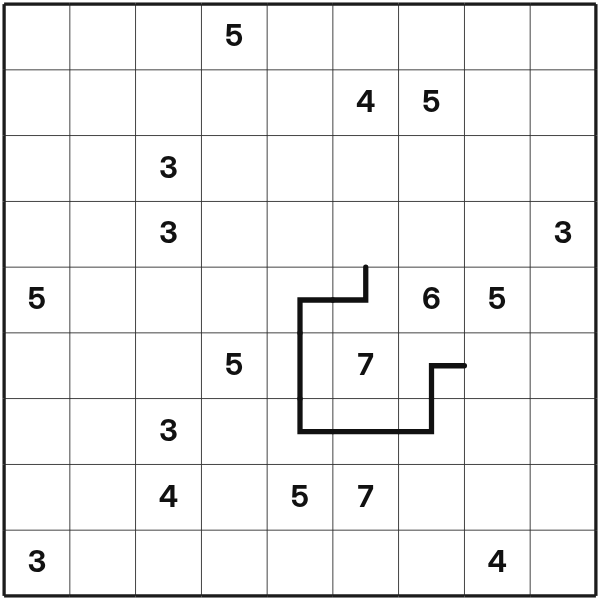
In the middle area of the following example, a 7 is present. Among its eight neighboring positions, one already contains another number cell, namely 6 diagonally above right. A number cell can never belong to the line.
Therefore, exactly seven neighboring cells are possible. Since the clue 7 requires all seven, they must all be line cells.
4. When a clue is satisfied, all other neighbors are excluded
Consider the 3 in the third row in the following example. Suppose exactly three of its neighboring cells are already known to be line cells: two above and one diagonally below left.
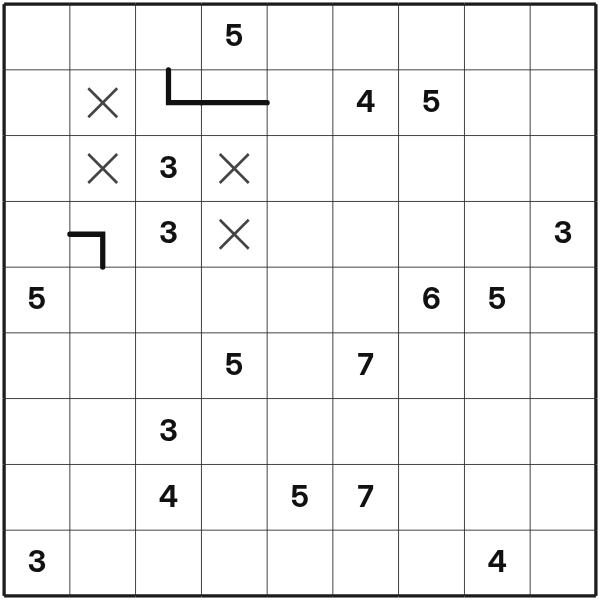
The 3 is thus fully satisfied. All other adjacent cells may no longer belong to the line and are marked with x. The number cell directly below is not a line cell anyway.
This conclusion aligns with classic Minesweeper logic: once the required number is reached, all other possibilities are eliminated.
5. A line cell requires exactly two orthogonal continuations
The maximum clue 5 at the top edge of the following example has among other things the cell directly to its left as a line cell. This cell is in the first row.
Upward the grid ends; to the right is the number cell 5. The line cell can only extend to the left and downward. Both orthogonal neighbors must also be part of the line.
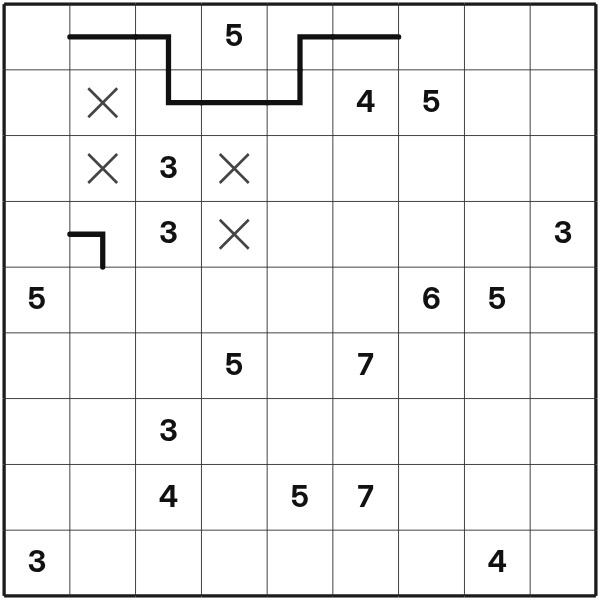
Similarly, the cell directly to the right of 5 must extend to the right and downward. The cell geometry determines these two necessary connections.
6. Diagonal neighbors count for clues but not as line connections
A number counts all eight surrounding cells, including diagonal line cells. However, the line itself cannot jump diagonally from one cell to the next.
Two diagonally adjacent cells can both count towards a number clue but require horizontal or vertical intermediate paths for actual connection. These two levels should not be confused.
7. Avoid small closed loops
Each line cell needs two connections. Still, one should not connect a segment to a small closed circle if there are still other safe line cells outside.
If a segment closes prematurely, it cannot connect to the remaining cells. Since exactly one loop must be formed at the end, the closing connection in such a case is excluded.
8. Compare neighboring clues
If the neighborhoods of two number cells overlap, their requirements can be compared. For example, if a clue already has five line cells known and a neighboring clue needs six, the additional line cell must lie in the part of the neighborhood only visible to the second clue.
Such difference conclusions are crucial when no single clue alone determines all cells.
Typical Solution Process
- Look first for corner and edge clues whose number equals the maximum number of neighbors.
- Mark all line cells thereby forced.
- If a clue is satisfied, exclude its other neighbors.
- If the number of remaining possible neighbors exactly matches the number still needed, mark all as line cells.
- For each line cell, check its orthogonal continuations: it needs exactly two.
- Compare overlapping neighborhoods of neighboring clues.
- Prevent branching, dead ends, and premature small loops.
- Connect all line cells into exactly one closed loop.
Common Mistakes
- Not counting diagonally adjacent cells for number clues.
- Drawing the line through a number cell.
- Closing a small loop when other line cells outside still exist.
- Considering multiple disconnected loops as valid solutions.
Tips for Beginners
- Start with maximum clues at corners and edges.
- Use counters like "Known line cells / Missing line cells" for each clue.
- Mark excluded cells just as consistently as line cells.
- Mentally separate the eight neighbor cells of a clue from the four possible line directions.
- Immediately verify how each new line cell can have two orthogonal connections.
Linesweeper combines local Minesweeper counting with a global loop rule. The numbers determine which neighboring cells are visited, while the line logic specifies how these cells are connected into a single loop without crossing, branching, or forming separate circles.