
Download puzzle & solution
Share puzzle
Our puzzles are completely free. Please support this website by recommending it to your friends and family. Thank you!
New puzzle
Nurikabe
Nurikabe is a Japanese logic puzzle in which white islands are separated from each other by a connected black wall. Some cells contain numbers. Each number belongs to exactly one white island and indicates its total size.
All black cells must be connected horizontally or vertically. Simultaneously, no fully black 2x2 area may form anywhere. Each white island contains exactly one number hint and must not touch other islands.
Basic Rules
- Number cells remain white at all times.
- Each number indicates the number of connected white cells in its island.
- An island contains exactly one number hint.
- Different islands must not touch horizontally or vertically.
- Diagonally adjacent islands are allowed.
- All black cells must form a single connected wall via shared sides.
- No fully black 2x2 square may be formed.
- The puzzle is solved when all island sizes are correct and both wall rules are satisfied.
Strategies for Solving
1. A cell between two numbers becomes black
In the first row of the example below, an empty cell lies directly between the 2 and 4.
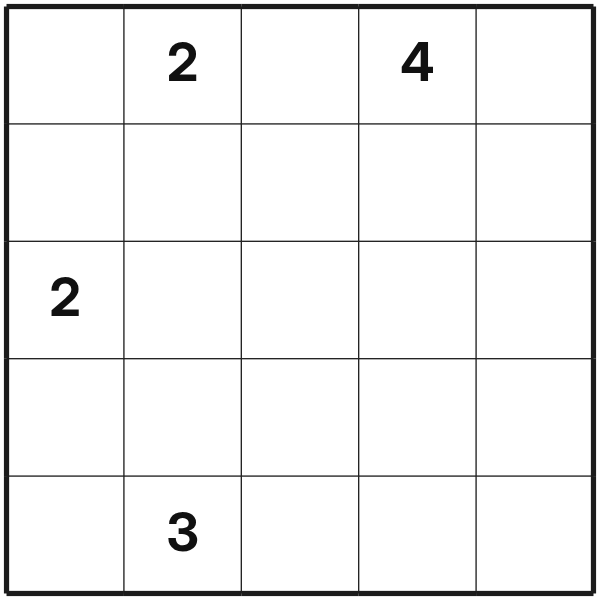
If this cell remains white, it could connect the two number cells into one white area. But each island can only contain one number hint.
Therefore, the cell between the two numbers must be black.
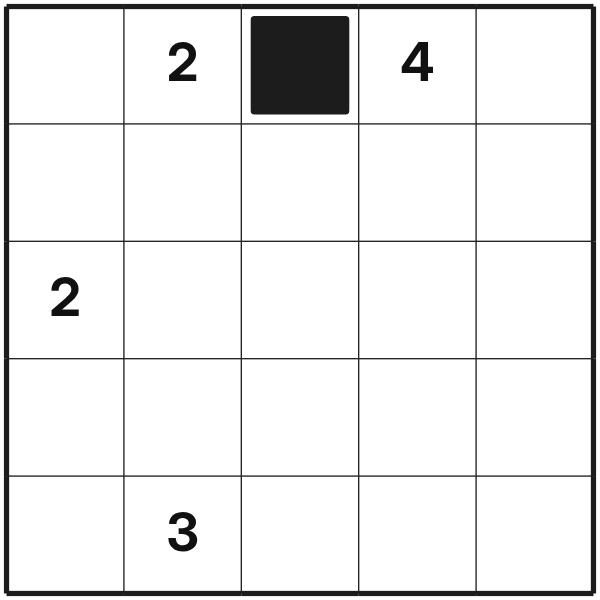
This conclusion is independent of the subsequent shapes of the two islands.
2. Ensuring continuous black cells
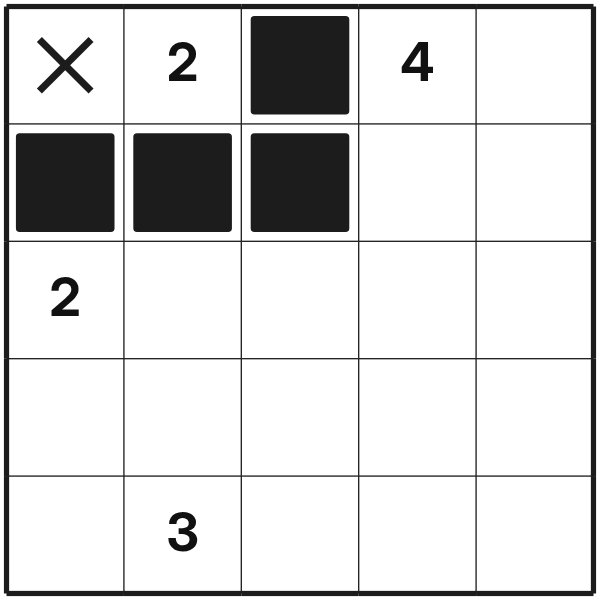
The cell in the middle of the first row is black according to the previous example. Cells to the left and right of it are number cells, which cannot be black. Since no separated black cells are allowed, the cell below this black cell must also be black.
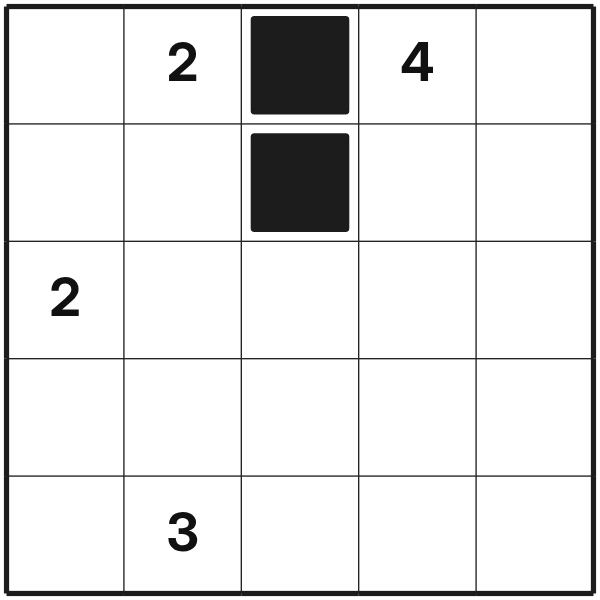
For the cell with the 2 in the first row, there are two possibilities: either the cell to the left or the cell below the 2 stays white.
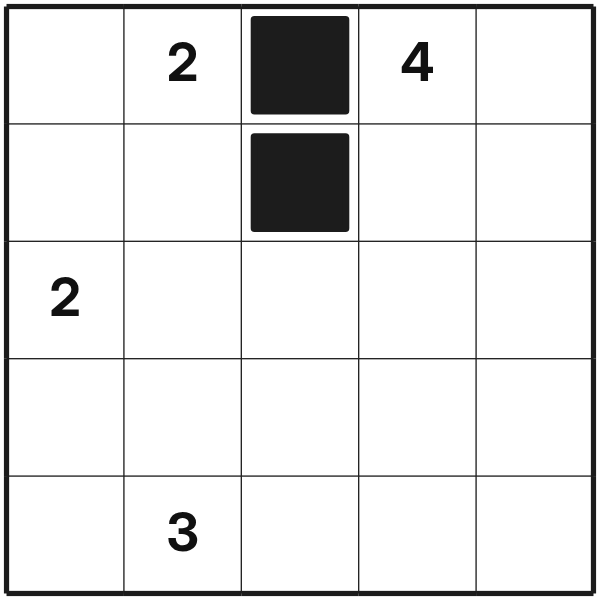
If the cell below remained white, the top two cells in the first column would be black. This would mean not all black cells are connected:
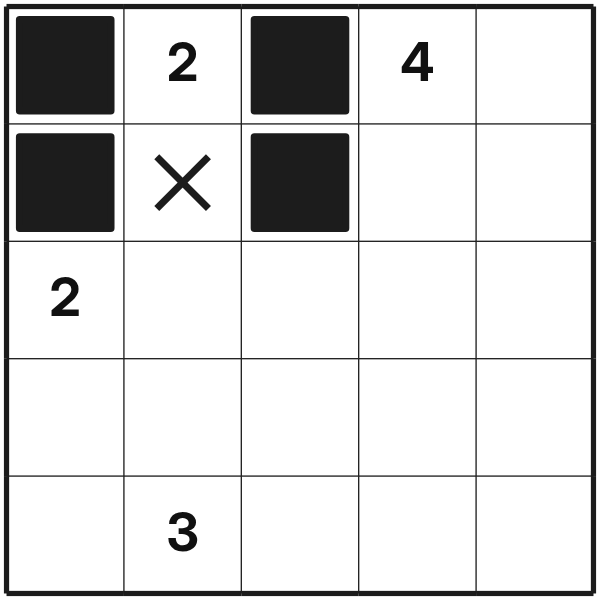
For the cell with the 2, the left cell must therefore be white. The two cells below clearly separate the island, ensuring connected black cells.
3. A cell must not connect two islands
In the example below, consider the 2 in the first column. Assume the cell to the right of this 2 definitely belongs to its island. Simultaneously, above that cell is the island of the upper 2.
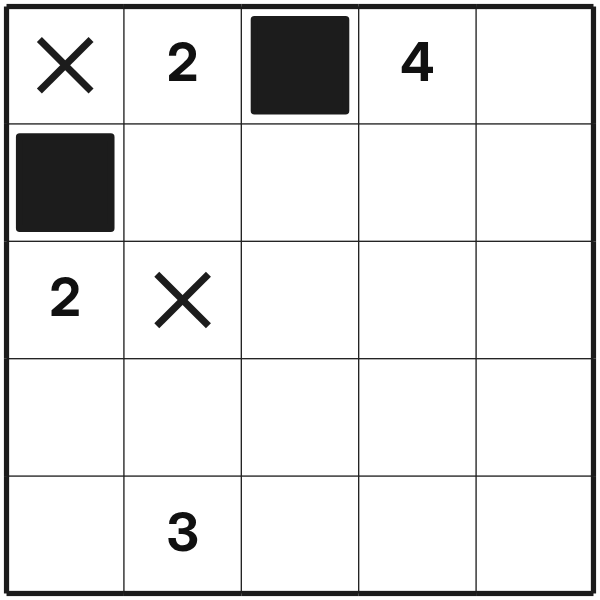
The empty cell directly between these two white areas cannot be white regardless of the island size: it would connect the island with the upper 2 and the island with the left 2 into one area.
Since an island can never contain two numbers, this intermediate cell must be black.
4. Three black cells in a 2x2 area force a white cell
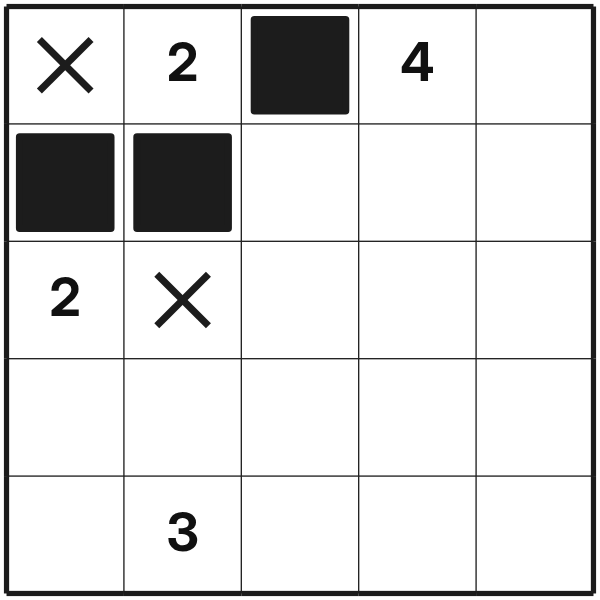
The black wall cannot contain a fully black 2x2 square. In the example below, three cells in a 2x2 area are already black.
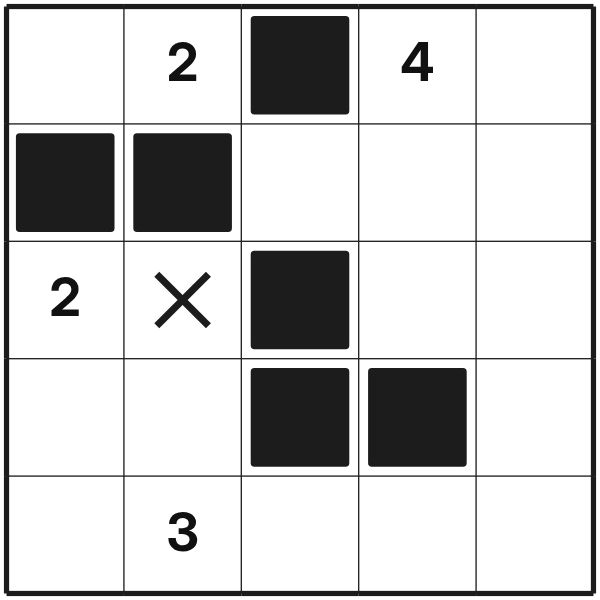
If the fourth cell of this 2x2 area were also black, it would form a forbidden black 2x2 square.
Therefore, this cell must stay white.
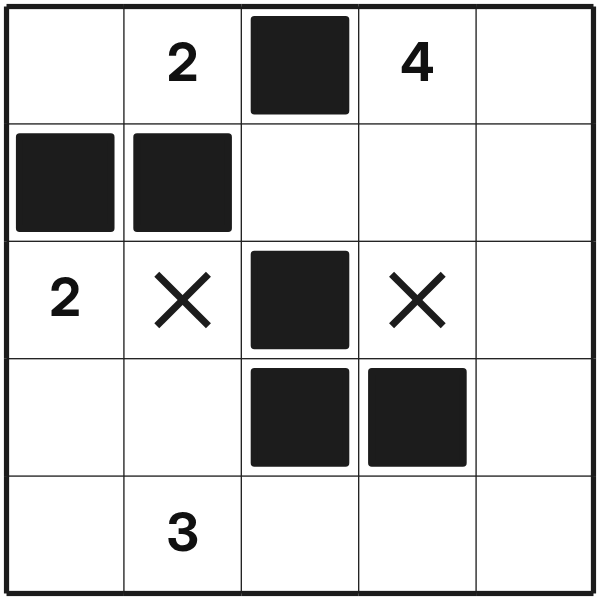
This conclusion initially only states that the cell is white. Which island it belongs to is determined through further connections.
5. A complete island frees up adjacent wall cells
In the example below, the island of 4 consists of the number cell at the top, the cell to its right, and two cells below.
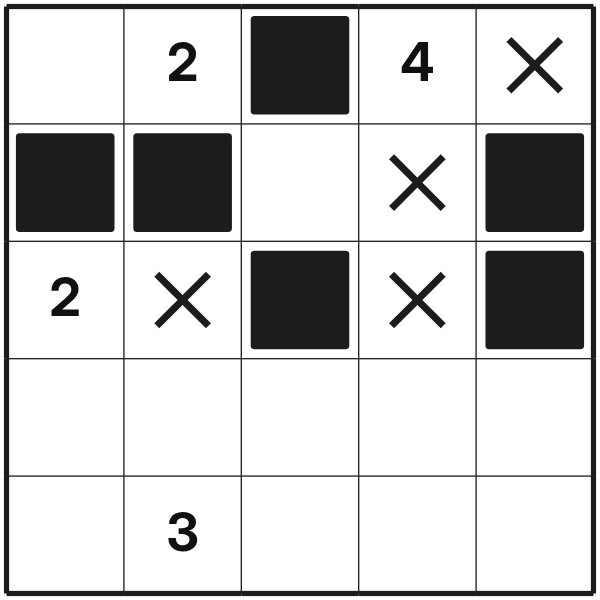
The four white cells are connected and contain exactly the number 4. The island is thus complete.
All other orthogonally adjacent cells must be black. This prevents the island from growing or touching another island.
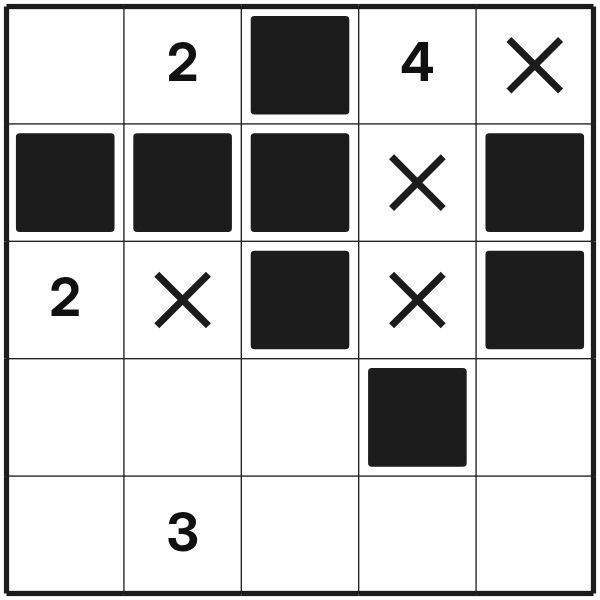
6. An island with only one possible growth cell must expand there
If an island is still too small and needs more cells, and all possible exits except one are blocked by black cells, the edge, or other islands, the remaining cell must be white.
This technique is particularly useful for small numbers. A 2-island needs exactly one additional cell. Once only one direction remains open, that cell is surely part of the island.
7. A cell without an accessible number is black
Every white cell must belong to an island with a number hint. If an unknown cell cannot reach a number due to known black cells, it cannot remain white.
This isolated cell must turn black. This conclusion prevents white areas without numbers.
8. The black wall must not be separated
All black cells must eventually be connected. If a cell assumed to be white would permanently separate two large black areas, that cell must stay black.
Typical solving process
- Blacken cells directly between two number hints.
- Determine possible growth directions for small islands.
- Complete grown islands with black cells.
- Prevent a white cell from connecting two number islands.
- Check each 2x2 area and keep at least one cell white.
- Mark cells with no reachable number as black.
- Regularly verify that the black wall can remain connected.
Common mistakes
- Allowing an island to be larger than its number.
- Connecting two islands horizontally or vertically.
- Overlooking a complete black 2x2 square.
- Accepting multiple separated black wall areas as final.
- Leaving a white cell without connection to a number.
- Falsely forbidding diagonally neighboring islands.
- Marking a cell as white when multiple island assignments are still possible.
Tips for Beginners
- Start with cells between nearby numbers.
- For each island, count "white cells present / island size".
- Immediately enclose an island once it reaches its correct size.
- Check the neighboring 2x2 areas after each blackening.
- Consistently mark safe white cells as well as black cells.
Nurikabe links local island sizes with two global wall rules. Each safe island cell limits potential black cells, and each safe wall cell influences the growth paths of islands. This interplay develops the solution step by step without guessing.